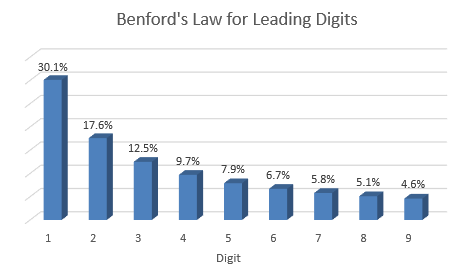
The IRS can catch fraudsters by how often their reported figures start with the number 1. Amounts, populations, lengths in nature, etc. 30% of the time begin with a 1.
by rsandio

The IRS can catch fraudsters by how often their reported figures start with the number 1. Amounts, populations, lengths in nature, etc. 30% of the time begin with a 1.
by rsandio
18 Comments
I bet LLM’s can fake figures to beat this.
This is true for any phenomena that experiences exponential growth. For a constant growth rate, 30% of the time it takes to grow by a factor of 10 is spent between a given value and its double. So, for example, if you start at $100, if it takes ~30 days to double it to $200, it would take ~70 more days to get up to $1000.
I’m too dumb to read the article, but I’m assuming fraudsters like to claim a lot of big numbers with 9’s when real figures use more 1’s?
A polling firm got busted making up numbers because of the way they were distributed

It’s called Benfords Law
Benfords law.
The IRS is in a tough spot actually. The folks in the best position to cheat are also the ones with the means to defend themselves legally from the IRS.
You want to go after Johnny Q Public with a take home salary of $68k a year for fudging the numbers of his vending machine side hustle?
Enjoy that $1988 they recoup.
People tried to use Benford’s Law as evidence that there was voter fraud in Chicago during the 2020 election. If you actually look at the data you’ll find that they’re wrong, but they tried lol.
Stand-up Maths does an excellent breakdown
https://youtu.be/etx0k1nLn78?si=d1jlpcLFHNnxhAet
Yea forensic accounting catches fraud pretty quickly
Nerds
“Claude, fudge these numbers, evading Benfords Law”
Benford’s Law
Only 3 out of 18 numbers on that chart begin with 1. I think that’s about 17%.
The IRS uses benfords law but for some reason that same law can’t be used for the 2020 election results…
I was trained by the IRS when i did VITA for other service members about 15 years ago. They literally told us that if too many entries end in a 5 or a 0, it sends up flags for manual review.
For instance, if its $95 here, $35 there, $30 here, another $20 there…too many make it look suspicious. That $35 just became $32. That $95 just became $94.
I’m not a big math guy, but I’ve heard of Benfords Law and this is how I think about why 1 would be the most popular number by far and not just an even distribution:
Let’s say we’re looking at the population of a city that is slowly growing. It has 8,000 people in it and grows by 5% each year. For the first 5 years it will be between 8,000-9,999, but then for the next 14 years it will be between 10,000-19,999.
Maybe someone has a better explanation but that’s what made sense to me.
I remember reading about this in a book about randomness and statistics. Random isnt always random.