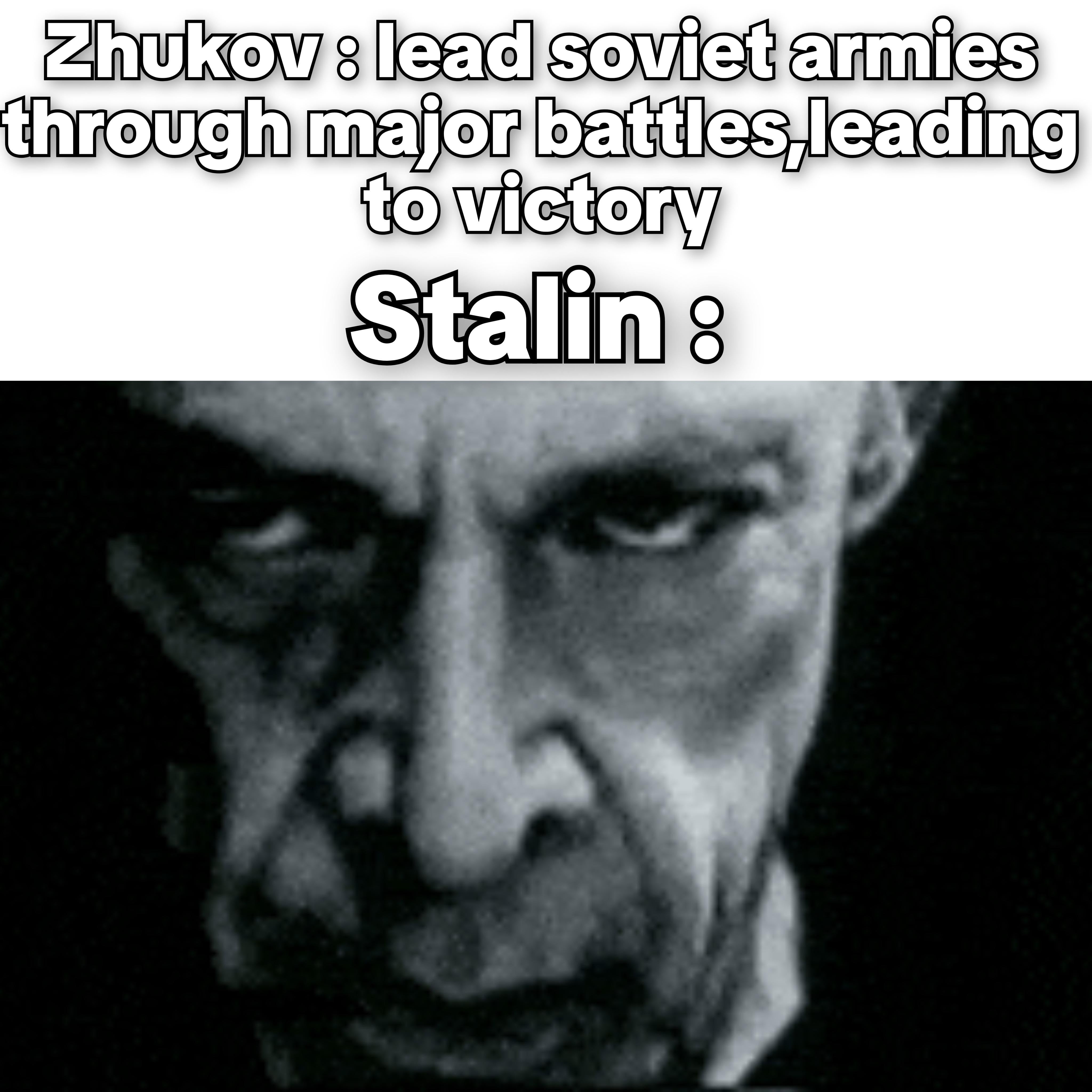
Imagine getting rid of the general who gave you victories because he’s getting famous
by Global_Sentence_4544

Imagine getting rid of the general who gave you victories because he’s getting famous
by Global_Sentence_4544
12 Comments
Following the German invasion of the Soviet Union in June 1941, Zhukov lost his post as chief of staff after disagreeing with Stalin over the defense of Kiev. Zhukov, often in collaboration with Aleksandr Vasilevsky, was subsequently involved in the Soviet actions at Leningrad, Moscow, Stalingrad, and Kursk. He held the title of deputy commander-in-chief of the armed forces from August 1942, and was promoted to Marshal of the Soviet Union in January 1943. He participated in the planning of Operation Bagration in 1944, and in 1945 commanded the 1st Belorussian Front as it led the Vistula–Oder Offensive into Germany, where he oversaw the Soviet victory at the Battle of Berlin. In recognition of Zhukov’s key role in the war, he was chosen to accept the German Instrument of Surrender and to inspect the 1945 Moscow Victory Parade. He also served as the first military governor of the Soviet occupation zone in Germany from 1945 to 1946.
After the war, Zhukov’s popularity caused Stalin to see him as a potential threat.[1] Stalin stripped him of his positions and relegated him to military commands of little strategic significance. After Stalin’s death in 1953, Zhukov supported Nikita Khrushchev’s bid for leadership, and in 1955, he was appointed Defence Minister and made a member of the Presidium. In 1957, Zhukov fell out of favour again and was forced to retire. He never returned to a top post, and died in 1974. Zhukov is remembered as one of the greatest Russian and Soviet military leaders of all time, along with Alexander Suvorov, Mikhail Barclay de Tolly, and Mikhail Kutuzov
Shoot him !
I’m just kiding.
Trosky really gave Stalin a PTSD that can be only cured by an ice pick
Interestingly, at least in my opinion, the exact traits that made Zhukov such a competent military commander also made him a poor politician who probably never would have done well post war. He was famously blunt, honest, and completely unwilling to compromise if he thought he was the only one in the room who had a good strategy. These traits would have honestly made for a poor commander in many, as it would normally mean they are too difficult to work with, but Zhukov could afford to be hard headed as he was very simply correct in his assertions so often. He butted heads with everyone in the Soviet command including Stalin, and would be kicked out of or left out of meetings at times due to his argumentative and blunt nature (which was often a terrible idea, leading to many of the worst defeats of the Soviets in WW2). If he were a less competent commander he would have been purged early on, but Stalin simply couldn’t afford to remove someone who was such an objective tactical and strategic genius. His life story and military history as the Soviet’s most competent commander should have made him an iconic Soviet hero that the entire nation revered. I mean fuck the dude practically represented the Soviet ideal as someone who worked their way up to the highest levels of command from the depths of the worst poverty imaginable. However, he was just so hard to be in a room with. It wasn’t just Stalin that hated him, most of the upper brass in the Soviet government couldn’t stand Zhukov even when he ostensibly agreed with him, but he was objectively indespensible during the war.
Welcome back late Roman emperor
The same way Aetius and Belisarius were killed by those who owed them the survival of their Empires
He didn’t have it the worst. Marshal Grigory Kulik was executed in the 50s, as were multiple generals who had comitted the crime of being captured, regardless of their service before that.
Imagine being unable to get rid of a general/admiral because they are famous.
WWII: Douglas MacArthur (also a problem in the Korean War) and Bill “Bull” Halsey. FDR was stuck with them because the political cost to remove them was too high. Caused the war to last longer and kill more American servicemen.
Given that the political power ultimately comes out of a barrel of a gun, victorious generals are very dangerous when source of political legitimacy isn’t determined by constitution or birthright.
If anything, it’s surprising that Stalin managed to wait till the war was over before eliminating Zhukov as a political threat.
I mean, with a personality cult based one party state, a popular geenral is generally by default seen as a potential political threat. A dictator moat fears their own army usually
“Thank you Commander for so thoroughly and brutally dispatching my enemies. But now I’m afraid you’ve outlived your usefulness…”
Zhukov is certainly the most famous Soviet commander, but the more I learn about him the less impressive he becomes. He was undoubtedly the person giving Stalin the best advice during Barbarossa, but he was also responsible for the 1941 mobilization plan, which, when implemented, sent thousands of unarmed Red Army soldiers to regions by then already occupied by the Germans, allowing them to be effortlessly captured. Zhukov also falsified the historical record to make it look like he came up with the battle plan for Stalingrad, Operation Uranus, rather than its actual author, Yeremenko. He also probably took higher casualties than other Red Army commanders (though there remains some historical dispute about this); now, this would be one thing if he took heavy losses while winning and was the only one who could win, but other Soviet commanders like Rokossovsky and Konev also won while taking proportionally fewer losses than Zhukov. So overall, he’s a mixed bag.