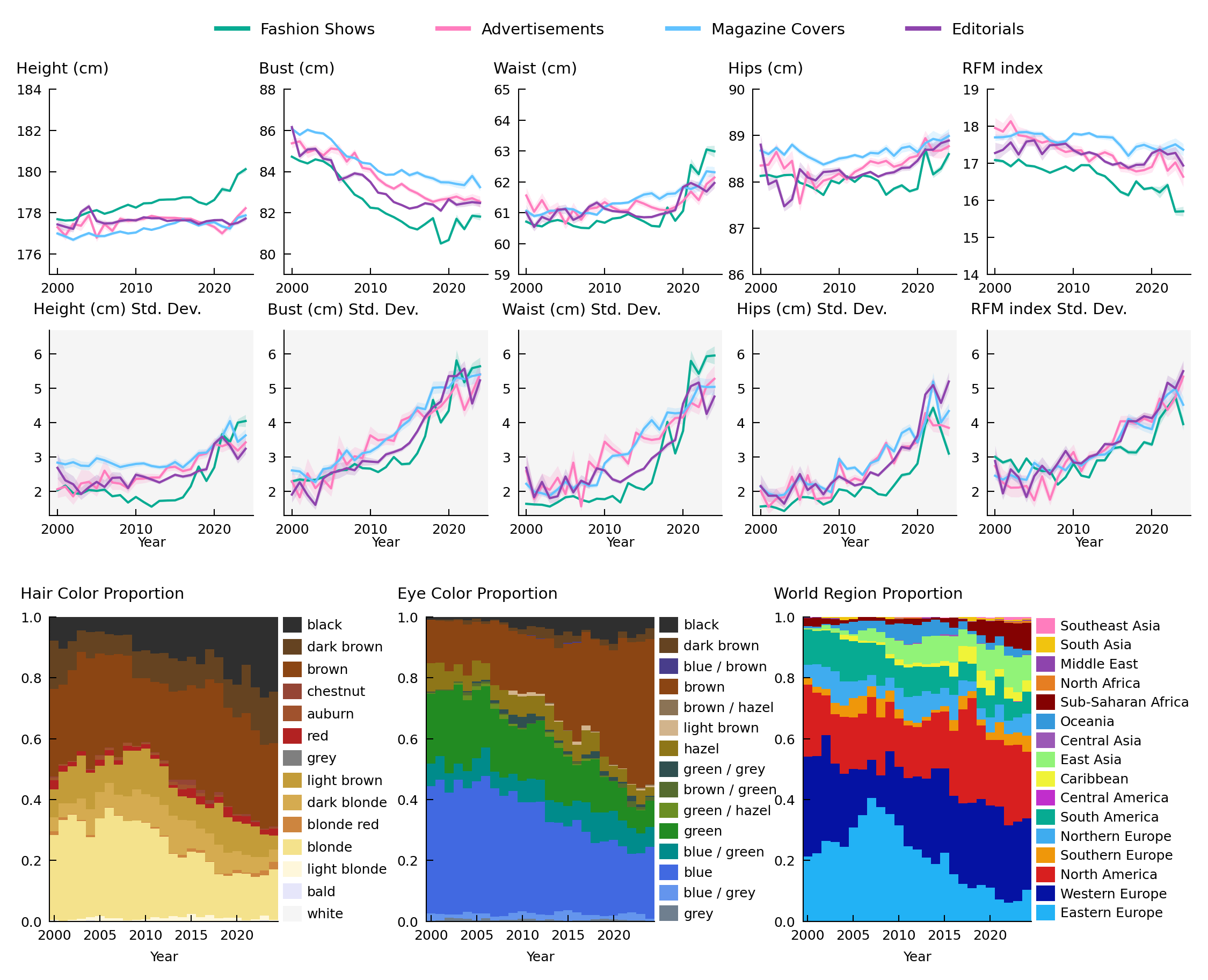
Beauty standards shape self-perception and health through social comparison and objectification, while exposure to idealized imagery exacerbates body-image concerns. Media and fashion are central arbiters of these ideals, yet long-term, quantitative, intersectional studies on how representation has changed remain scarce. We assembled a dataset of 793,199 records spanning 25 y of advertising, magazine covers, runway shows, and editorials to quantify changes in anthropometric and demographic representation. We find a paradox in the evolution of beauty ideals: While representational diversity has increased, the median model physique remains stable. This is driven by selective plus-size inclusion at the upper tail, while the typical physique continues to diverge from the US population. Intersectionally, non-White models aretimes more likely to be plus-size, suggesting that the industry consolidates multiple markers of diversity onto already underrepresented individuals rather than broadening inclusion structurally. Stratifying the industry via a data-driven prestige hierarchy, we find that thinness is overrepresented at the top tier. Finally, descriptive comparisons of two regulatory interventions suggest that numeric thresholds may be more effective than flexible guidelines at reducing underweight appearances. Our results quantify the cultural evolution in media and fashion, revealing that inclusion has increased; however, gains are uneven and intersectionally concentrated on size and ethnicity, whereas the prevailing thin ideal remains largely unchanged. [https://www.pnas.org/doi/10.1073/pnas.2602380123](https://www.pnas.org/doi/10.1073/pnas.2602380123)
lo_fi_ho on
I’m assuming this are female measurements?
Maleficent_World_159 on
love the eyes color chart!
Sea_Theory7574 on
Is op an author on the paper?
RubyRaven907 on
Stupid American here…zoomed in,saw Metric used, and bailed.

5 Comments
Beauty standards shape self-perception and health through social comparison and objectification, while exposure to idealized imagery exacerbates body-image concerns. Media and fashion are central arbiters of these ideals, yet long-term, quantitative, intersectional studies on how representation has changed remain scarce. We assembled a dataset of 793,199 records spanning 25 y of advertising, magazine covers, runway shows, and editorials to quantify changes in anthropometric and demographic representation. We find a paradox in the evolution of beauty ideals: While representational diversity has increased, the median model physique remains stable. This is driven by selective plus-size inclusion at the upper tail, while the typical physique continues to diverge from the US population. Intersectionally, non-White models aretimes more likely to be plus-size, suggesting that the industry consolidates multiple markers of diversity onto already underrepresented individuals rather than broadening inclusion structurally. Stratifying the industry via a data-driven prestige hierarchy, we find that thinness is overrepresented at the top tier. Finally, descriptive comparisons of two regulatory interventions suggest that numeric thresholds may be more effective than flexible guidelines at reducing underweight appearances. Our results quantify the cultural evolution in media and fashion, revealing that inclusion has increased; however, gains are uneven and intersectionally concentrated on size and ethnicity, whereas the prevailing thin ideal remains largely unchanged. [https://www.pnas.org/doi/10.1073/pnas.2602380123](https://www.pnas.org/doi/10.1073/pnas.2602380123)
I’m assuming this are female measurements?
love the eyes color chart!
Is op an author on the paper?
Stupid American here…zoomed in,saw Metric used, and bailed.