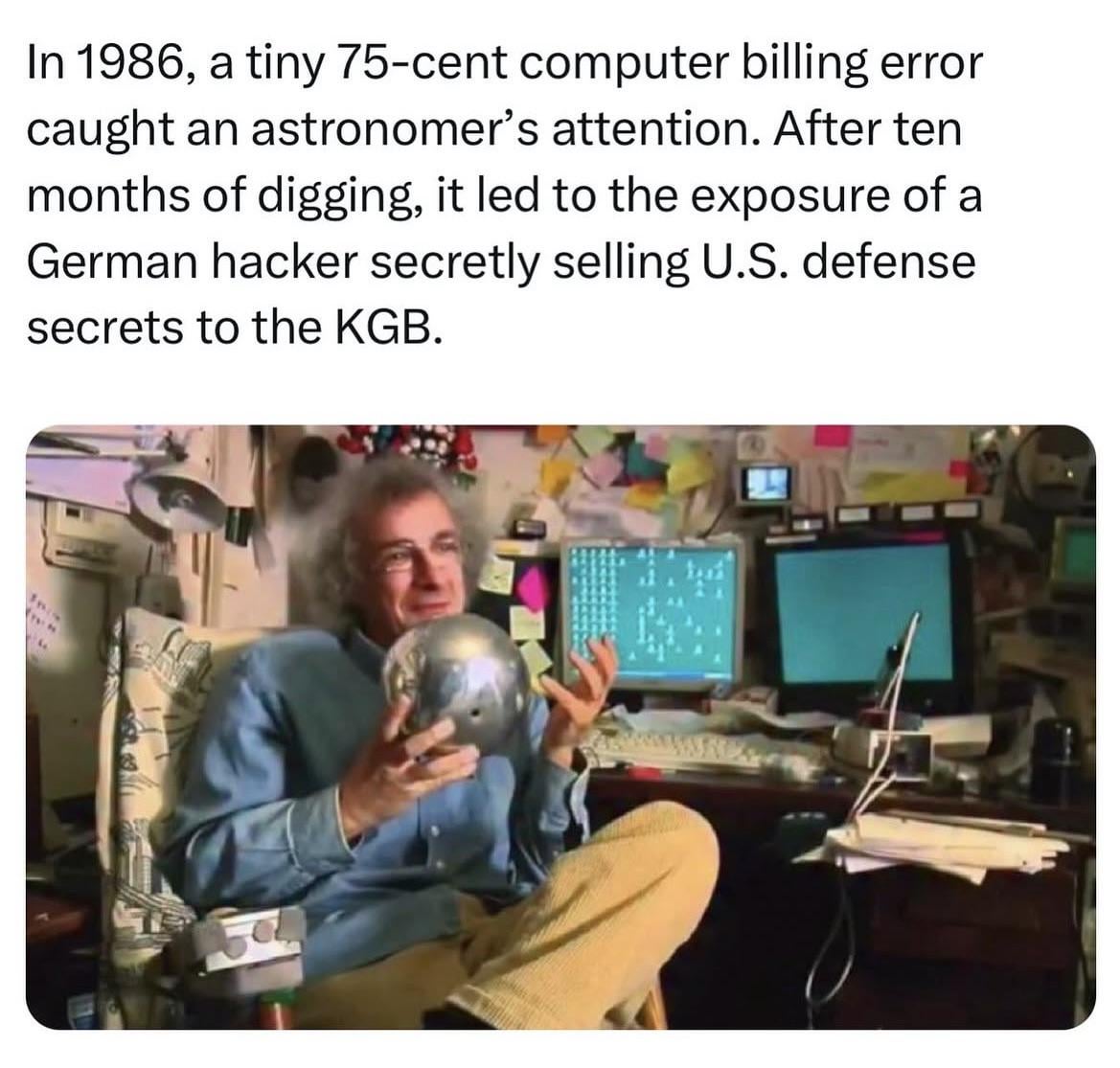
In 1986 an astronomer trying to trace a 75 cent computer time discrepancy for 10 months eventually found a German hacker selling defense secrets to the KGB
by SnackSamurai

In 1986 an astronomer trying to trace a 75 cent computer time discrepancy for 10 months eventually found a German hacker selling defense secrets to the KGB
by SnackSamurai
31 Comments
In 1986, astronomer and systems administrator Clifford Stoll noticed a 75-cent discrepancy in a computer usage bill while working at Lawrence Berkeley Laboratory, a mistake small enough that most people would have ignored it. Instead, Stoll spent months tracing the anomaly through system logs and network activity, eventually realizing that an unauthorized user was accessing U.S. military and research computers through the lab’s network.
The investigation uncovered a West German hacking ring led by Markus Hess, who was selling stolen U.S. defense and research information to the Soviet KGB during the Cold War. Working with the FBI, CIA, and West German authorities, Stoll helped track the intrusions in real time, leading to arrests and prosecutions overseas. The case became one of the earliest documented examples of international cyber-espionage and was later chronicled in Stoll’s 1989 book The Cuckoo’s Egg, now considered a foundational text in cybersecurity history.
If it wasn’t for that meddling astronomer, I’d have SOLD ALL THE SECRETS!
The title of this post is giving my head errors.
Autism for the win baby!
His book on this “The cuckoos egg”, is an awesome read. Highly recommended!
watch it here: [https://www.youtube.com/watch?v=PGv5BqNL164](https://www.youtube.com/watch?v=PGv5BqNL164)
75 cent time discrepancy, wat
There is fun documentary about it on youtube called “The KGB the computer and me”
Year’s back I read the Cuckoo’s Egg by Stoll. Fascinating stuff. He raced around his Berkeley facility on a Friday night stealing/borrowing every printer he could find and splitting the incoming signal between the terminals it was meant to go to and the printer.
This way, no matter what the hacker did to “look over his shoulder” with system commands, there was no way the hacker could detect that his output was being sent to a printer.
Stoll then rigged it so if a printer went off over the weekend, it would trigger his pager.
Then back late late Sunday night to put everybody’s printers back as if they hadn’t been touched.
I can’t remember how many weekends he did that, but eventually the pager went off and raced into the facility to see what the hacker was up to.
Oh! AND, it’s coming back to me now, the hacker grabbed the program used to encrypt passwords. And he gragged the encrypted password file. ( don’t forget, this was all new back then ). Weeks later the hacker was back and he had everybody’s passwords. What the hell??? Stoll was baffled. Then he figured it out. He calculated with a modern home computer it would take a few weeks to encode every word in a dictionary. And then the hacker could compare an encrypted entry from the password file with his encrypted dictionary, find a match and he had the password!
ok sure, we laugh and say “yaya, dictionary hack, we all know about that”. But, back then? Nobody had heard of any of that stuff…. Stoll had to figure it out on his own.
Oh!!! And then.. then he had to get somebody’s attention. Who??? FBI? They weren’t interested. CIA? Maybe. I think he eventually got the US Secret Service’s attention? ( or maybe it was CIA ). But it took a lotta hand-waving before they paid him any attention!
The funniest thing about this is that of all science disciplines, astronomy cares the least about tiny numbers. Astronomical distances, fluxes, etc, are so big that in general getting things within an order of magnitude is good enough.
https://preview.redd.it/24c1u510gy2h1.jpeg?width=510&format=pjpg&auto=webp&s=b1e96153b3a4b202905234b820a7c17ab88ee53a
75 cents in 1986 could’ve bought you a house in the suburbs, thats why they cared enough to look into it
Awww. Hello autism.
Didn’t he turn into the guy with all the Klein bottles stored under his house? That was a pretty viral thing, um, fifteen years ago or so
Great book.
The book is fantastic:
https://www.goodreads.com/en/book/show/18154.The_Cuckoo_s_Egg
What a fascinating read that book was! A coworker at my very first software development job out of college loaned me the book and said to me “this is going to be right up your alley” and boy was he right. I remember staying up late reading chapter after chapter. Thanks Pete and rest in peace !
I highly recommend this book to anyone who is interested who is interested in technology!
This sounds like it would make for an interesting movie.
There’s a German movie about the life of the hacker called 23 https://en.wikipedia.org/wiki/23_(film)
It’s semi-historical and a great view into a young man at the start of the internet ago falling down the rabbit hole of conspiracy theories and getting involved with the KGB.
It covers topics like drug abuse, the early hacker scene in Germany and the unique environment that was West-Berlin during the time of the cold war.
Check it out if you find it somewhere, very fascinating movie.
edit: fixed the link
I remember seeing this on PBS. It may have been an episode of NOVA.
FWIW, in college I was given a ‘budget’ for using VMS/VAX system.
Clifford Stoll now sells 4 dimensional klein bottles stored under his house.
Hagbard, Urmel, pengo and dob were the guys behind the so called KGB Hack. Karl Koch (Hagbard) was found burnt to death in the woods of northern Germany on June the 1st 1989. The authorities called it suicide but there were rumors he was murdered by the KGB or the Stasi.
There is a movie based on the events: https://www.imdb.com/title/tt0126765/?ref_=ext_shr 23 – Nichts ist so wie es scheint
Fun fact: Cliff’s other big claim to fame is writing a nationally syndicated article in 1995 about how the Internet is just a flash in the pan and nobody will be using the web anymore by the early 2000s.
*The Cuckoo’s Egg* is a fantastic book, especially if you’ve got any memories of the USENET/BBS days.
He’s a Reddit user, too. https://www.reddit.com/user/CliffStoll
When I met Clifford in the early 90’s he reminded me a lot of Doc Brown from Back to the Future – a complete mad genius with zero filter. Brilliant man, I thought his book Silicon Snake Oil was pretty spot-on as well.
Funny, a friend was just telling me about Cuckoo’s Nest.
It’s a great book read too, insights into the early wonderful days of the internet and hardware.
Is that the klein bottle dude or am I just twisted?
Isn’t this the same guy who is making and selling “zero” volume glass sculptures out of his house?
Well back in that era 75 cents was equal to forty million dollars now.
Parents and bosses: don’t be so OCD, get done with that assignment and move on!
Cliff Stoll is a top tier human.