
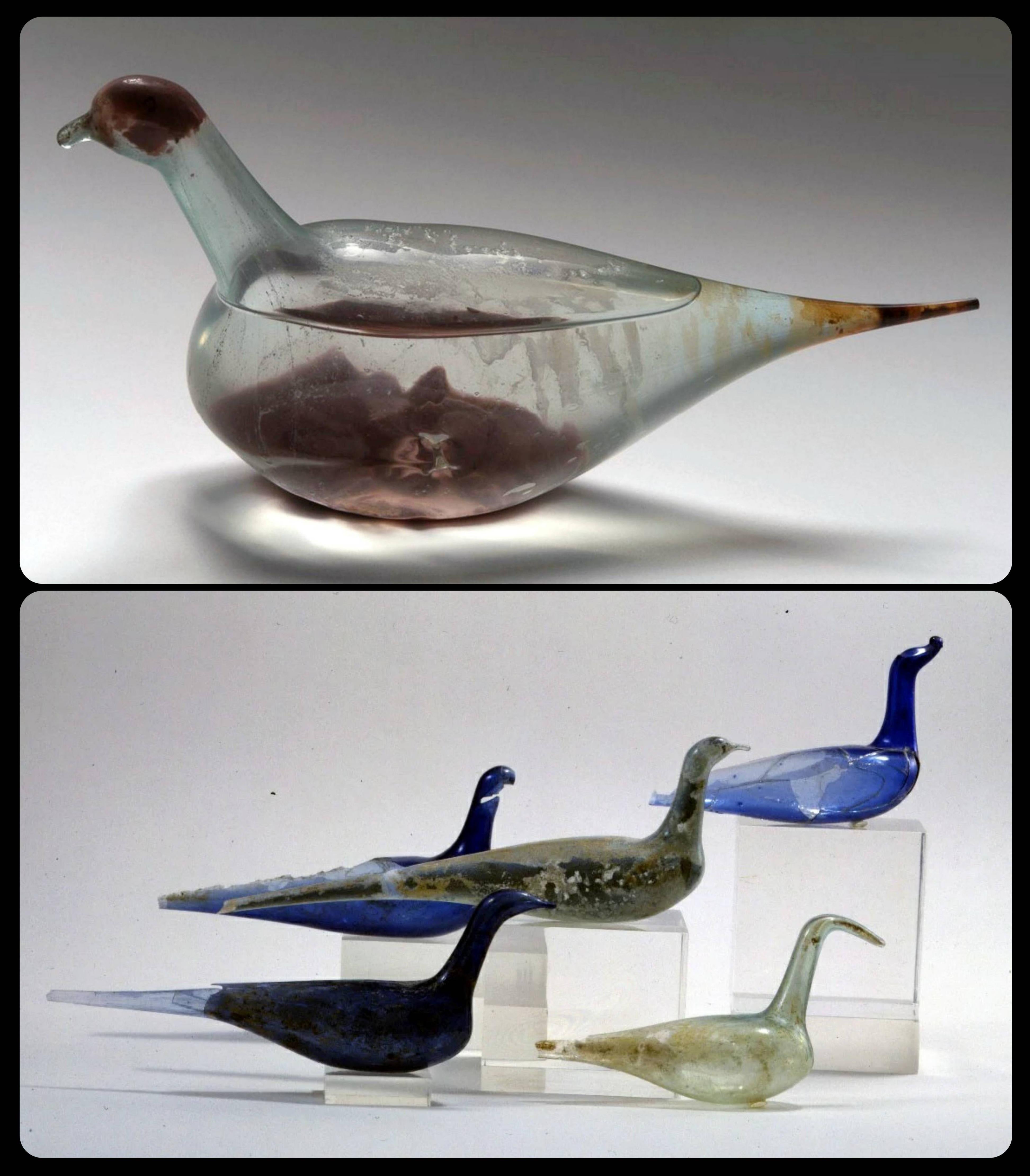
Dove-Shaped Perfume Bottles from the Roman Empire, c.50-100 CE: these glass vessels were filled with scented oils or cosmetic powder and then sealed, meaning that their contents could only be accessed by breaking the dove’s neck or tail [3889×4441]
by SixteenSeveredHands
3 Comments
These bottles were created and used as *unguentaria* (otherwise known as *balsamaria*) which are ancient vessels that were typically filled with scented oils, cosmetic powders, balms, or ointments. *Unguentaria* could be crafted from ceramic, glass, or stone, and they came in various shapes and sizes, but dove-shaped vessels made of glass were especially popular during the second half of the 1st century CE, when they were produced and distributed throughout the Roman Empire.
Each bottle was crafted from blown-glass that was carefully modeled into the shape of a bird; the inner cavity was then filled with perfume or cosmetic powder, and the tip of the tail was reheated and compressed, effectively sealing the vessel.
As [this article](https://www.academia.edu/126085188/New_Finds_of_Bird_Shaped_Glass_Vessels_with_Residues_of_their_Former_Content_Exceptional_Grave_Goods_from_the_Southwest) explains:
> The vessels were produced with glass blowing pipes by so-called free blowing, and are for this reason extremely thin-walled, with body thicknesses significantly below 0.1 cm.
> After the containers had been filled, the tail feathers were sealed airtight by reheating to protect the contents from moisture. Parts of the containers, such as the head or tail feathers, had to be broken off in order to access the contents of the vessels, which means that they were disposable packaging.
Once the vessel was opened, the contents were removed/used and then the bottle was discarded. Some sources even describe this as the earliest surviving example of a mass-produced, single-use bottle.
Most of these vessels were made from clear or pale blue Roman glass, but some were crafted with a dark blue, green, purple, or yellow appearance instead:
> As cheap, mass-produced goods, the packaging consisted mainly of the conventional thin-walled and transparent Roman glass with an unintentional light blue colouring. Specimens made of intentionally coloured transparent glass (e.g. dark blue, dark green, violet or yellow) are less common. This may also have to do with the fact that the pink or white contents could be visually better distinguished and marketed if the vessels were made of the conventional Roman glass, which offered more transparency to the beholder than the intentionally coloured glass.
Research suggests that many of these vessels were filled with powder, including pink substances that have been described as “blush” or “rouge,” while others were filled with liquid.
Vessels with this design (which is also known as Isings form 11) have been unearthed at Roman-era sites located throughout Europe:
> Evidence shows that these glass containers were widely marketed in the Roman Empire. The main areas of distribution are the central and northern Italian regions of Campania et Latium, Venetia et Histria, and Transpadana, along with the northwestern provinces of Gallia Belgica, Gallia Lugdunensis, Germania inferior and Germania superior [in what is now Italy, France, Belgium, Luxembourg, Germany, Austria, Switzerland and the Netherlands].
> There is also evidence from the Balkan and Danube region in the provinces of Dalmatia and Pannonia, and also from the eastern Mediterranean in the provinces of Achaea, Creta et Cyrenae and Macedonia. The distribution in the western Mediterranean seems to be limited to Hispania Tarraconensis.
#Sources & More Info:
– The Austrian Archaeological Institute: [New Finds of Bird-Shaped Glass Vessels with Residues of their Former Content](https://www.academia.edu/126085188/New_Finds_of_Bird_Shaped_Glass_Vessels_with_Residues_of_their_Former_Content_Exceptional_Grave_Goods_from_the_Southwestern_Necropolis_of_Virunum_Zollfeld_Austria_)
– Glassware and Glassworking in Thessaloniki: 1st Century BC-6th Century AD: [Bird-Shaped *Unguentaria*](https://books.google.com/books?id=WExmEAAAQBAJ&lpg=PP1&ots=pYchYu-hvg&dq=info%3AwofB7cf0xU8J%3Ascholar.google.com%2F&lr&pg=PA144#v=onepage&q&f=false)
– The British Museum: [Roman Perfume Bottle in the Shape of a Bird](https://www.britishmuseum.org/collection/object/G_1878-1230-97)
– Società Friulana di Archeologia: [Glass Doves and Globes from Thessaloniki: North Italian Imports or Local Products?](https://www.academia.edu/127018695/Glass_Doves_and_Globes_from_Thessaloniki_North_Italian_Imports_or_Local_Products)
– Analytical Chemistry for Archaeology and Cultural Heritage: [Compositional Analysis of Greco-Roman *Unguentaria* Residues](https://www.mdpi.com/2571-9408/8/5/170)
So cool!
Basically Roman ampoules!