This would be better without the stupid fucking narration.
Catarga on
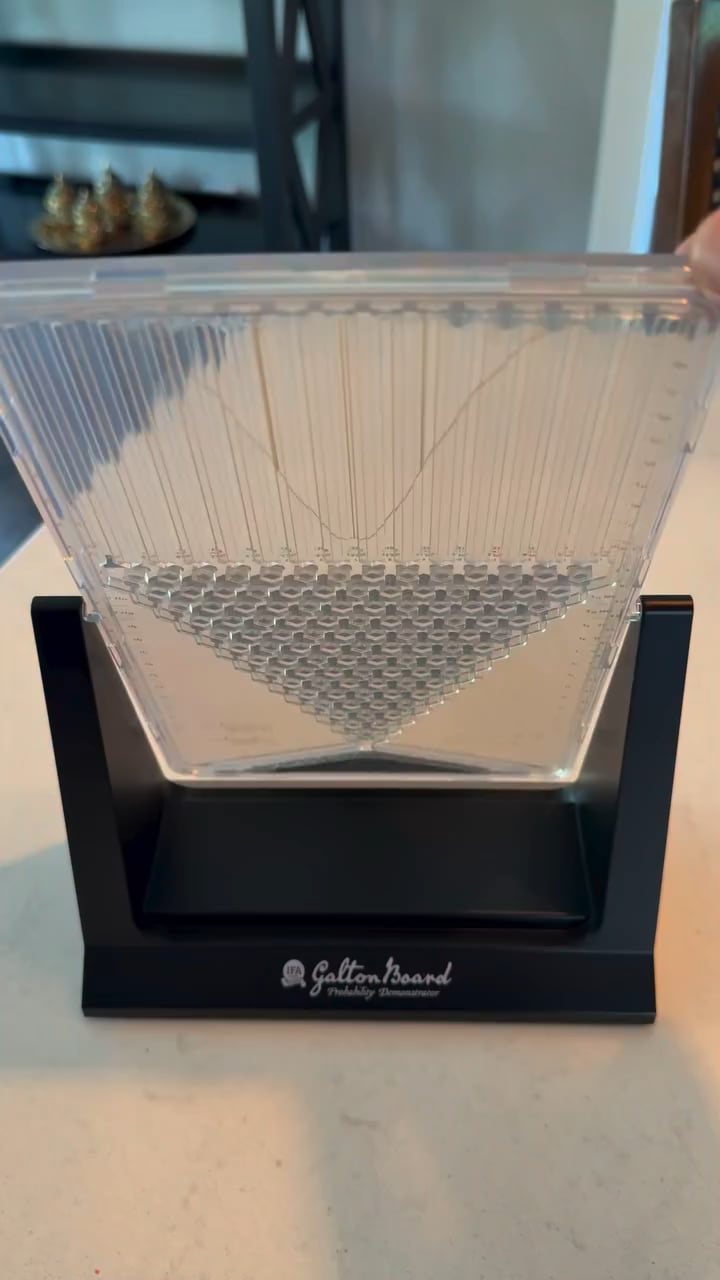
So this is basically a Gaussian distribution, right?
ShadowScythe93 on
I don’t know anything about this, but wouldn’t the beads bumping into each other influence where it goes? Compared to dropping 1,000 or whatever 1 at a time?
flergnergern on
Well if they’re all dropped in the center it’s kind of obvious they would be concentrated in the center
guitarpic69 on
Wait so is this how it works or I’m confused
proxyproxyomega on
yeah but what about evenly distributed pegs and balls, it would fall as even pattern on average
redditknees on
Omg i need this. I’m an epidemiologist…
BennyVibez on
Randomness is just a lack of understanding.
SlashMatrix on
It does not bounce “randomly”, it has very tight constraints as one can see in the video.
an_older_meme on
This would get boring in about two minutes
DevillesAbogado on
I wonder if they would just one BB at a time, would all of them still end up with that distribution?
Trojanheadcoach on
Okay but this isn’t even random. You’re dropping stuff down on one skinny avenue and then sorting it through a pyramid shape. Nothing about this is random. Of course this makes the bell curve because it was designed to do that
goztepe2002 on
Its not random, its arranged in a triangle pattern.
eshian on
How fucked are we the day it inverts the bell curve?
sandstone-oli on
i mean there’s a higher concentration dropping from the center and landing in the center below
Golden-Grams on
It’s not random, if the input point stays the same. In this video, he even says that the reason the distribution happens on the board, is due to more pegs being in the center.
>Most of the balls end up in the middle because there are more ways to get there.
Move the input on either side of the middle, and see the distribution then. If the input changes, so will the distribution.
It’s also not random in direction. Each time the ball “has a choice”, it is either left or right, as a pathway. That’s not random, either.
karma_the_sequel on
The *mathematics* of probability.
unsightly_buildup on
Absolutely not chaos.
Ok-Yak549 on
how would just one flat spot p/ball change things?
PercentageOk6120 on
This is more physics than demonstrating probability. It’s really dumb to conflate the two in terms of learning
br0b1wan on
I just finished “The Black Swan” by Nassim Nicholas Taleb. This is mentioned very briefly in the book. Taleb is quite disdainful of Gaussian bell curves, however
jonnysteezz on
I want one
Loring on
Predictable…
nyybmw122 on
What if there is no gravity? What if you were to do this out in the middle of space?
So does this principle really show up EVERYWHERE?
Impossible_Craft_108 on
Does the result be same if we release beads at once horizontally rather than via a cone conduit. Just wondering
Magic_Zach on
“Theres more ways to get there” is a pretty good way to shorthand explain this.
Another visual example. Take a coin and flip it 10 times. Each coin toss is random, and you are more likely to evenly get both heads and tails. In other words, you’re more likely to flip 5 heads and 5 tails, than 0 heads snd 10 tails, or 10 heads and 0 tails. The likelihood tapers off at the extreme ends of random chance. You are much more likely to get a 5/5 on this coin flip, or a 4/6. Now make it 20 times for s “cycle”. Now your “resolution” into the likelihood is better and you can see the pattern forming.

29 Comments
[source](https://www.instagram.com/reel/DYmmZYggU2-/)
Stock Market Returns, Casino odds, test scores,…
Plinko
“Human genetics”?
This would be better without the stupid fucking narration.
So this is basically a Gaussian distribution, right?
I don’t know anything about this, but wouldn’t the beads bumping into each other influence where it goes? Compared to dropping 1,000 or whatever 1 at a time?
Well if they’re all dropped in the center it’s kind of obvious they would be concentrated in the center
Wait so is this how it works or I’m confused
yeah but what about evenly distributed pegs and balls, it would fall as even pattern on average
Omg i need this. I’m an epidemiologist…
Randomness is just a lack of understanding.
It does not bounce “randomly”, it has very tight constraints as one can see in the video.
This would get boring in about two minutes
I wonder if they would just one BB at a time, would all of them still end up with that distribution?
Okay but this isn’t even random. You’re dropping stuff down on one skinny avenue and then sorting it through a pyramid shape. Nothing about this is random. Of course this makes the bell curve because it was designed to do that
Its not random, its arranged in a triangle pattern.
How fucked are we the day it inverts the bell curve?
i mean there’s a higher concentration dropping from the center and landing in the center below
It’s not random, if the input point stays the same. In this video, he even says that the reason the distribution happens on the board, is due to more pegs being in the center.
>Most of the balls end up in the middle because there are more ways to get there.
Move the input on either side of the middle, and see the distribution then. If the input changes, so will the distribution.
It’s also not random in direction. Each time the ball “has a choice”, it is either left or right, as a pathway. That’s not random, either.
The *mathematics* of probability.
Absolutely not chaos.
how would just one flat spot p/ball change things?
This is more physics than demonstrating probability. It’s really dumb to conflate the two in terms of learning
I just finished “The Black Swan” by Nassim Nicholas Taleb. This is mentioned very briefly in the book. Taleb is quite disdainful of Gaussian bell curves, however
I want one
Predictable…
What if there is no gravity? What if you were to do this out in the middle of space?
So does this principle really show up EVERYWHERE?
Does the result be same if we release beads at once horizontally rather than via a cone conduit. Just wondering
“Theres more ways to get there” is a pretty good way to shorthand explain this.
Another visual example. Take a coin and flip it 10 times. Each coin toss is random, and you are more likely to evenly get both heads and tails. In other words, you’re more likely to flip 5 heads and 5 tails, than 0 heads snd 10 tails, or 10 heads and 0 tails. The likelihood tapers off at the extreme ends of random chance. You are much more likely to get a 5/5 on this coin flip, or a 4/6. Now make it 20 times for s “cycle”. Now your “resolution” into the likelihood is better and you can see the pattern forming.