
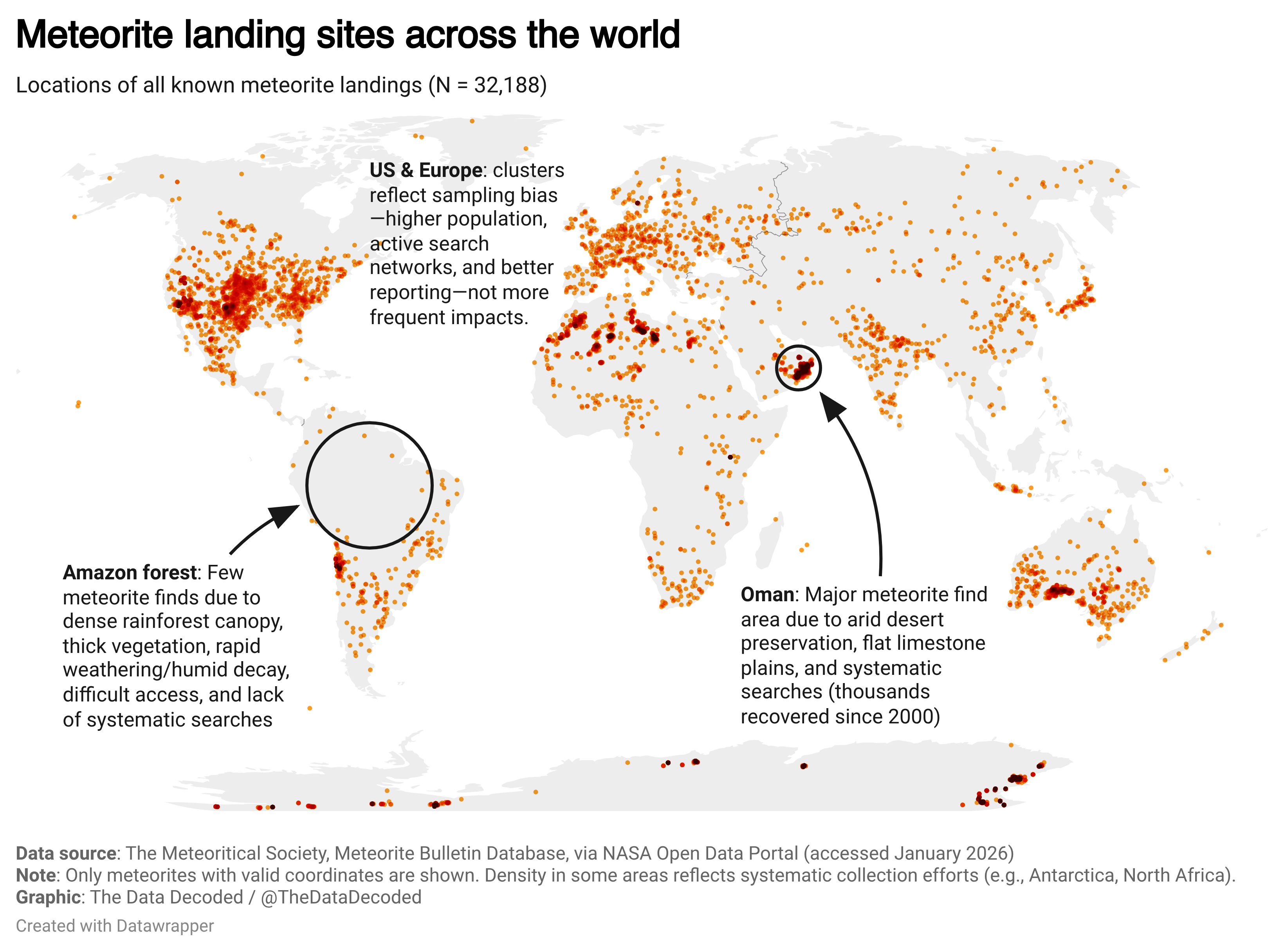
Meteorites fall roughly uniformly across Earth’s surface, but landing sites are not evenly distributed.
Dense clusters form in areas with:
– Arid deserts: e.g. Sahara and Arabian deserts
– Polar ice sheets: e.g. Antarctica
– High population density: e.g. U.S., Europe, Japan
Areas with few findings include:
– Dense tropical rainforests: e.g. Amazon basin, Congo basin, Southeast Asian jungles
– High mountains & remote rugged terrain: Himalayas, Andes, Tibetan Plateau, central African highlands
Bottom line: What we see on the map is mostly a story of accessibility + preservation conditions + search effort, not where meteorites actually hit more often.
[Note: some coordinate errors have been corrected. There are likely some I have missed]
by Low-Car6464
8 Comments
**Data source**: The Meteoritical Society, Meteorite Bulletin Database, via NASA Open Data Portal (accessed January 2026)
**Tools used**: Datawrapper, Google sheets
@ TheDataDecoded on X (Twitter)
Should be “discovery” not “landing”.
Meteorites probably impact everywhere on earth in a more-or-less even distribution, it’s just that we don’t find them if they land somewhere we aren’t searching for them or where they disappear too quickly (eg the ocean).
Antarctica is interesting but doesn’t have an arrow. It’s much smaller than shown in this projection but has lots of finds?
Is the map or the data wrong because I don’t see a dot at Lappajärvi, FInland for example.
I’m curious about the Nullarbor.
What explains the north african cluster? They don’t enjoy the US/EU socio-structural conditions or the gulf’s geological properties.
It’s crazy how all meteorite impacts are on land and they all managed to avoid the oceans
I envy the people who went and found this. They probably received a few heavy cavalry units back home.