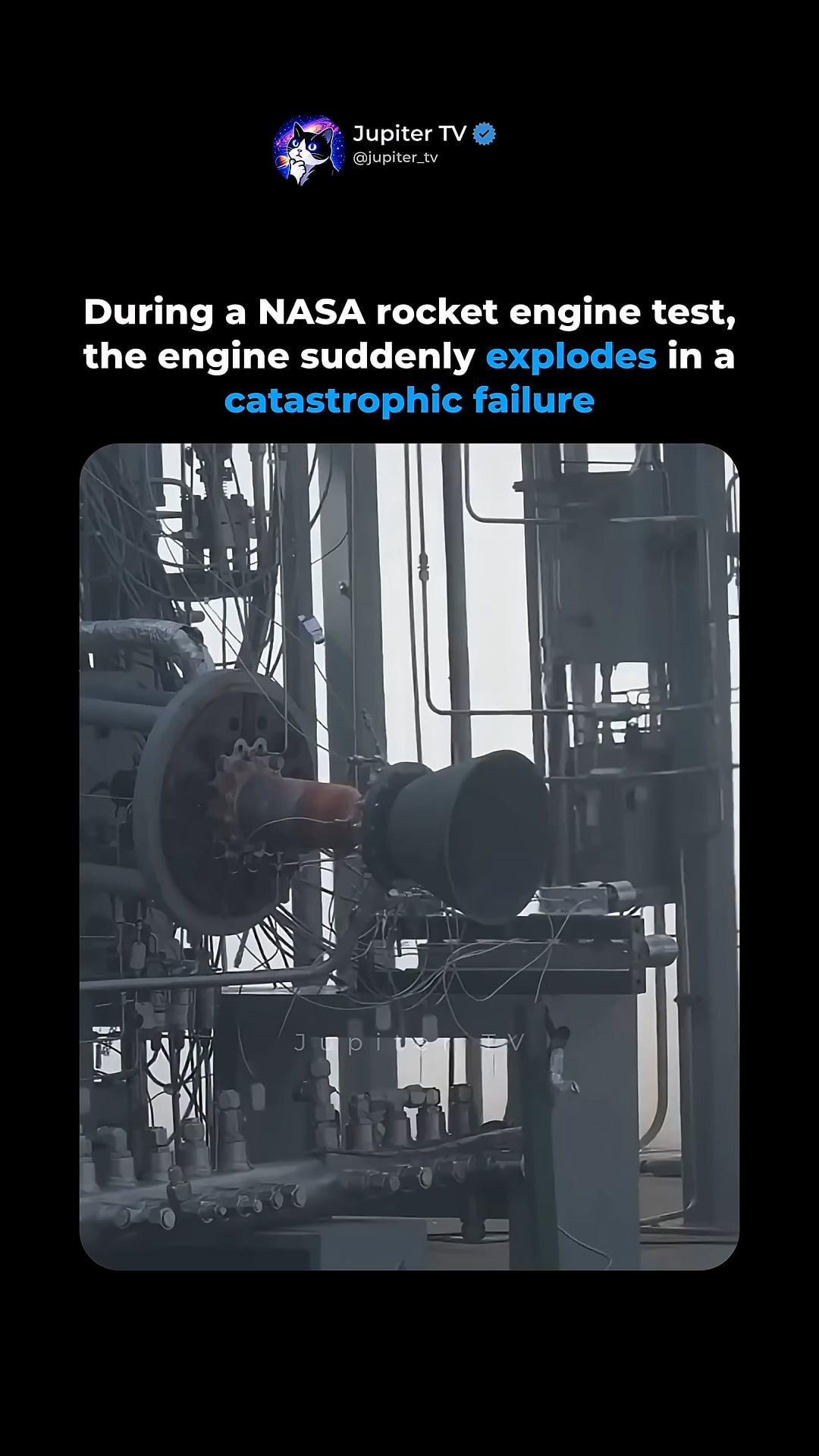
After the back cup (I know nothing about rockets…) explodes, the blue circle effect remains and it looks so surreal being in balance so far away from the engine.
Uddiya on

Talusthebroke on
And that’s why we test things! We want it to go boom when lives aren’t at stake, not when they are
KHWD_av8r on
As I recall, this experimental engine had been 3D printed, and the burnthrough was caused by a void in one of the layers.
Infinite_Big_7004 on
Dang, Still had the price tags on it
LittleMissAhrens on
“There are a thousand lessons to be learned from failure, but seldom few from success.”
A failure like this is a great teacher, and is better that it happened in a controlled testing environment, than on a launch! Congrats to the engineers who now know how not to do it, and will build a better engine next time!
iovnow on
I live in a city where these engines are commonly tested. I think Blue Origin does most of the testing around here now. They are pretty loud. Usually its just a low rumble, sometimes it’s a series of booms that rattle windows.
NASA has been known to purposely stress test to failure. These stress tests can result in some very loud booms. I remember one instance; the furthest call we got that I heard about was from a city ~60 miles away. The bigger booms will break windows of nearby houses and business. Living here since 1992, I generally don’t even notice the normal engine tests.

31 Comments
Neat
Looks like it melted.
Does the fuel get fed into the cone?
Just needs a lil duct tape. 🤔
Why we test things
They didn’t double tap it and say “This ain’t going anywhere”!
Rooky mistake!
Great now I’m thinking about that day our teacher was excited to let us watch a shuttle take off
Rapid unscheduled disassembly. At least no severe explosion failure.
Why did it look like a bunch of vapor was shoowing the opposite way after it came apart?
Wouldn’t it just stop working?
What are tall the dangling things?
Back fell off.
Flex Tape
Stay behind the red line!
The really interesting part to me is the cone flies off and doesn’t make/change the sound.
Aftermath of tacobell.
Funny how nozzle just poofs out of existence
The front fell off
How many horsepower is that?
Cone? What cone?
Scott Manley did a great in depth [video](https://youtu.be/S5TdVYSgqr4) on this event. Testing of additively manufactured rocket nozzles.
“Rapid unscheduled disassembly”
Here’s the NASA technical report of the failure its an enjoyable read:
https://ntrs.nasa.gov/citations/20170008950
https://ntrs.nasa.gov/api/citations/20170008950/downloads/20170008950.pdf
After the back cup (I know nothing about rockets…) explodes, the blue circle effect remains and it looks so surreal being in balance so far away from the engine.

And that’s why we test things! We want it to go boom when lives aren’t at stake, not when they are
As I recall, this experimental engine had been 3D printed, and the burnthrough was caused by a void in one of the layers.
Dang, Still had the price tags on it
“There are a thousand lessons to be learned from failure, but seldom few from success.”
A failure like this is a great teacher, and is better that it happened in a controlled testing environment, than on a launch! Congrats to the engineers who now know how not to do it, and will build a better engine next time!
I live in a city where these engines are commonly tested. I think Blue Origin does most of the testing around here now. They are pretty loud. Usually its just a low rumble, sometimes it’s a series of booms that rattle windows.
NASA has been known to purposely stress test to failure. These stress tests can result in some very loud booms. I remember one instance; the furthest call we got that I heard about was from a city ~60 miles away. The bigger booms will break windows of nearby houses and business. Living here since 1992, I generally don’t even notice the normal engine tests.
Better there than on the way up.
Me after one trip to Taco Bell.