
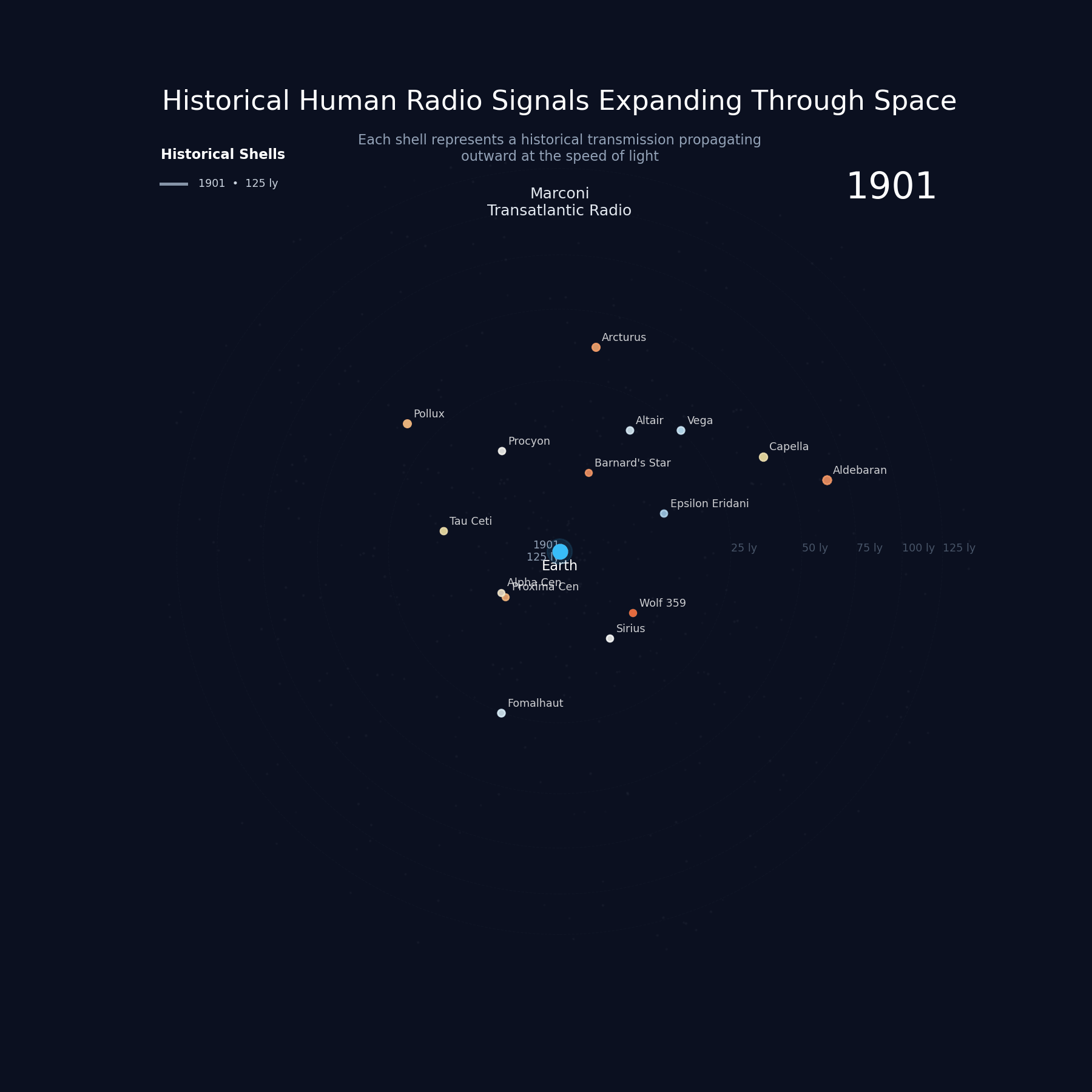
Right now a sphere of electromagnetic radiation is expanding from Earth at the speed of light.
It has been growing since the 1930s when our signals first became powerful enough to escape the ionosphere.
I plotted it using real stellar positions from the HIPPARCOS catalogue nearby stars at their
actual distances, with concentric rings marking key broadcast milestones.
Key numbers:
→ Bubble diameter: ~240 light-years
→ Proxima Centauri: It received our first signals around 1904
→ Vega (25 LY): the star from Contact has been receiving us since 1925
→ Pleiades (440 LY) won't know we exist for another 314 years
→ Voyager 1 at 170 AU is still inside the innermost shell
The sobering part: by the time a 1980s TV broadcast reaches a star 50 light-years away,
it's indistinguishable from background cosmic noise. A receiver roughly 900km in diameter
would be needed to detect Earth's leakage from just 1 light-year away.
We're not broadcasting. We're whispering.
Full post with methodology, stellar data, and the Arecibo Message breakdown:
https://www.thescientificdrop.com/2026/05/earths-radio-bubble-every-signal-weve.html
Tool: Python (matplotlib, numpy)
Data: HIPPARCOS Star Catalogue, NASA
by Budget-Ferret2662
8 Comments
Tool: Python
Libraries: matplotlib, numpy
Data source: ESA HIPPARCOS Star Catalogue
[https://www.cosmos.esa.int/web/hipparcos](https://www.cosmos.esa.int/web/hipparcos)
Stellar positions plotted at real distances from Earth. Concentric rings represent the
expanding shells of each major broadcast milestone since 1901, calculated as:
ring radius (LY) = 2026 – broadcast year
Key milestones shown:
– Marconi transatlantic signal: 1901 (~125 LY)
– First ionosphere-escaping signals: 1933 (~93 LY)
– Berlin Olympics TV broadcast: 1936 (~90 LY)
– Moon landing broadcast: 1969 (~57 LY)
– Arecibo Message: 1974 (~52 LY)
– Voyager launch: 1977 (~49 LY)
Nearby stars plotted at real HIPPARCOS distances.
Voyager 1 annotated at 170 AU still inside
the innermost shell at this scale.
Full methodology and post:
[https://www.thescientificdrop.com/2026/05/earths-radio-bubble-every-signal-weve.html](https://www.thescientificdrop.com/2026/05/earths-radio-bubble-every-signal-weve.html)
Why do the gap between the rings get smaller together as they expand?
You should add how mich the signal weakens over the distance
I think you meant invisible to anyone *outside* it?
>>→ Vega (25 LY): the star from Contact has been receiving us since 1925
[https://www.youtube.com/watch?v=DRD-tO7jV9U](https://www.youtube.com/watch?v=DRD-tO7jV9U)
[https://www.youtube.com/watch?v=-_vPP64JCC0](https://www.youtube.com/watch?v=-_vPP64JCC0)
>The sobering part: by the time a 1980s TV broadcast reaches a star 50 light-years away, z
it’s indistinguishable from background cosmic noise. A receiver roughly 900km in diameter
So you’re telling me extraterrestrials never received Hitler’s broadcast?
You definitely did not visualize every human radio signal ever sent
[lightyear.fm](http://lightyear.fm) ~~was~~ is a great website (its’ back) that was inspired by the opening from the film, contact. A visual of space as you receded away from earth and the sound track went back in time.
really cool! maybe a white background would have been better? and you can use more colors for improved visibility?