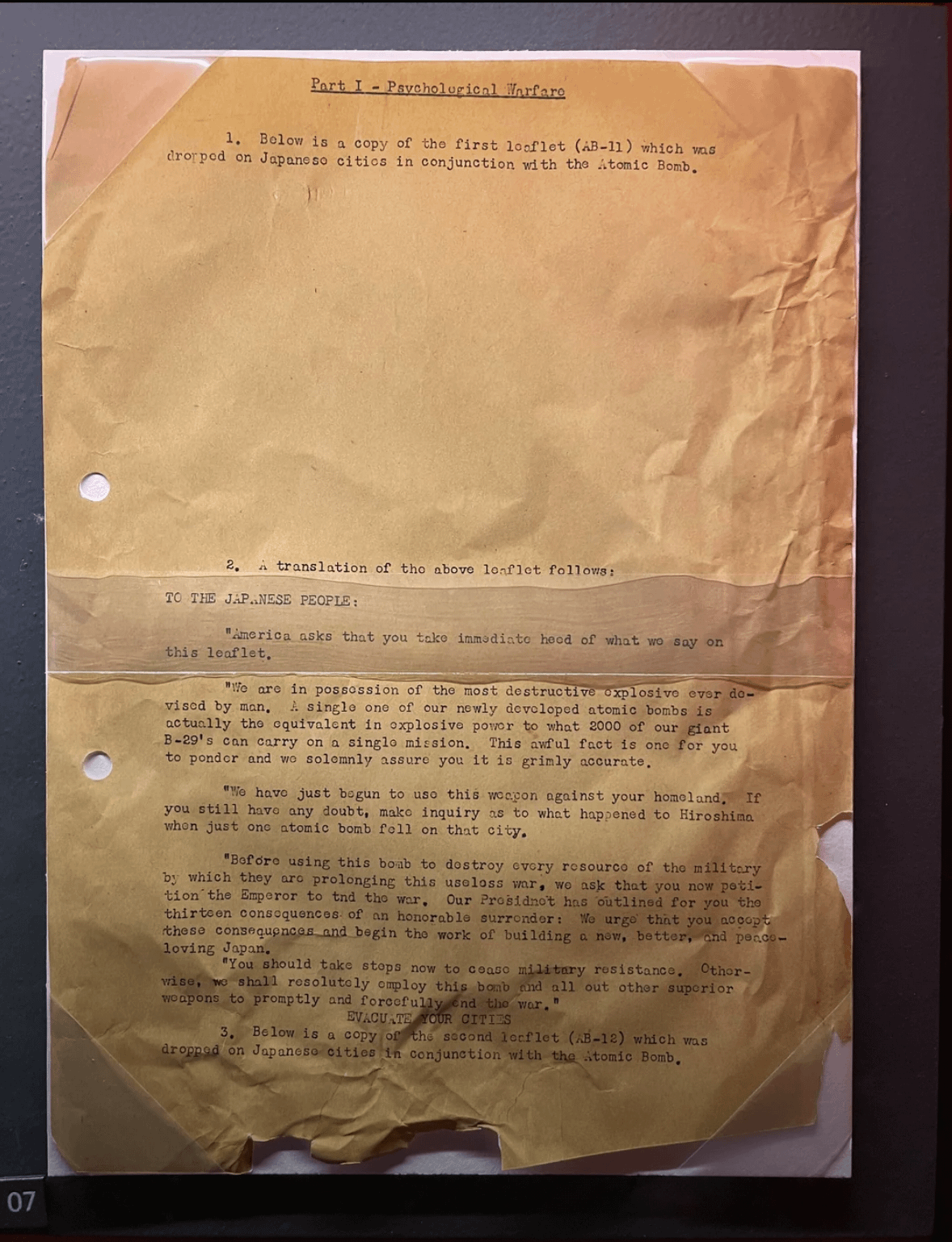
“America asks that you take immediate heed of what we say on this leaflet.”We are in possession of the most destructive explosive ever devised by man. A single one of our newly developed atomic bombs is actually the equivalent in explosive power to what 2000 of our giant B-29’s can carry on a single mission. This awful fact is one for you to ponder and we solemnly assure you it is grimly accurate.”We have just begun to use this weapon against your homeland. If you still have any doubt, make inquiry as to what happened to Hiroshima when just one atomic bomb fell on that city.”Before using this bomb to destroy every resource of the military by which they are prolonging this useless war, we ask that you now petition the Emperor to end the war. Our President has outlined for you the thirteen consequences of an honorable surrender. We urge that you accept these consequences and begin the work of building a new, better, and peace-loving Japan.”You should take steps now to cease military resistance. Otherwise, we shall resolutely employ this bomb and all out other superior weapons to promptly and forcefully end the war.”
Fanatical_Destructor on
So it goes
Juneauite on
They left typos in there so Japanese folks would know it’s not AI slop.
volgendeweek on
There seems to be typos. Are these all written by typewriter and not pressed for mass production?
braunyakka on
Probably should have written it in Japanese 🤷♂️
PDXGuy33333 on
Historian Alex Wellerstein disagrees. The US did not warn the residents of Nagasaki before the bomb was dropped on that city. The leaflet is apparently genuine. It was not, however, dropped at Nagasaki. Or at least not before the bomb was used there.
How nice of them to drop leaflets before mass murdering hundreds of thousands of civilians
Plenty-Giraffe6022 on
Did Trump type that?
Ambitious-Score11 on
Yet no one listened.
Salt-Wish5140 on
Dang. At least the US warned them.
The Japanese government must have cast these warnings aside. Which is sad because it condemned hundreds of thousands to their deaths.
You can’t reason with that kind of mentality. When you’re so committed to not surrendering you literally have to be bombed into submission. Surrender dishonorably, or surrender dishonorably and less two cities.
This stubborn resistance didn’t change the course of the war whatsoever. Just got more Japanese killed before the wars conclusion.
Granted, the Japanese may have thought it was a bluff, but what a terrible bluff to try and call..
Ibushi-gun on
Also, the Japanese POW were treated very kindly by the Americans. They were in utter shock how kind the Americans were to them.
waltur_d on
Lots of typos. Probably Spam
Sarcastic_Backpack on
I’m questioning the authenticity of this. It’s a well established fact that Nagasaki was the backup location. The original target was Kokura. The target was shifted to the secondary target of Nagasaki due bad weather.
CynicalKnight on
This did not happen before the bombing. That would have been incredibly stupid. The secrecy surrounding the Manhattan project and the subsequent transport of the finished product was paramount, not to mention the incredible cost and effort that went into just making two of them. Why would they then give the enemy a chance to destroy such an expensive weapon mere hours or minutes before it is to be used?
This was likely an after-the-fact propaganda effort to alleviate American guilt about the enormous and gory civilian death toll.
Omg I just went to this museum a couple weeks ago. I definitely took the same picture you did about this leaflet. Behind you is a vase that you can tell which side was facing the blast with its burn marks and a few melted jars a soldier took as a souvenir after the blast.
Was0nce on
Apparently proofreading for error correction wasn’t a major concern
Avalanc89 on
Only to ensure that USA lives lost stay at 0.03% of USA population of that time.
Almost as many Japanese people died because of 2 bombs in Hiroshima and Nagasaki as all American death toll in II WW.
Let that sink in
RevLewis on
… how thoughtfull of them.
incutt on
TLDR
PersonalityMiddle864 on
The original “Most moral army”
Walter_Stonkite on
tnd the war.
For the love of God, tnd the war.
Neat-Attempt3681 on
Did they maybe send it in Japanese too lol
xSweetSlayerx on
Can’t even be bothered to translate into Japanese.
michaelphenom on
What is the point of dropping panflets in english if the natives cant read them?
So they gave them all of 3 days to get out of town. Taking into account the speed of communications moving from Hiroshima to Nagasaki at the time.
Quiet-Doughnut2192 on
Unbelievable that there’s a typo.
“Petition the Emperor to tnd the war”
TitShark on
Damn, found a typo
Dynamitedave20 on
How come they didn’t drop it on a military target like I know in the movie about it they said there’s not any big enough but come on if you just delete 2 major naval ports that’s gotta have similar impact like yes less people scared but also one less naval base to repair and refit ships at and the whole thing about making them think they have more bombs still works
Phun_Symphony on
Reddit post: this was psychological warfare
Timing Issues: Historical records indicate that while millions of these leaflets were printed, they were often dropped after the atomic attacks occurred. For example, Nagasaki reportedly received its quota of leaflets the day after it was hit.
LateralEntry on
Chilling. And it worked – the war ended and Japan was rebuilt as a peaceful, incredible country
ingolopinion on
This is clearly bullshit. If they’d done that, it’d be written in Japanese.

39 Comments
TO THE JAPANESE PEOPLE:
“America asks that you take immediate heed of what we say on this leaflet.”We are in possession of the most destructive explosive ever devised by man. A single one of our newly developed atomic bombs is actually the equivalent in explosive power to what 2000 of our giant B-29’s can carry on a single mission. This awful fact is one for you to ponder and we solemnly assure you it is grimly accurate.”We have just begun to use this weapon against your homeland. If you still have any doubt, make inquiry as to what happened to Hiroshima when just one atomic bomb fell on that city.”Before using this bomb to destroy every resource of the military by which they are prolonging this useless war, we ask that you now petition the Emperor to end the war. Our President has outlined for you the thirteen consequences of an honorable surrender. We urge that you accept these consequences and begin the work of building a new, better, and peace-loving Japan.”You should take steps now to cease military resistance. Otherwise, we shall resolutely employ this bomb and all out other superior weapons to promptly and forcefully end the war.”
So it goes
They left typos in there so Japanese folks would know it’s not AI slop.
There seems to be typos. Are these all written by typewriter and not pressed for mass production?
Probably should have written it in Japanese 🤷♂️
Historian Alex Wellerstein disagrees. The US did not warn the residents of Nagasaki before the bomb was dropped on that city. The leaflet is apparently genuine. It was not, however, dropped at Nagasaki. Or at least not before the bomb was used there.
https://blog.nuclearsecrecy.com/2013/04/26/a-day-too-late/
Goes hard
How nice of them to drop leaflets before mass murdering hundreds of thousands of civilians
Did Trump type that?
Yet no one listened.
Dang. At least the US warned them.
The Japanese government must have cast these warnings aside. Which is sad because it condemned hundreds of thousands to their deaths.
You can’t reason with that kind of mentality. When you’re so committed to not surrendering you literally have to be bombed into submission. Surrender dishonorably, or surrender dishonorably and less two cities.
This stubborn resistance didn’t change the course of the war whatsoever. Just got more Japanese killed before the wars conclusion.
Granted, the Japanese may have thought it was a bluff, but what a terrible bluff to try and call..
Also, the Japanese POW were treated very kindly by the Americans. They were in utter shock how kind the Americans were to them.
Lots of typos. Probably Spam
I’m questioning the authenticity of this. It’s a well established fact that Nagasaki was the backup location. The original target was Kokura. The target was shifted to the secondary target of Nagasaki due bad weather.
This did not happen before the bombing. That would have been incredibly stupid. The secrecy surrounding the Manhattan project and the subsequent transport of the finished product was paramount, not to mention the incredible cost and effort that went into just making two of them. Why would they then give the enemy a chance to destroy such an expensive weapon mere hours or minutes before it is to be used?
This was likely an after-the-fact propaganda effort to alleviate American guilt about the enormous and gory civilian death toll.
[https://www.youtube.com/watch?v=u9S41Kplsbs](https://www.youtube.com/watch?v=u9S41Kplsbs)
I don’t like reading stuff like that these days.
I suppose the yellow paper is translation from the era.
The [original leaflet](https://ahf.nuclearmuseum.org/ahf/key-documents/warning-leaflets/) gotta be this one
https://preview.redd.it/akrjhb2uur1h1.png?width=768&format=png&auto=webp&s=d7a025e750c6d7ccb9ac18d92d39b361ca47ef1a
Omg I just went to this museum a couple weeks ago. I definitely took the same picture you did about this leaflet. Behind you is a vase that you can tell which side was facing the blast with its burn marks and a few melted jars a soldier took as a souvenir after the blast.
Apparently proofreading for error correction wasn’t a major concern
Only to ensure that USA lives lost stay at 0.03% of USA population of that time.
Almost as many Japanese people died because of 2 bombs in Hiroshima and Nagasaki as all American death toll in II WW.
Let that sink in
… how thoughtfull of them.
TLDR
The original “Most moral army”
tnd the war.
For the love of God, tnd the war.
Did they maybe send it in Japanese too lol
Can’t even be bothered to translate into Japanese.
What is the point of dropping panflets in english if the natives cant read them?
How heroic.
https://preview.redd.it/augd331c0s1h1.jpeg?width=1016&format=pjpg&auto=webp&s=f1e749f6d934fac057423109715ed47236e14ef1
Presidnot
So they gave them all of 3 days to get out of town. Taking into account the speed of communications moving from Hiroshima to Nagasaki at the time.
Unbelievable that there’s a typo.
“Petition the Emperor to tnd the war”
Damn, found a typo
How come they didn’t drop it on a military target like I know in the movie about it they said there’s not any big enough but come on if you just delete 2 major naval ports that’s gotta have similar impact like yes less people scared but also one less naval base to repair and refit ships at and the whole thing about making them think they have more bombs still works
Reddit post: this was psychological warfare
Timing Issues: Historical records indicate that while millions of these leaflets were printed, they were often dropped after the atomic attacks occurred. For example, Nagasaki reportedly received its quota of leaflets the day after it was hit.
Chilling. And it worked – the war ended and Japan was rebuilt as a peaceful, incredible country
This is clearly bullshit. If they’d done that, it’d be written in Japanese.

> For six months before the atomic bombings, the U.S. [20th Air Force](https://en.wikipedia.org/wiki/Twentieth_Air_Force “Twentieth Air Force”) under [General](https://en.wikipedia.org/wiki/General_(United_States) “General (United States)”) [Curtis LeMay](https://en.wikipedia.org/wiki/Curtis_LeMay “Curtis LeMay”) executed low-level [incendiary raids](https://en.wikipedia.org/wiki/Firebombing “Firebombing”) [against Japanese cities](https://en.wikipedia.org/wiki/Air_raids_on_Japan “Air raids on Japan”). The most destructive air raid to occur during the process was not the nuclear attacks, but the [*Operation Meetinghouse* raid on Tokyo](https://en.wikipedia.org/wiki/Bombing_of_Tokyo “Bombing of Tokyo”). On the night of March 9–10, 1945, *Operation Meetinghouse* commenced and 334 [Boeing B-29 Superfortress](https://en.wikipedia.org/wiki/Boeing_B-29_Superfortress “Boeing B-29 Superfortress”) [bombers](https://en.wikipedia.org/wiki/Bomber “Bomber”) took off to raid, with 279 of them dropping 1,665 tons of [incendiaries](https://en.wikipedia.org/wiki/Incendiary_bombs “Incendiary bombs”) and [explosives](https://en.wikipedia.org/wiki/Explosive “Explosive”) on [Tokyo](https://en.wikipedia.org/wiki/Tokyo “Tokyo”). The bombing was meant to burn wooden buildings and indeed the bombing caused fire that created a 50 m/s wind, which is comparable to tornadoes. Each bomber carried 6 tons of bombs. A total of 381,300 bombs, which amount to 1,783 tons of bombs, were used in the bombing. Within a few hours of the raid, it had killed an estimated 100,000 people and destroyed 41 km^2 (16 sq mi) of the city and 267,000 buildings in a single night — the deadliest bombing raid in [military aviation](https://en.wikipedia.org/wiki/Military_aviation “Military aviation”) history other than the atomic raids on Hiroshima and Nagasaki. By early August 1945, an estimated 450,000 people had died as the U.S. had intensely firebombed a total of 67 Japanese cities.
Why isn’t it in Japanese?