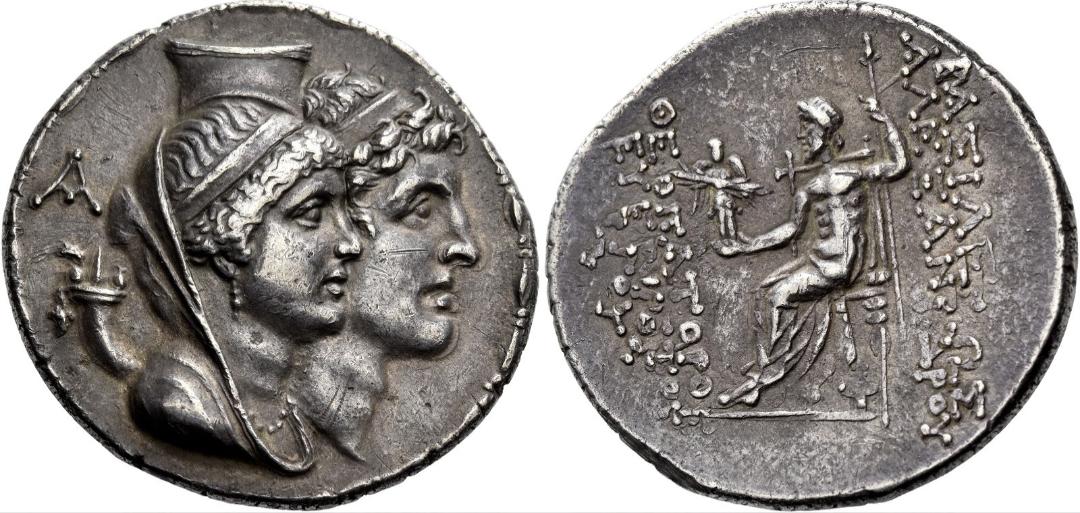
A Hellenistic Tetradrachm of the Seleucid King Alexander Balas and his wife Cleopatra Thea, likely minted at Ake-Ptolemais to commemorate the couples marriage in 150 BC. [1080×513]
by coinoscopeV2

A Hellenistic Tetradrachm of the Seleucid King Alexander Balas and his wife Cleopatra Thea, likely minted at Ake-Ptolemais to commemorate the couples marriage in 150 BC. [1080×513]
by coinoscopeV2
1 Comment
Description from Numismatica Ars Classica-
Affairs between the Ptolemaic and Seleucid kings – who were fair-weather friends at the best of times, and combatant enemies at others – were especially complex in the mid 2nd Century B.C. This rare and beautiful tetradrachm was struck shortly after Cleopatra Thea, daughter of the Egyptian king Ptolemy VI, married the Seleucid usurper Alexander I Balas. Balas claimed to be a bastard child of the former king Antioch IV, and he rebelled against the reigning Seleucid king Demetrius I with the help of the Roman senate, Attalus I of Pergamum, Ariarathes V of Cappadocia and Ptolemy VI of Egypt. Balas’ supporters – especially Ptolemy VI – feared a revival of Seleucid power under Demetrius, who had escaped captivity in Rome to lead his own coup. Balas proved to be as weak-willed as his supporters hoped, and his reign is often seen as the cause of the subsequent instability of the Seleucid dynasty. Unlike Balas, his consort Cleopatra Thea was a remarkable politician. As the daughter of a king, a queen herself, the wife of three kings, and the mother of two kings, she did much to define politics in her age. When she issued coins bearing her portrait conjoined with a Seleucid king (initially her husband, Balas, and later her son, Antiochus VIII), her portrait is topmost, in the position of honour. One could hardly ask for more explicit evidence of her forceful personality. After three successive marriages to Seleucid kings – Alexander Balas, Demetrius I, and Antiochus VII – Cleopatra assumed supreme power in the Seleucid Empire, which required the murder of her eldest son, Seleucus V, and the promotion of her youngest son, Antiochus VIII, as co-ruler.