
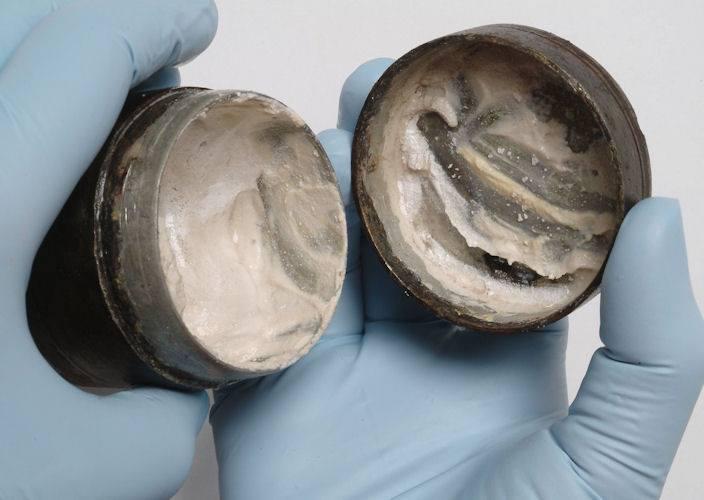
A small canister with a close fitting lid was discovered during excavations of a Roman temple complex located in Tabard Square, Southwark. The canister was found in the boundary ditch surrounding the temples and is thought to have been an offering to the gods.
Upon close inspection, conservators discovered that the canister still contained a soft cream, which after chemical analysis was identified as a cosmetic or face cream.
The cream was composed of animal fat mixed with starch, with tin oxide also added. The fat and starch, mixed together in the correct proportions, would have produced a skin moisturiser, while the tin oxide gave the complexion a translucent glow.
The cream was still soft when the lid of the pot was first removed, and finger marks were visible on its surface. The soft cream began to solidify shortly after the pot was opened.
Few cosmetics survive from that period, making this a rare glimpse into the everyday life of the Romans.
You can take a look for yourself here: https://www.londonmuseum.org.uk/collections/v/object-727368/tin-tin-alloy-canister/?utm_source=chatgpt.com
by Federal_Extreme_8079
5 Comments
The finger tracks are still there! To think this survived thousands of years, when far grander things do not. It blows my mind.
Okay but which intrepid archeologist tried a dab on a test-patch?
Is there an analysis of contents? Can it be remade?
I wasn’t exactly sure what tin oxide was, so in looking it up, I inadvertently discovered that it is [still in use](https://www.ewg.org/skindeep/ingredients/706558-TIN_OXIDE/) in cosmetic products!
In 2003