Sorry, are you saying ancient greece was 500 years ago?
Achian37 on
At this point, I am just too tired to start explaining. Ask chatgpt, gemini or your school janitor.
ApartRuin5962 on
* coastline is depicted rising all the way up to the fucking tropics, due east of Brazil and Indonesia
* no Antarctic Penninsula, no Ross or Weddell Sea
* name scrawled on it is pretty much just “Southern continent” in Greek
Spacer176 on
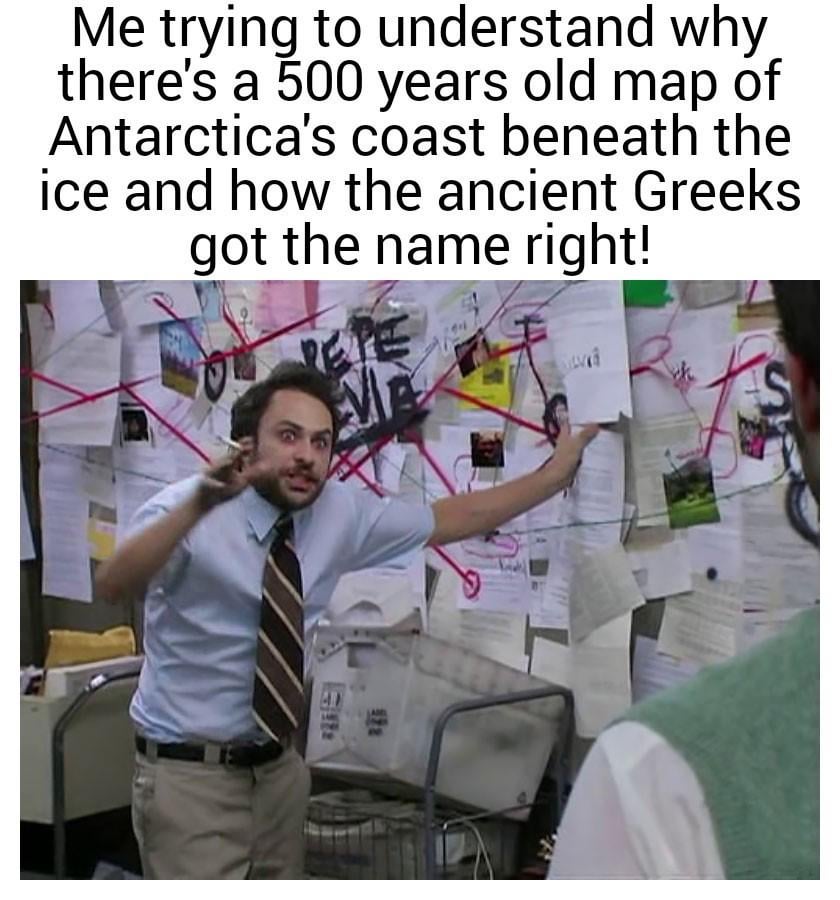
The Ancient Greeks didn’t ‘get the name right’. Ocean explorers spent 500 years attempting to find a hypothesized “ante-arctic” on the opposite side of the world to the Arctic. It’s been southern South America and Australia (which even gets is name to mean “the southern land”.
For over 2000 years there was a hypothesized landmass as far south as you could go to “balance the world out.” But it was unreachable until the 1800s because it turns out the extreme south is *really cold.*
What is convenient is that the common name which means “opposite of bear land” is how said landmass had no bears. (Personally I take “antarctic” to mean “opposing the place where there’s bears.” But getting it right on a guess that the ante-arctic has no bears is too funny.)
AppiusPrometheus on
Both things are a complete coincidence.
1) It was widely assumed that there was a big southern landmass, for the sole reason the southern hemisphere needed a landmass to balance the northern ones.
2) The world Arctic comes from a Greek root meaning “bear”, in reference to the Ursa major / Ursa minor constellations from the northern hemisphere (which names respectively mean “big female bear” and “small female bear”), two famous reference point. Naming something from the southern hemisphere “Antarctic” (“opposite to the bear constellation”) isn’t really odd.
Cpdio on
Wait what? 500 years? Tf…
ekkostone on
People back then assumed that there was an equal amount of land north and south of the equator. The hypothetical continent of ‘Terra Australis’ was pure guesswork. When the Europeans discovered Australia, they assumed it was part of the larger landmass they thought existed and that’s how Australia got its name. Not long after that it was discovered that Australia and Antarctica were not actually the same landmass and since Australia had taken the name, they made up the name ‘Antarctica’ which simply means ‘opposite of the Arctic’. Nobody knew Antarctica existed, they just assumed there would be land there and got lucky that there is land on the southern hemisphere.
Elmalab on
The expected topography of Antarctica using modern data and accounting for isostatic rebound shows no similarities with the Piri Reis map.
KenseiHimura on
Someone needs to do some basic Googledebunking, bro.
nikstick22 on
Thats a lot of research for having all of your facts wrong
Marioninleather on
Its like proper exective function borea.
bdrwr on
Man, it’s too bad Graham Hancock is a nutcase, because some of his ideas were interesting and plausible.
I do think it is believable that there could have been some preserved pre-ice age human knowledge that ancient cultures had access to. If a pre-ice age culture made maps on cloth or paper-like plant material, I could believe that one of those maps survived to the ancient world and got copied before it fully degraded. That would allow an ancient map to show the coastline of Antarctica and Bimini Road above sea level, long after those features had changed.
flapd00dle on
I thought it was an Ottoman map from 1500?
Aethelmaew on
From reading this thread, can I just say that none of you have any imagination and this wasn’t as fun as I wanted it to be.
BlankTank1216 on
Me when I don’t have Google
The_Captain_Jules on
Let’s dispel some bullshit!
1. Yes there is a map, the Piri Reis map, make by the Turks in the 1500s, and recovered in the 1920s. Its a very cool map, a classic renaissance era compilation map, its missing a shitload but its a great find
2. The map is _kind of_ based on ancient greek writings – its a compilation map, so it draws from loads of sources. Yes, ancient greeks, but also Arab maps, portuguese, columbus, and many others
3. The map does not depict Antarctica. Not really. It shows a southern landmass, extending from the southern tip of south america – yknow, ancient cartographers weren’t immune to the superstitions of their eras, and popular thinking at the time argued that there must be a massive southern landmass to “balance” the northern hemisphere. What is depicted is probably a hypothetical extension of south america informed by that thinking, and it does not “accurately depict the coastline of Antarctica under the ice” unless you want to put the most rose-tinted glasses on earth on and even then you have to stretch, compress, and ignore a lot of whats there to claim that it depicts Antarctica with any measure of accuracy

16 Comments
Sorry, are you saying ancient greece was 500 years ago?
At this point, I am just too tired to start explaining. Ask chatgpt, gemini or your school janitor.
* coastline is depicted rising all the way up to the fucking tropics, due east of Brazil and Indonesia
* no Antarctic Penninsula, no Ross or Weddell Sea
* name scrawled on it is pretty much just “Southern continent” in Greek
The Ancient Greeks didn’t ‘get the name right’. Ocean explorers spent 500 years attempting to find a hypothesized “ante-arctic” on the opposite side of the world to the Arctic. It’s been southern South America and Australia (which even gets is name to mean “the southern land”.
For over 2000 years there was a hypothesized landmass as far south as you could go to “balance the world out.” But it was unreachable until the 1800s because it turns out the extreme south is *really cold.*
What is convenient is that the common name which means “opposite of bear land” is how said landmass had no bears. (Personally I take “antarctic” to mean “opposing the place where there’s bears.” But getting it right on a guess that the ante-arctic has no bears is too funny.)
Both things are a complete coincidence.
1) It was widely assumed that there was a big southern landmass, for the sole reason the southern hemisphere needed a landmass to balance the northern ones.
2) The world Arctic comes from a Greek root meaning “bear”, in reference to the Ursa major / Ursa minor constellations from the northern hemisphere (which names respectively mean “big female bear” and “small female bear”), two famous reference point. Naming something from the southern hemisphere “Antarctic” (“opposite to the bear constellation”) isn’t really odd.
Wait what? 500 years? Tf…
People back then assumed that there was an equal amount of land north and south of the equator. The hypothetical continent of ‘Terra Australis’ was pure guesswork. When the Europeans discovered Australia, they assumed it was part of the larger landmass they thought existed and that’s how Australia got its name. Not long after that it was discovered that Australia and Antarctica were not actually the same landmass and since Australia had taken the name, they made up the name ‘Antarctica’ which simply means ‘opposite of the Arctic’. Nobody knew Antarctica existed, they just assumed there would be land there and got lucky that there is land on the southern hemisphere.
The expected topography of Antarctica using modern data and accounting for isostatic rebound shows no similarities with the Piri Reis map.
Someone needs to do some basic Googledebunking, bro.
Thats a lot of research for having all of your facts wrong
Its like proper exective function borea.
Man, it’s too bad Graham Hancock is a nutcase, because some of his ideas were interesting and plausible.
I do think it is believable that there could have been some preserved pre-ice age human knowledge that ancient cultures had access to. If a pre-ice age culture made maps on cloth or paper-like plant material, I could believe that one of those maps survived to the ancient world and got copied before it fully degraded. That would allow an ancient map to show the coastline of Antarctica and Bimini Road above sea level, long after those features had changed.
I thought it was an Ottoman map from 1500?
From reading this thread, can I just say that none of you have any imagination and this wasn’t as fun as I wanted it to be.
Me when I don’t have Google
Let’s dispel some bullshit!
1. Yes there is a map, the Piri Reis map, make by the Turks in the 1500s, and recovered in the 1920s. Its a very cool map, a classic renaissance era compilation map, its missing a shitload but its a great find
2. The map is _kind of_ based on ancient greek writings – its a compilation map, so it draws from loads of sources. Yes, ancient greeks, but also Arab maps, portuguese, columbus, and many others
3. The map does not depict Antarctica. Not really. It shows a southern landmass, extending from the southern tip of south america – yknow, ancient cartographers weren’t immune to the superstitions of their eras, and popular thinking at the time argued that there must be a massive southern landmass to “balance” the northern hemisphere. What is depicted is probably a hypothetical extension of south america informed by that thinking, and it does not “accurately depict the coastline of Antarctica under the ice” unless you want to put the most rose-tinted glasses on earth on and even then you have to stretch, compress, and ignore a lot of whats there to claim that it depicts Antarctica with any measure of accuracy