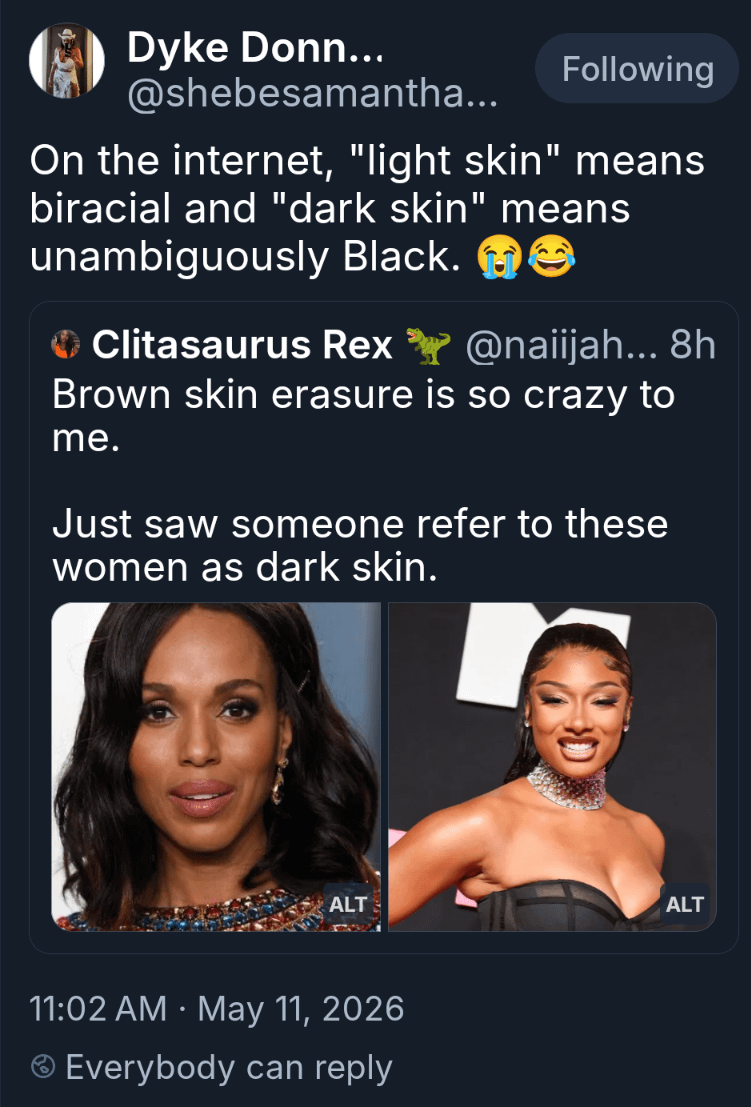
There’s like ten shades of light skin before we get to brown sugar and mahogany. We will not stand for redbone and light brite erasure.
by Rekdon

There’s like ten shades of light skin before we get to brown sugar and mahogany. We will not stand for redbone and light brite erasure.
by Rekdon
17 Comments
I dont think black people want to black anymore.
Maybe it just depends on who your comparing them to.
Nobody said dark skinned people are unattractive.
Don’t nobody know what mahogany is these days.
Try to decenter mayosapiens from your life
I miss the days when black people of all shades, body types etc, were simply referred to as………black people……or African Americans lol.
this is because white people learned our terminology and ran amok with it, as per usual
I lol’d at “light brite erasure.”

It’s weird not knowing where one stands in American standards. If your skin is too light, then damn your features or what your parents look like—you just aren’t black, just mixed. But if you describe yourself as being just mixed, you would be called out for wanting to pass (when you don’t)or erase your blackness.
This sub does more work separating by color than white people
Rage bait….don’t fall for it
If we put half as much effort into eating the rich as we do naming colors.
Yea bc some group of people high jacked the term brown skin. Smh
The CIA plants working overtime
This is a real thing. There was a time their skin tone was actually considered light skinned
Well what was the color of the person calling them dark skin?
Race in and of itself is a nebulous concept and blackness is no exception. Race & blackness are political labels that have no bearing in biological reality (meaning race is not scientific). It’s not surprising that people have varying beliefs about what counts as “black” and what doesn’t.
In the United States, we had/have the one-drop rule but that wasn’t a thing in Brazil, for example—so who is included in blackness is on a sliding scale depending on where you are in the world. Because we’re mostly always going off of visuals and your historical understanding of what blackness is in your culture, the “blackness” of lighter skinned people (biracial or not) with racially ambiguous features can be up for debate depending on who you ask.
Media representation plays into this as well. Blackness has been historically underrepresented in western media, but those who did receive the spotlight in the entertainment industry were oftentimes light skin, especially the women, BUT they were typically “just” light skin or black/white mixed. In this current era of much more visibly mixed or ambiguous racial identities, and how race and ethnicity overlap, it creates this new sliding scale that blackness is measured by that primarily features light skin to brown skin people because that is who primarily featured in western media.
Sorry for the essay lmao.
Bring back “medium” 😂