
Source: Open Electricity
Tools: Open Electricity data export, Strata (OE in-house analysis tool), Claude, Premiere Pro
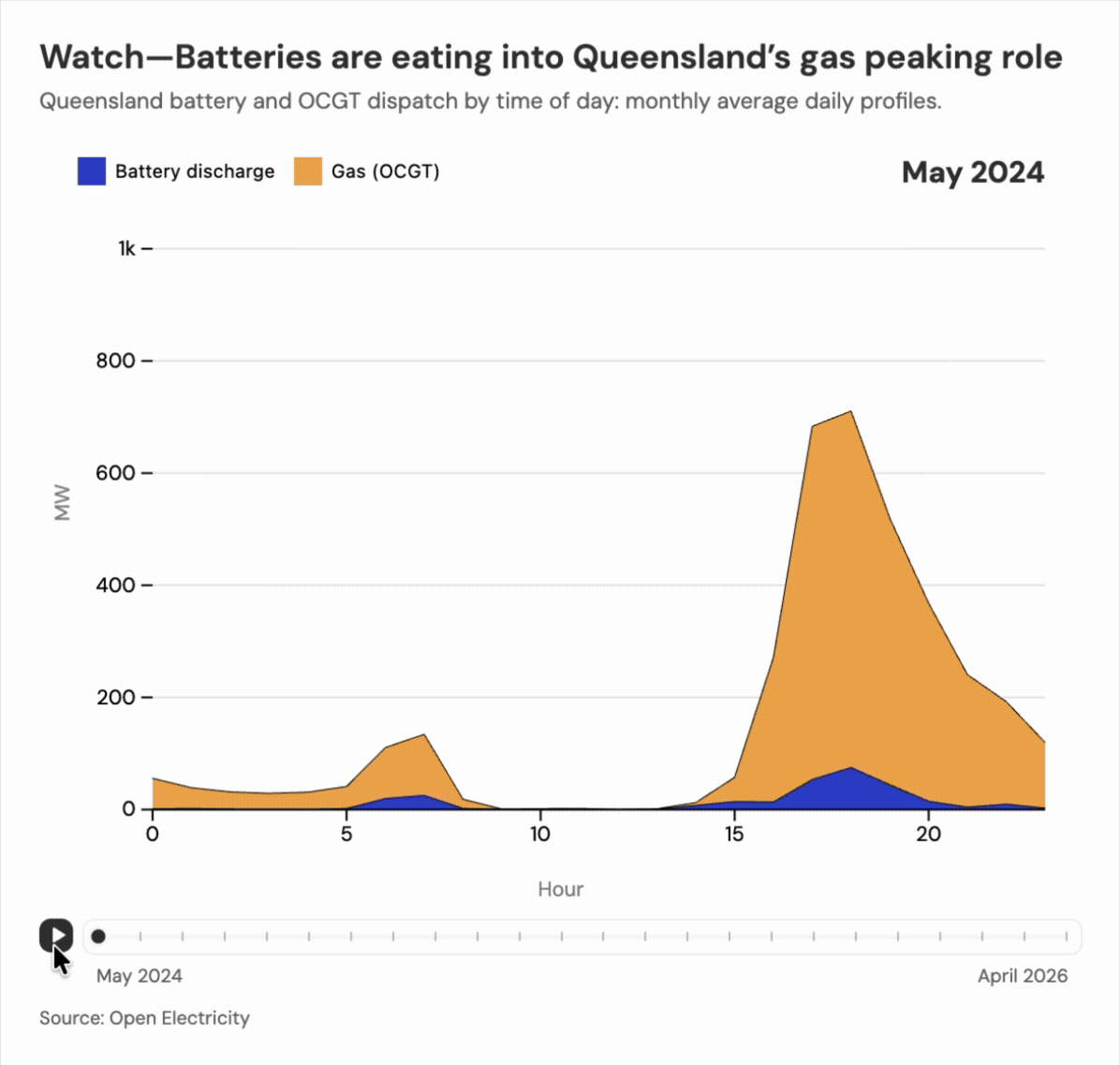
Each frame in this animation shows a single month, from May 2024 to April 2026. The x-axis is hour of day, and the y-axis is megawatts of electricity generated in Queensland, averaged across every day of that month.
The two 'bumps' in each chart are times of peak usage in electricity system, as households turn on electric appliances to cook and warm or cool their houses etc. These times of the day are the hardest to decarbonise, as solar generation is low and wind is variable. Traditionally, gas generation has filled the void.
Now, due to record deployment of utility scale batteries across Australia's electricity network, batteries are now eating gas generation's breakfast…. and dinner.
by paperadam
6 Comments
Source: [Open Electricity](http://openelectricity.org.au)
Tools: Open Electricity data export, Strata (OE in-house analysis tool), Claude, Premiere Pro
I misread the title and I thought somehow coin batteries were helping the power grid
That must be a fuck ton of watch batteries to have that effect. Those things are tiny.
We’ve gone from about $200-$300 a month for electricity, to just $30-50. With the lower amount being the supply charge from the grid.
It’s crazy how quick exponential growth gets for technology adoption.
The thing that really did this was the government basically saying they would pay for part of the battery cost. It brought the cost of batteries from a “Yeah, it’ll kind of pay for itself in a reasonable time.” To “Yeah, that’s a really fast payback.”
The side channel of this is that the transmission costs drastically fall from local batteries that also do some local export. Since by their nature, battery power rarely has to travel far since it’ll mostly be a person selling power to their next door neighbor.
Another aspect is that most of the Australian grid is within an hour of each other timezone wise, it largely runs north south. There has been talk of joining east and west coast, but give WA was lucky enough to avoid privitisation of its power grid, it’ll likely end up with the East sucking WA dry due to its cheap gas.