
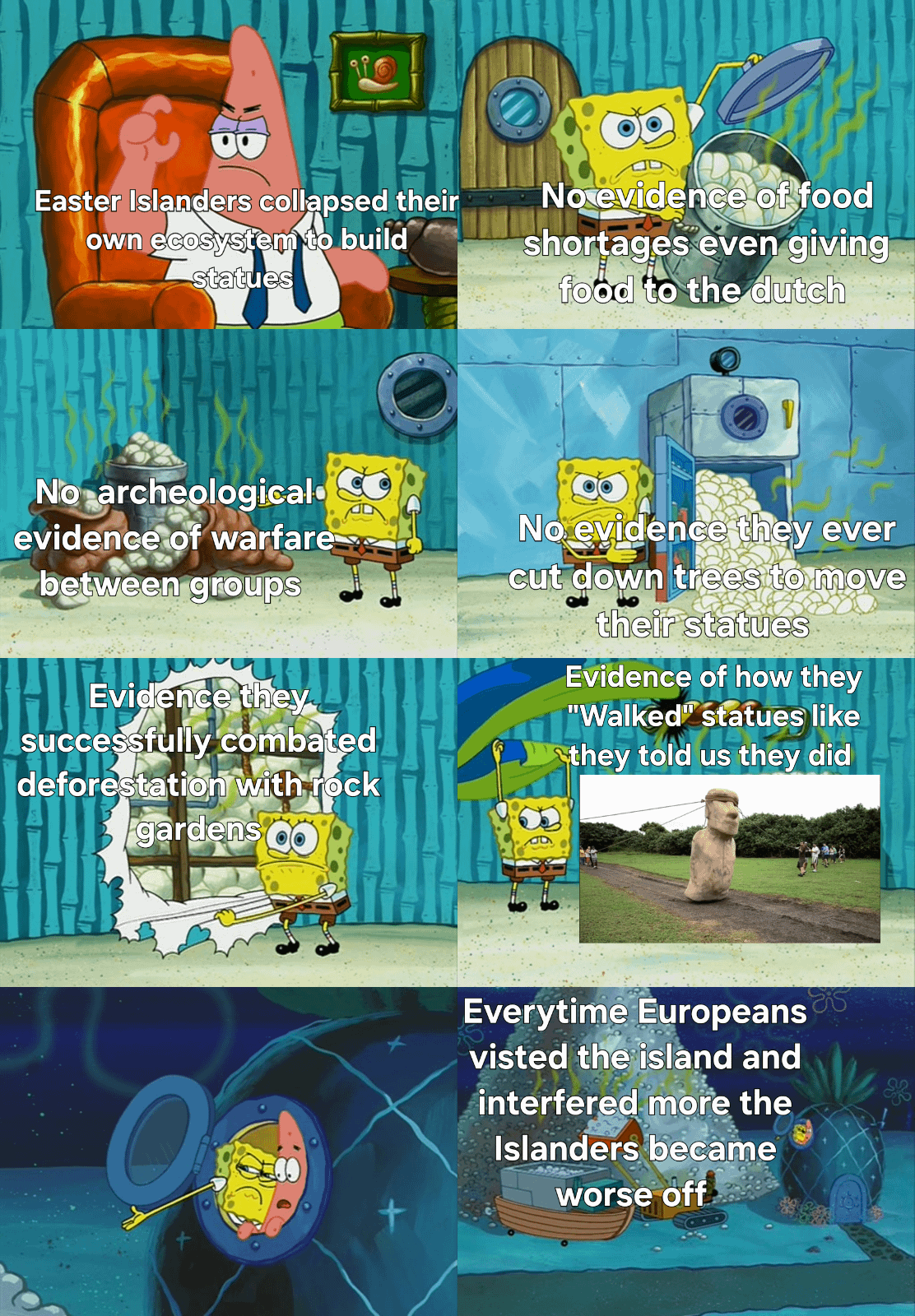
Context: https://www.sapiens.org/archaeology/easter-island-demise/
The ecocide hypothesis centers on two major claims. First, that the island’s population was reduced from several tens of thousands in its heyday to a diminutive 1,500–3,000 when Europeans first arrived in the early 18th century.
Second, that the palm trees that once covered the island were callously cut down by the Rapa Nui population to move statues. With no trees to anchor the soil, fertile land eroded away, resulting in poor crop yields, while a lack of wood meant islanders couldn’t build canoes to access fish or move statues. This led to internecine warfare and, ultimately, cannibalism.
The question of population size is one we still cannot convincingly answer. Most archaeologists agree on estimates somewhere between 4,000 and 9,000 people, although a recent study looked at likely agricultural yields and suggested the island could have supported up to 15,000.
But there is no real evidence of a population decline prior to the first European contact in 1722. Ethnographic reports from the early 20th century provide oral histories of warfare between competing island groups. The anthropologist Thor Heyerdahl—most famous for crossing the Pacific in a traditional Inca boat—took these reports as evidence for a huge civil war that culminated in a battle of 1680, where the majority of one of the island’s tribes was killed. Obsidian flakes, or mata’a, littering the island have been interpreted as weapon fragments testifying to this violence.
However, recent research led by Carl Lipo has shown that these were more likely domestic tools or implements used for ritual tasks. Surprisingly few of the human remains from the island show actual evidence of injury—just 2.5 percent—and most of those showed evidence of healing, meaning that attacks were not fatal. Crucially, there is no evidence, beyond historical word-of-mouth, of cannibalism. It’s debatable whether 20th-century tales can really be considered reliable sources for 17th-century conflicts.
So what—if anything—happened to the Native population for its numbers to dwindle and for statue carving to end? And what caused the reports of warfare and conflict in the early 20th century?
The real answer is more sinister. Throughout the 19th century, South American slave raids took away as much as half of the Native population. By 1877, the Rapanui numbered just 111. Introduced disease, destruction of property, and enforced migration by European traders further decimated the Natives and led to increased conflict among those remaining. Perhaps this, instead, was the warfare the ethnohistorical accounts refer to and what ultimately stopped the statue carving.
by Salty_Strain3313
7 Comments
Nothing make an ignorant happier than to push for any narrative that makes justified European imperialism, since for him history is something that makes them feel shame and they made up their pride when in reality history is neither about those.
I remember once watching a show which presented a variation of the ecocide hypothesis though it had nothing to do with the statues. It said that they kept destroying the forests to acquire more farmland as the old one kept degrading.
OP presents his revisionist interpretation as *fait accompli* but there is still lots of mainstream support for ecological population decline, and with good reason.
For one, he neglects to mention that the statue carving didn’t simply stop – they were *deliberately destroyed* en masse somewhere between the Dutch visit in 1722 and Captain Cook’s visit in 1774, a period with extremely minimal European contact and certainly no imperialism there. This suggests a catastrophic social upheaval, *likely a war,* between Rapa Nui factions. Neatly backing the oral history that they themselves told us.
Secondly, it is trivially true that the natural palm forests *were* almost completely gone upon first contact with Europeans. Erosion and loss of soil fertility is exactly what we would expect to happen from an ecological perspective, even with no other information available. If the Rapa Nui *didn’t* experience a decline in agricultural productivity it would have to be due to some extraordinary technique we are unaware of.
There is other evidence as well, and I would encourage anyone who wants to take OP at face value to actually read about the ecocide theory first. That’s not to deny the 19th century slave raids did occur and were gravely evil. All I’m saying is they targeted an already depleted population, they weren’t the sole cause.
The European nation of Peru
The fall of civilizations podcast did an episode on [Easter Island](https://open.spotify.com/episode/0pGCsvdjo344EQ2dALE6dD?si=gMvLfsIKTuWcjt5d67xGqQ)
All of Easter Island’s Royal family died
This is an interesting topic which has apparently raised some strong feelings on this thread. When that kind of thing happens, what should happen is people should cite reputable sources who are experts on the topic, rather than making unfounded claims or start name-calling.
OP cites the works of Lipo and scientists from UC Davis, while the top comment offers pop history, based seeming off Diamond, who is not a historian nor a sociologist. This is of course a meme sub, but if someone is going to try to rebuke a well-cited post, they should at least cite an authority who is responding to OPs claims.