
Context
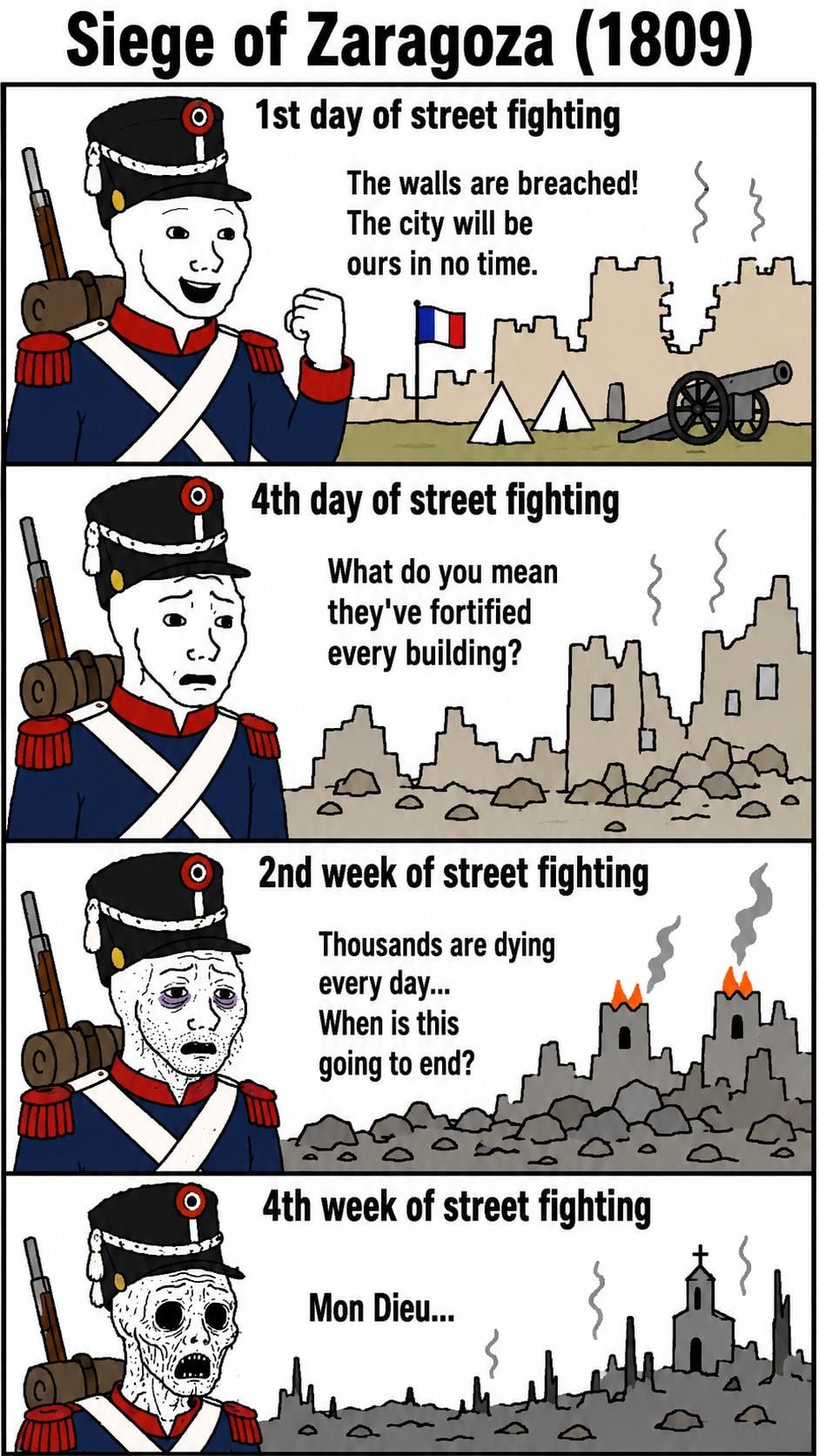
On 20 December 1808, roughly 45,000 to 50,000 French troops closed in on the Spanish city of Zaragoza. The city had already humiliated the French during the first siege in the summer of 1808, when a smaller French force was driven out of the city by Spanish militia. This time, the French came back with the numbers, the guns and the intention of finishing the job.
Marshal Moncey and Marshal Lannes expected to take Zaragoza by conventional siege methods: capture the outworks, bring up heavy artillery, breach the walls, silence the guns and force the defenders either to retreat or surrender.
What followed instead was some of the fiercest street fighting since the Fall of Carthage.
General José de Palafox, who commanded the defence of Zaragoza, had learned from the weaknesses exposed during the first siege of 1808. The city was turned into a trap for any attacker: houses were linked by passages knocked through interior walls, loopholes were cut into buildings, streets were blocked with barricades, convents and other large stone structures were turned into strongpoints. The outer defences were strengthened as well, with new works, ditches and positions anchored on the Huerva and the heights of Monte Torrero. By the start of the siege Palafox had around 32,000 infantry, 2,000 cavalry, and 10,000 armed volunteers inside the city. Zaragoza was also stocked for a long defence: there was enough food to feed the army for about three months, townspeople had built up private food reserves, gunpowder was manufactured inside the city during the siege, so the defenders were not expected to run out of ammunition quickly.
The siege began on 20 December 1808. On the following day, the French seized the key height of Monte Torrero, giving them a commanding position from which to place their artillery against the city’s southern defences, although their attack on San Lázaro failed. Over the next several weeks, the French steadily captured the outer positions, brought up their heavy guns, and tightened the siege. By 16 January the main outworks were in French hands. From 17 January the bombardment of the walls intensified, and on 27 January the French finally broke through the southern defences, capturing positions such as Santa Engracia and forcing the battle into the city itself. The walls fell quickly. The city did not.
An excerpt from Wikipedia:
"The Spanish defenders had been preparing
for street fighting from the beginning. Lannes, however, had decided on a slow block-by-block siege of each individual fortification in order to minimise French casualties."
"Individual battles were remarkable for their ferocity. At one point in the San Augustin Convent, the French held the altar end of the chapel and exchanged shots for hours on end with the Spanish entrenched in the nave and the belfry. However, French superiority in equipment and training took its toll, and thousands were falling daily both in the fighting and to disease, which was rampant throughout the city."
Elsewhere, houses had to be cleared from cellar to roof, because defenders fired through loopholes in floors and walls, struck from rooftops, and sometimes set buildings on fire as they withdrew in order to slow the French advance into the next block. Mines were also used to blow open walls and bring down entire buildings, turning the siege into a battle for staircases, rooms and even floors of the same house. One French officer later described Zaragoza as a place where death seemed to be waiting everywhere: in cellars, behind doors, behind shutters and above a soldier’s head.
The human cost was appalling. French troops advancing into abandoned positions sometimes found hospitals and convents littered with dead and wounded men who had not been evacuated in time. In one such position, a French eyewitness recalled choking smoke, burning timber, and the smell of burnt flesh after the defenders left fire and mines behind them. Disease made everything worse. By February, illness was devastating Zaragoza’s garrison and population: only 8,495 healthy men remained from the original 32,000-man garrison, while 10,000 were already dead and 13,737 were sick or wounded. Disease also spread through the French side, one officer remembered the military hospital as filthy and haunted by the sight of the dead and dying piled around him.
Morale reflected that horror. The French, unable to see how badly the defenders were collapsing inside the city, increasingly felt trapped in a seemingly endless nightmare of narrow streets, barricades, mines and ambushes. On the Spanish side, morale held remarkably long, sustained by the belief that Zaragoza could still be defended and that relief might come.
Lannes had refused to repeat the reckless street assaults of the first siege. Instead, the French reduced the city block by block, treating each convent, church and cluster of houses as a separate fortress. Buildings were shattered by artillery, whole blocks were fought over for days and the defenders sometimes set ruined houses on fire as they fell back.
At the end of the third week of urban combat, on 18 February, the French captured San Lázaro on the north bank of the Ebro, which exposed the northern part of the city to French artillery as well. By then the defenders were collapsing from every cause at once: combat, exhaustion, hunger and disease. Palafox himself was gravely ill. What had begun as a fortified city was ending as a field of wrecked convents, broken walls, burning houses and streets choked with rubble, dead and wounded.
On 19 February, Palafox sent an aide to Lannes to discuss surrender, then resigned his military command to General St. March and his civil authority to a 33-member junta. His first offer was rejected, and fighting resumed briefly on 20 February. But by that evening the civilian council accepted the French terms and the siege was over. Under those terms, the garrison marched out and laid down its arms outside the Portillo gate. Of the roughly 32,000 men who had formed the garrison at the start of the siege, only about 8,000 survived to go into captivity.
The aftermath was catastrophic. Zaragoza itself had been destroyed. Contemporary municipal estimates put the death toll at around 54,000 people — about 20,000 soldiers and 34,000 civilians — and Lannes believed the city’s population had fallen from roughly 55,500 before the siege to just 15,000.
by Last_Adhesiveness530
11 Comments
that’s a chilling description… War trully is hell
I knew this was Zaragossa before I opened it.
The siege was litteraly use as the reference throughout the XIXth century to describe the intensity of combats in a city. Overlooked too much.
[War to the knife](https://en.wiktionary.org/wiki/war_to_the_knife).
Third year of the siege of Carthage:
The first mistake when fighting a desperate dug in urban seige is fighting it at all.
Take the high ground and then use the Kreig approach
Really? U had to use ai for this?
Small Tokmachka
Jesus Fucking Christ
On the lions lead by donkeys episode for this battle they talked about how some traps were set in homes for soldiers to fall through into the cellars, where literal children would pop out of hiding and stab them to death.
I was looking for something about pre industrial urban warfare.