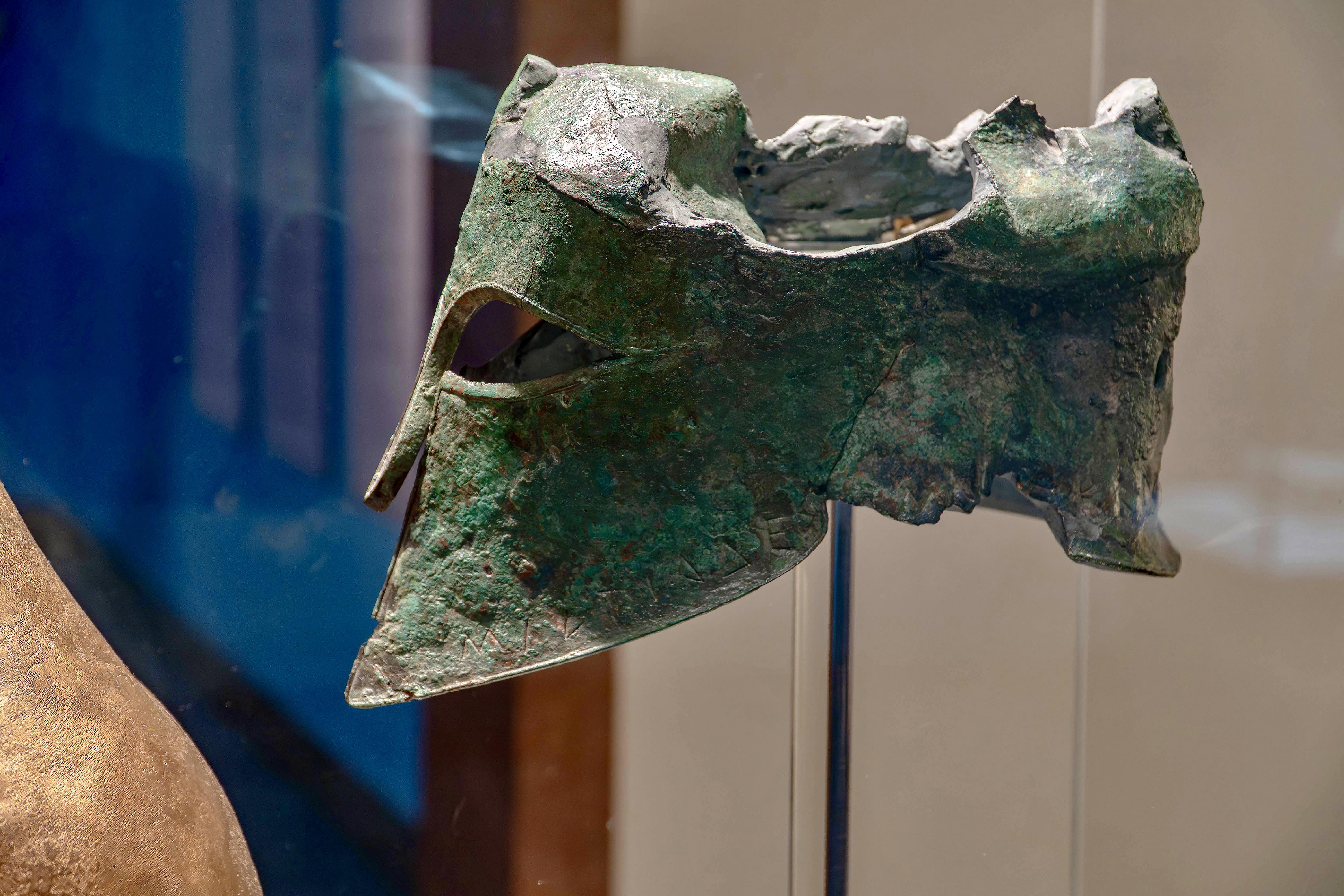
The Helmet of Miltiades, the Lando Calrissian of Ancient Greece (OC, Info in comments) [6000×4000]
by PorcupineMerchant

The Helmet of Miltiades, the Lando Calrissian of Ancient Greece (OC, Info in comments) [6000×4000]
by PorcupineMerchant
9 Comments
What you’re looking at is one of the very few surviving pieces from Ancient Greece that’s tied to a specific person.
This is the Helmet of Miltiades, owned by a man who was *the* man…and history’s original Lando Calrissian. He once served the Persians, then led the charge to drive them out of Greece forever. If by “forever,” you mean “ten years,” because the Persians later came back and got whipped again.
You can zoom in and see his name as well as some other text on the helmet. I’m including some [other images here,](https://imgur.com/gallery/helmet-of-miltiades-1IMfBhC) as well as images of another helmet it sits next to. I’ll explain what they say later.
**Lando & LeBron**
Miltiades was the son of a famous Olympic chariot racer. Kind of like how LeBron James’ son went on to great success in a different field, thanks to starring in Space Jam: A New Legacy. Except apparently that was an actor, and not his real son. Nevermind.
Miltiades grew up in Athens, then went to take over his uncle’s colony in what’s now Turkey. He was a tyrant, though that word didn’t mean the same thing it does now. It basically just meant he was a ruler who didn’t come to power through conventional means. Kind of like how LeBron’s son…okay, that analogy doesn’t work here either.
But colonial life didn’t last long. King Darius of the Persian Empire invaded the area of Miltiades’ colony, and made him a vassal. Basically, his bitch. Miltiades had to pay taxes to Persia and give them ships and troops for their battles. Yes, that included himself.
As they marched to war on the side of the Persians, he supposedly tried to destroy a bridge to strand Darius and his men, but couldn’t convince anyone to help him. Obviously people tattled on him, and Miltiades had to take off.
Did he hide? No, quite the opposite. Miltiades was the man, after all. He joined the Ionian Revolt, working to help other Greek colonies fight off the Persians. See? Lando Calrissian.
Eventually the revolt fell apart, and he went back to Athens. In the time since he’d left, it had become a democracy and now thought the idea of a “tyrant” was gross. So instead of having a big party with lots of wine, Miltiades gets put on trial. Not just for being a nasty old tyrant, but for working with the Persians.
But Miltiades, being a smooth operator, told them that he’d just gone along with Darius as a front. And not only that, but he knew all the Persian tactics and had even brought a bunch of Persian booty back to Athens. Which eventually sold them on the fact that Lando was in fact not secretly teamed up with Vader.
**Knock Knock**
Eventually, the Persians come knocking. They were pissed that Athens had helped the colonies in the Ionian Revolt. They want Athens to be their bitch, just like they did with Miltiades’ colony and so many others.
The Persians did this by sending heralds to demand a gift of “earth and water,” meaning you give up and agree to be subservient. And Athens didn’t just say no…possibly on the advice of Miltiades, they killed the heralds.
You know the well-kicking thing from the 300 movie? Same thing, except that was Sparta.
The Persians make their way through Greece, fighting and burning and all that nasty stuff. They have their sights set on Athens.
Miltiades and some other generals argued that if they waited for a siege, Athens would be destroyed. Miltiades himself is credited with making the winning argument, and they lead the troops out of the city.
Though they were joined by a group from the neighboring city-state of Plataea, they’re horribly outnumbered. They send a runner to Sparta to ask for help, which is a staggering 150 miles away. I know this part sounds like bullshit, but most historians agree this did actually happen. Ancient Greece had some awesome professional distance runners.
According to the ancient historian Herodotus (Which is where a lot of our information about the Persian Wars comes from), the guy’s name was Pheidippides. You should remember him for being so impressive.
He gets there within two days, but the Spartans say no, they’re busy having a religious festival. Yes, this actually happened too. Some people try to give them a pass, because there really was a festival and they weren’t supposed to fight, but…come on.
Miltiades and the rest are facing a massive army and seem to have no chance.
So they waited.
Eventually, some Ionians forced to serve in the Persian army signaled that their cavalry was gone. Miltiades sets a plan in motion: He blocked the exits from the plain of Marathon, and reinforced the flanks. It looked like the Greek army was wide open for attack.
The Persians took the bait, and moved towards the center. Miltiades ordered the Greeks on the sides to sprint, not giving the Persians enough time to use their bows to any effect.
The Greeks swarm the Persians.
It was a slaughter. The Persians go running back to their ships, thinking they’ll swing around and take the undefended city of Athens. But Miltiades, being the man, ordered his troops to hustle back to the city.
The Persian ships arrived to see the same guys who’d just whipped them waiting for another fight, and they sailed all the way home.
Three days later, the Spartans arrived at Marathon — just in time to see all the dead Persians. Thanks, Sparta.
**A Present for Zeus**
At some point after the Battle of Marathon, Miltiades goes to the Temple of Zeus at Olympia; the same place where his dad won all those chariot races.
There, he leaves his helmet, most likely as a thanks to the king of the gods. On it, the inscription:
ΜΙΛΤΙΑΔΕΣ ΑΝΕ[Θ]ΕΚΕΝ [Τ]ΟΙ ΔΙ.
*Miltiades dedicated me to Zeus*
It’s almost certainly Miltiades’ own personal helmet, as it was common for Greek soldiers to dedicate their own armor to the gods. In a sense, he was giving up this precious piece of equipment in gratitude.
You probably noticed the top has quite a bit of damage, and is missing the crest. It’s possible this was the result of “votive killing,” where such objects were intentionally broken. They were making them unusable, and sealing the idea that they were giving them to the gods.
Or, it could just be the result of being lost for around 2500 years. All things considered, I think it held up pretty well.
Of course, as I said at the beginning, the Persians came back ten years later. This is when the Battle of Thermopylae took place, and the eventual defeat of Darius’ son and the rest of the Persians, who were sent home once again.
As for Miltiades, I’d like to tell you he lived a life of peace and wine after blowing up the second Death Star, but that’s not what happened.
He led a bunch of Athenian ships to attack Greek islands that had supported the Persians, and lost. He also got wounded in the leg pretty bad. When he got back to Athens, his political enemies took advantage of his loss and put him on trial. He got off with a fine, but died in jail; probably of gangrene from his wound.
Not exactly the most heroic ending, but no one remembers him for that. Instead, they remember him for this helmet, and for being the man who helped defeat the largest empire on the planet.
You can see his helmet for yourself in the museum at Olympia, which is where I saw it. It sits next to a Persian helmet also from Marathon, with the inscription:
AII AOENAIOI MEAON AABONTE
*The Athenians [dedicated this] to Zeus, having taken it from the Persians*
You can also go see the mounds at Marathon where the Athenians and the Plateans are buried. I tried, but they were closed. It was Greek Independence Day. Yes, I should’ve known that. I don’t want to talk about it.
This is normally where I’d post a link to a video I made about this helmet, but I’ve got nothing. It’s hard to make a video when there isn’t much to use in the way of visuals. I do have an extremely lengthy one [about the “discovery” of Machu Picchu](https://youtu.be/rHZEJw4Hj7o?si=Vj9_uEdE6K3B2kAe) which is completely irrelevant, I’m just posting it to hopefully give myself some incentive to get back in the swing of writing these excessively long explanations of artifacts.
I really enjoyed reading that. Thank you
Where was this helmet found? Was he buried with it, or was it found in a field?
That … was bloody interesting. Thanks for posting
Of course I know him, it’s me
Found on location at the Battle of Taanab
I married into a Greek family and am going back this summer. My daughter was a little too young to do a lot of the ruins and sites/museums last time we were there but she’s old enough this time. Super pumped – may have to add this one to the list – thanks!
Great write up, thanks for taking the time, I really enjoyed it.
I couldn’t help but notice the similarities in his story with the story of Themistocles who also worked for the persians but went on to help Athens defeat them, although they both had different roles to play and ended up having very different ends.
Of all the bad-ass relics from an earlier time still on this planet, this has to be in the top10. Read PorcupineMerchant’s brief bio of him in this thread.