This sub has a soft corner for Christianity and america, they will “rationally” analyze everything and point out wrongs but with these two, it’s just crazy defending that much I saw.
realnanoboy on
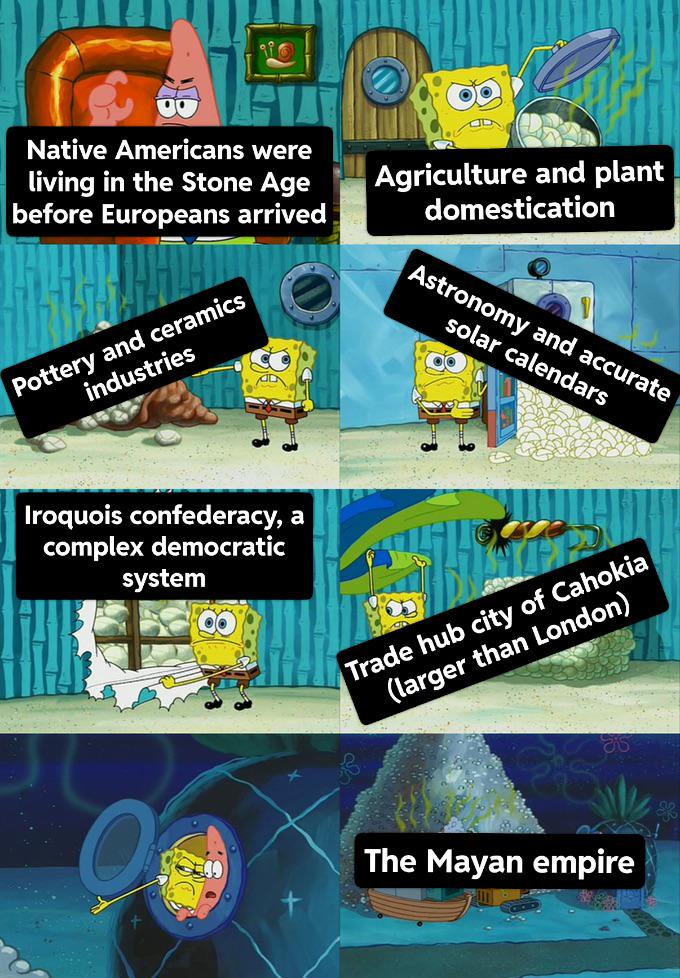
While all these things are true, and there were complex societies already established before the brutality of Europe washed onto the shores of the Americas, those same things are true of neolithic Europeans. They also had complex societies. Being in the Stone Age just means you haven’t worked out metals yet.
EtherealPheonix on
None of that disputes a designation of stone age, it just reveals your own bigotry in considering societies without metal as lesser. What does disrupt the stone age allegations is the significant usage of copper across much of the continents and even bronze in some places.
Worth adding that many N American cultures were in a particularly hunter-gathery period when Europeans arrived due to some climate effects which selected for it. Go back a few hundred years and there was much more agricultural based societies.
Muted_Competition_35 on
The Natchez Chiefdom was more advanced than the Iroquois Confederacy but it got encountered and wiped out by the Europeans way earlier. It was prolly the last vestige of the Mississippian mound builders. We showed up to North America when it was in a dark age fr
Fun-Calligrapher-745 on
I feel like this operates under the assumption of being in this stone age is inherently bad, it’s not You can still have a complicated society while only using stones instead of metals.
AlexanderCrowely on
Tercio legionaries for life! Viva Conquista.
ManyRelease7336 on
Non of these examples have anything to do with not being stone aged
ArteDeJuguete on
Mayan empire? The Mayans never had an empire, they had city-ststes instead. I think you must be referring to the Aztec empire
VenitianBastard on
ffs the Mayans didn’t have an empire.
Maybe Mayan city-states had loose “empires”, but there was no singular empire of the Mayans that was unified.
Wintermaulz on
I would not equate the native Americans of Canada and the US too the mesoamericans of central america. They had vastly different political structures and social centralization.
shumpitostick on
Yeah, sounds like the Neolithic.
I know the popular imagination of “stone age” is humans living in caves and unga bunga and obviously that’s not what the Native Americans had but their tools and weapons were made of stone and they didn’t work bronze or iron. So yes, they were technically in the stone age.
Angel_OfSolitude on
They were still in the stone age with no wheel. They weren’t stupid, but they were severely behind in the civilizational race. Saying people are in the stone age isn’t a comment on intelligence or social structure, but of technological progress.
jwahnmike on
I mean…. you can be a stone age civilization, and do everything you mentioned. Egypt for example, had all those things even before they started using bronze.
Issue with this post is that, the listed counter-points are fragmented relics spread across the entire American continents. Yes, Cahokia had this, Iroquois did that, and Mayan empire was a marvelous state that could develop calendars and pyramids, but they were not a single unified political entity. Spain alone did all the thing mentioned by themselves and that was not something unique in the old world countries. The native american states were destroyed by the Europeans because the difference in the level of development was thay great.
interesseret on
What do you think Stone Age means, OP?
Do you think it’s an insult?
We have neolithic sites that predate agriculture.
Beta-Minus on
You can have agriculture and astronomy without metallurgy. Pretty sure that’s how it went in the old world too.
Verhulst88 on
What 1 game of CK2 Sunset Invasion does to a man
adirtysocialist- on
This doesnt…oh never mind.
wsdpii on
People often forget that the Natives were living through a post-apocalypse. The initial contact with Europeans caused mass plague to rip through 90% of the population continent wide. Society collapsed. They had oral traditions and apprenticeships. If the people with knowledge died of illness, then that knowledge vanished into the ether.
Imagine coming across a bunch of tribals in Fallout and going “man, all these people must have always been dumb as fuck”, ignoring the fact that they’re a bare remnant of their society that’s undergone a significant technological recession.
Linscotticus on
The incan empire had a super advance form of communication and logistics in what can be considered some of the most inhospitable terrain.
33Sharpies on
It would be more accurate to say they never got past the Bronze Age before the Europeans arrived
Boring-Entrance-2881 on
You’re proving their point
ZeltbahnLife on
You can do all these things and still be a Stone Age society.
Swellmeister on
Firstly they were in the Chacolithic, because they had a large use of copper.
Secondly the Peruvian native cultures were in a bronze age.
FrenchMen420 on
What was the age between stone and bronze? Oh wait they were all stone age….
Gentle_Snail on
I’d have changed the first quote to be ‘Native Americans were uncivilised’ or something, because none of these points actually disagree with the statement that native American’s didn’t have mainstream metal tools
Ikairos-seeker on
Stone Age is a technological assessment not a cultural development one
Apprehensive_Gur_302 on
Is the musket in the room with us?
baneblade_boi on
I think the main issue is that this is normally used in specific in relation to the North of North America, where modern US and Canada is, not Mexico.
Also, IIRC the Iriquois confederation (or Hodenaushaune) was more of a confederacy of different allied tribes doing politics and waging war collectively, nothing necessarily democratic about it. Each tribe was ruled by chieftains and elder matriarchs. If I’m wrong, please correct me, I’m interested.
Zerskader on
Technically the Native Americans were just sorta stuck in a really long Neolithic Revolution. The lack of development towards metal tooling is why they are viewed as primitive or “Stone Age” although they developed a lot of the similar technologies you would see in ancient China, Mesopotamia, Europe, and India.
The trade hub city mentioned was impressive as were the dirt mound burial sites but they were very early form of trade and barter utilizing a very weak form of natural currency as compared to the minted early currency you see in the old world. This lack of minted currency has made it hard to track early Native American history where trade was present.
The issue is that Native Americans found a way to live successfully while engaging in conflicts amongst each other that did not lead to developing more advanced forms of war. While native copper can be found in some parts of the Americas, most of the metal recquires significant processing.
Asherkowki on
[ Removed by Reddit ]
Stankbooty253 on
Stone age means they hadn’t quite figured out how to create a sustainable source of metal. They can have all of these things listed and still be in the stone age.
SinesPi on
Didn’t the native north Americans lack the wheel though? I wouldn’t call that stone age, but that’s a hell of an invention to be lacking.
TheDwarvenGuy on
I mean that’s technically the stone age, just the neolithic
Some were in the copper and bronze age though, like the Inca.
AppleJoost on
Cahokia was never larger than London. Around 1300 London had 80.000 inhabitants, Cahokia had 20.000.
HonestDishonestWork on
…….. Yup, that’s what we consider the stone age. Did you think the stone age was just barely sentient monkey people wracking each other sticks?
HC-Sama-7511 on
Both of these “positions” are wrong because there was not a single interconnected meta-culture across the 2 whole continents and numerous islands, stretching across the whole latitude of the planet Earth, containing a variety of ecosystems where one mode of living would work.
Many indigenous people in the Western hemisphere were living at essentially stone age levels of social structure and technology. In fact, it was the exception that inventions like agriculture, and metal working, and organized governments existed in any form.
This doesn’t make anyone less human or intelligent.
Gigantopithecus1453 on
Stone Age isn’t really a judgement of societal advancement, rather simply what material is used for tools. And the native Americans did just use stone and wood tools, with the occasional outlier like obsidian or ivory. And while the native Americans were fairly advanced in some fields (particularly astronomy as I understand it) they were on the whole far less advanced than the Europeans who had maintained extensive contact with the outside world for millennia
GaryRegalsMuscleCar on
All of that is Stone Age. The Neolithic was awesome, guys.
Necessary_Debate_319 on
All achievable in a Stone Age, though
Primarch-Amaranth on
So….?
People really have an awful opinion of the Stone age, as if that meant everyone lived in caves. It merely entails that metallurgy, was rare. Sure used to make decorative weapons and jewelry, but it wasn’t widespread enough for common use. Remember they used obsidian for their weapons. They were in the stone age, that foes not invalid their cultural advancements on astrology and the like, nor the building of cities.
I am focusing mostly in Center and South America. I do believe northern tribes did have more advanced metallurgy, but don’t quote me on that.
ShortPea6000 on
“Industries”
Ha. Haha. Ahhaha. Wonderfully comedic.
awawe on
Agriculture and ceramics are emblematic of the paleo- and mesolithic (younger and middle stone age) respectively
The_Arachnoshaman on
CANADIANS HATE THIS ONE SIMPLE TRICK
jac0777 on
What’s jarring is the how the Spanish conquistadors who overwhelmingly came from Seville (itself a beautiful city even back then) couldn’t shut up about the clean beauty of Tenochtitlan to the point many of them were unsure if the city was a dream. And how some of the engineering marvels could only be achieved through ‘enchantments’. It’s incredible to think about.
And then they deliberately destroyed it all so we have little to no remnants of it 😂
FiberFirst on
Right it’s all crap
Feisty_Development59 on
In fact by definition there was a lack of advanced metallurgy, with some copper metals works, but this would still mean the “Stone Age” by definition.
Being in the Stone Age doesn’t mean much otherwise, just that there was a lack of advanced metal works.
kcpatri on
While most if not all cultures around the Americas when the Europeans came were stone or chalcalithic age, the argument you are arguing against is actually that the natives were savages, and further more that the material people use to make their tools out of determines how far along they were with their civilization. While technology is important to civilization, the idea of the straightforward march of progress is shattered when you remember that in order to go from the bronze age to the iron age civilization literally collapsed, the lack of trade for the creation of bronze leading to technology to make iron usable.

49 Comments
This sub has a soft corner for Christianity and america, they will “rationally” analyze everything and point out wrongs but with these two, it’s just crazy defending that much I saw.
While all these things are true, and there were complex societies already established before the brutality of Europe washed onto the shores of the Americas, those same things are true of neolithic Europeans. They also had complex societies. Being in the Stone Age just means you haven’t worked out metals yet.
None of that disputes a designation of stone age, it just reveals your own bigotry in considering societies without metal as lesser. What does disrupt the stone age allegations is the significant usage of copper across much of the continents and even bronze in some places.
Look at the [Incans](https://www.reddit.com/r/AskHistorians/comments/u5q4eh/the_incan_empire_was_the_most_successful/), who [created a vast, highly centralized empire without even a written language system](https://www.reddit.com/r/AskHistorians/comments/1blz69m/if_the_incas_didnt_have_a_written_language_how_do/).
Worth adding that many N American cultures were in a particularly hunter-gathery period when Europeans arrived due to some climate effects which selected for it. Go back a few hundred years and there was much more agricultural based societies.
The Natchez Chiefdom was more advanced than the Iroquois Confederacy but it got encountered and wiped out by the Europeans way earlier. It was prolly the last vestige of the Mississippian mound builders. We showed up to North America when it was in a dark age fr
I feel like this operates under the assumption of being in this stone age is inherently bad, it’s not You can still have a complicated society while only using stones instead of metals.
Tercio legionaries for life! Viva Conquista.
Non of these examples have anything to do with not being stone aged
Mayan empire? The Mayans never had an empire, they had city-ststes instead. I think you must be referring to the Aztec empire
ffs the Mayans didn’t have an empire.
Maybe Mayan city-states had loose “empires”, but there was no singular empire of the Mayans that was unified.
I would not equate the native Americans of Canada and the US too the mesoamericans of central america. They had vastly different political structures and social centralization.
Yeah, sounds like the Neolithic.
I know the popular imagination of “stone age” is humans living in caves and unga bunga and obviously that’s not what the Native Americans had but their tools and weapons were made of stone and they didn’t work bronze or iron. So yes, they were technically in the stone age.
They were still in the stone age with no wheel. They weren’t stupid, but they were severely behind in the civilizational race. Saying people are in the stone age isn’t a comment on intelligence or social structure, but of technological progress.
I mean…. you can be a stone age civilization, and do everything you mentioned. Egypt for example, had all those things even before they started using bronze.
Issue with this post is that, the listed counter-points are fragmented relics spread across the entire American continents. Yes, Cahokia had this, Iroquois did that, and Mayan empire was a marvelous state that could develop calendars and pyramids, but they were not a single unified political entity. Spain alone did all the thing mentioned by themselves and that was not something unique in the old world countries. The native american states were destroyed by the Europeans because the difference in the level of development was thay great.
What do you think Stone Age means, OP?
Do you think it’s an insult?
We have neolithic sites that predate agriculture.
You can have agriculture and astronomy without metallurgy. Pretty sure that’s how it went in the old world too.
What 1 game of CK2 Sunset Invasion does to a man
This doesnt…oh never mind.
People often forget that the Natives were living through a post-apocalypse. The initial contact with Europeans caused mass plague to rip through 90% of the population continent wide. Society collapsed. They had oral traditions and apprenticeships. If the people with knowledge died of illness, then that knowledge vanished into the ether.
Imagine coming across a bunch of tribals in Fallout and going “man, all these people must have always been dumb as fuck”, ignoring the fact that they’re a bare remnant of their society that’s undergone a significant technological recession.
The incan empire had a super advance form of communication and logistics in what can be considered some of the most inhospitable terrain.
It would be more accurate to say they never got past the Bronze Age before the Europeans arrived
You’re proving their point
You can do all these things and still be a Stone Age society.
Firstly they were in the Chacolithic, because they had a large use of copper.
Secondly the Peruvian native cultures were in a bronze age.
What was the age between stone and bronze? Oh wait they were all stone age….
I’d have changed the first quote to be ‘Native Americans were uncivilised’ or something, because none of these points actually disagree with the statement that native American’s didn’t have mainstream metal tools
Stone Age is a technological assessment not a cultural development one
Is the musket in the room with us?
I think the main issue is that this is normally used in specific in relation to the North of North America, where modern US and Canada is, not Mexico.
Also, IIRC the Iriquois confederation (or Hodenaushaune) was more of a confederacy of different allied tribes doing politics and waging war collectively, nothing necessarily democratic about it. Each tribe was ruled by chieftains and elder matriarchs. If I’m wrong, please correct me, I’m interested.
Technically the Native Americans were just sorta stuck in a really long Neolithic Revolution. The lack of development towards metal tooling is why they are viewed as primitive or “Stone Age” although they developed a lot of the similar technologies you would see in ancient China, Mesopotamia, Europe, and India.
The trade hub city mentioned was impressive as were the dirt mound burial sites but they were very early form of trade and barter utilizing a very weak form of natural currency as compared to the minted early currency you see in the old world. This lack of minted currency has made it hard to track early Native American history where trade was present.
The issue is that Native Americans found a way to live successfully while engaging in conflicts amongst each other that did not lead to developing more advanced forms of war. While native copper can be found in some parts of the Americas, most of the metal recquires significant processing.
[ Removed by Reddit ]
Stone age means they hadn’t quite figured out how to create a sustainable source of metal. They can have all of these things listed and still be in the stone age.
Didn’t the native north Americans lack the wheel though? I wouldn’t call that stone age, but that’s a hell of an invention to be lacking.
I mean that’s technically the stone age, just the neolithic
Some were in the copper and bronze age though, like the Inca.
Cahokia was never larger than London. Around 1300 London had 80.000 inhabitants, Cahokia had 20.000.
…….. Yup, that’s what we consider the stone age. Did you think the stone age was just barely sentient monkey people wracking each other sticks?
Both of these “positions” are wrong because there was not a single interconnected meta-culture across the 2 whole continents and numerous islands, stretching across the whole latitude of the planet Earth, containing a variety of ecosystems where one mode of living would work.
Many indigenous people in the Western hemisphere were living at essentially stone age levels of social structure and technology. In fact, it was the exception that inventions like agriculture, and metal working, and organized governments existed in any form.
This doesn’t make anyone less human or intelligent.
Stone Age isn’t really a judgement of societal advancement, rather simply what material is used for tools. And the native Americans did just use stone and wood tools, with the occasional outlier like obsidian or ivory. And while the native Americans were fairly advanced in some fields (particularly astronomy as I understand it) they were on the whole far less advanced than the Europeans who had maintained extensive contact with the outside world for millennia
All of that is Stone Age. The Neolithic was awesome, guys.
All achievable in a Stone Age, though
So….?
People really have an awful opinion of the Stone age, as if that meant everyone lived in caves. It merely entails that metallurgy, was rare. Sure used to make decorative weapons and jewelry, but it wasn’t widespread enough for common use. Remember they used obsidian for their weapons. They were in the stone age, that foes not invalid their cultural advancements on astrology and the like, nor the building of cities.
I am focusing mostly in Center and South America. I do believe northern tribes did have more advanced metallurgy, but don’t quote me on that.
“Industries”
Ha. Haha. Ahhaha. Wonderfully comedic.
Agriculture and ceramics are emblematic of the paleo- and mesolithic (younger and middle stone age) respectively
CANADIANS HATE THIS ONE SIMPLE TRICK
What’s jarring is the how the Spanish conquistadors who overwhelmingly came from Seville (itself a beautiful city even back then) couldn’t shut up about the clean beauty of Tenochtitlan to the point many of them were unsure if the city was a dream. And how some of the engineering marvels could only be achieved through ‘enchantments’. It’s incredible to think about.
And then they deliberately destroyed it all so we have little to no remnants of it 😂
Right it’s all crap
In fact by definition there was a lack of advanced metallurgy, with some copper metals works, but this would still mean the “Stone Age” by definition.
Being in the Stone Age doesn’t mean much otherwise, just that there was a lack of advanced metal works.
While most if not all cultures around the Americas when the Europeans came were stone or chalcalithic age, the argument you are arguing against is actually that the natives were savages, and further more that the material people use to make their tools out of determines how far along they were with their civilization. While technology is important to civilization, the idea of the straightforward march of progress is shattered when you remember that in order to go from the bronze age to the iron age civilization literally collapsed, the lack of trade for the creation of bronze leading to technology to make iron usable.