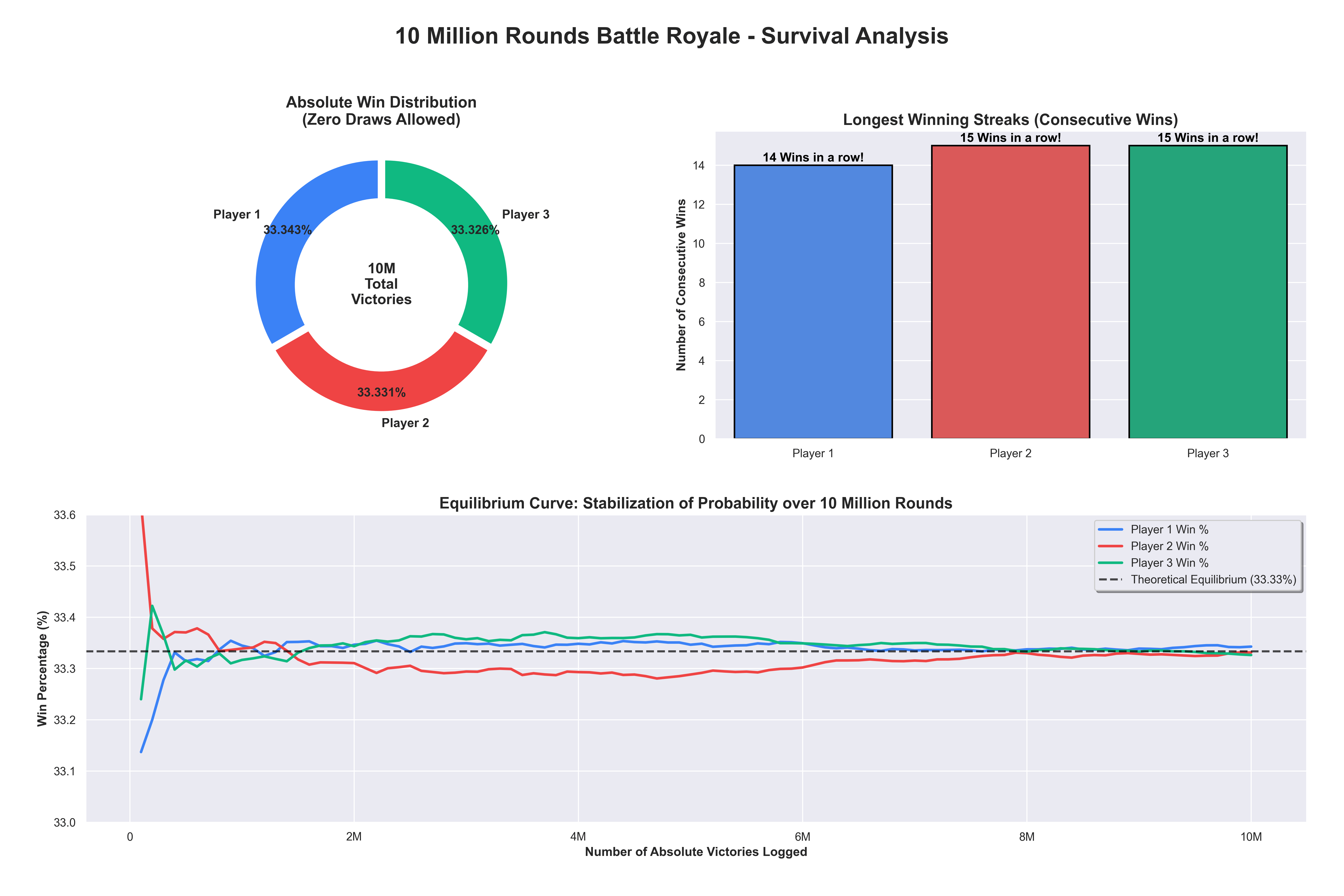
[OC] 10 Million Rounds of 3-Player Rock-Paper-Scissors: Absolute Win Distribution, Longest Streaks, and the Law of Large Numbers
by NoRevolution6394

[OC] 10 Million Rounds of 3-Player Rock-Paper-Scissors: Absolute Win Distribution, Longest Streaks, and the Law of Large Numbers
by NoRevolution6394
3 Comments
**Source:** Simulated data. I wrote a custom Node.js script to simulate a 3-Player “Battle Royale” style Rock-Paper-Scissors game until 10 million absolute victors were found. To avoid algorithmic bias, I used Node’s `crypto.randomInt` (Hardware-based True Random Number Generator) instead of standard `Math.random()`.
**Tools:** Python, Matplotlib, and Seaborn for data parsing and visualization.
**Context & Rules of the Simulation:**
* 3 players throw simultaneously.
* If all 3 throw the same, or all 3 throw differently, it’s a draw and they re-throw.
* If 2 players beat 1, the loser is eliminated, and the remaining 2 duel until a single victor remains.
* Because of the constant draws and 2-player duels, it actually took my CPU roughly **60 million throws** to generate these 10 million absolute wins!
**Fun Fact:** The probability of a single player winning 15 times in a row in this format is roughly 1 in 14.3 million. Due to the massive sample size, we naturally hit that exact statistical anomaly! The bottom chart also perfectly visualizes the Law of Large Numbers stabilizing at exactly 33.33%.
Nice, but I’d like to see this with real-world data instead of random.
Can you show me the python code for the simulation logic? Because I think you too may have done a similar mistake that I once made.