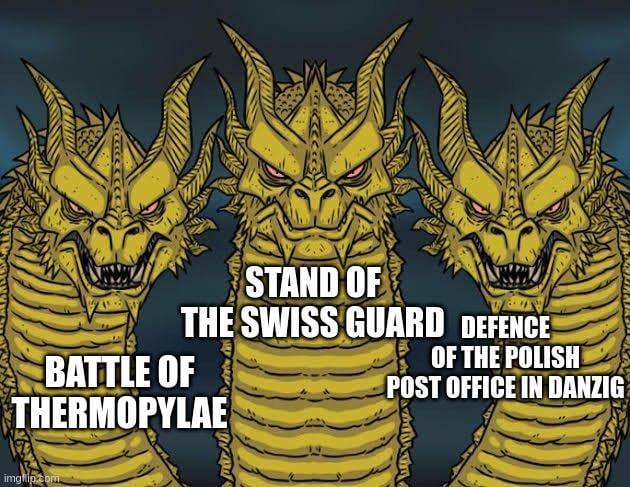
The Polish Post Office in the Free City of Danzig was created in 1920 under the Treaty of Versailles, and its buildings were considered extraterritorial Polish property.
As tensions between Poland and Germany grew, in April 1939 the Polish High Command detached combat engineer and Army Reserve Sublieutenant Konrad Guderski to the Baltic Sea coast. He helped organise the official and volunteer security staff at the Polish Post Office in Danzig, and prepared them for possible hostilities. In addition to training the staff, he prepared the defences in and around the building: nearby trees were removed and the entrance was fortified. In mid-August, ten additional employees were sent to the post office from Polish Post offices in Gdynia and Bydgoszcz (mostly reserve non-commissioned officers).
In the Polish Post Office complex on 1 September 1939 there were 56 people: Guderski, 42 local Polish employees, ten employees from Gdynia and Bydgoszcz, and the building caretaker with his wife and ten-year-old daughter, Erwina, who lived in the complex. The Polish employees had a cache of weapons, consisting of three Browning wz.1928 light machine guns, 40 other firearms and three chests of hand grenades. The Polish defence plan assigned the defenders the role of keeping Germans from the main building for six hours, when a relief force from Armia Pomorze was supposed to secure the area.
At 04:00 the Germans cut the phone and electricity lines to the building. At 04:45, just as the German battleship Schleswig-Holstein started shelling the nearby Polish Army military outpost at Westerplatte, the Danzig police began their assault on the building under the command of Polizeioberst Willi Bethke. They were soon reinforced by local SA formations and the SS units SS Wachsturmbann “E” and SS Heimwehr Danzig, supported by three police ADGZ heavy armoured cars.
The first attack failed. So did the second. In the fighting, Guderski was killed while stopping Germans who had broken into the building, but the defenders kept holding on. At about 11:00 a.m., the attackers escalated: they brought up two 75 mm guns and a 105 mm howitzer and tried again. That assault also failed. Even mortar support requested from the German forces around Westerplatte proved too inaccurate to finish the job.
At 15:00, the Germans declared a two-hour ceasefire and demanded that the Polish forces surrender, which they refused. In the meantime, German sappers dug under the walls of the building and prepared a 600 kg explosive device. At 17:00, the bomb was set off, collapsing part of the wall, and German forces under the cover of three artillery pieces attacked again, this time capturing most of the building except the basement.
Frustrated by the Poles’ refusal to surrender, Bethke requested a rail car full of gasoline. Danzig’s fire department pumped it into the basement, and it was then ignited by a hand grenade. After three Poles were burned alive (bringing the total Polish casualties to six killed in action), the rest decided to capitulate. The first one to leave the building was the director, Dr. Jan Michoń. He carried a white flag but was shot by the Germans regardless. The next person, commandant Józef Wąsik, was burned alive by a flamethrower. The remaining defenders were allowed to surrender and leave the burning building. Six people managed to escape from the building and evade the Germans, although two of them were captured in the following days. Sixteen wounded prisoners were sent to the Gestapo hospital, where six subsequently died (including the 10-year-old Erwina, who died due to burns several weeks later). In the end the building was defended for some 15 hours.
All the prisoners were put on trial in front of the martial court of the Wehrmacht’s Gruppe Eberhardt. All were sentenced to death as illegal combatants under the German special military penal law. The prisoners were mostly executed by firing squad on 5 October and buried in a mass grave at the cemetery of Danzig-Saspe (Zaspa).
And then you have the derpy dragon of “the last stand of Paraguay”. Uh… that was just sheer military idiocy.
Unofficial_Computer on
Gdansk*
KenseiHimura on
I would want to out the battle of Thermopylae as the goofy head. But to be honest even besides the Spartan propaganda that exaggerates their contribution, there was still a decent amount of other Greeks backing the defense.
LastEsotericist on
I always think of Fort Vaux as underrated in these, but a bunch of them actually lived so it doesn’t have the same kind of martyrdom bonus.
AffectionateTentacle on
What Danzig, I dont know any “Danzig”, what an awful sounding kraut name
Galendy on
The Spanish at Castlenovo
Gunz-n-Brunch on
Feasting in Valhalla with the Spartans? Please stop.
TheCoolPersian on
1: Idk why the Polish would want to feast with the proto-fascist slave state asswipes who the Nazis loved.
2: It wasn’t just the 300 Spartans at Thermopylae, they also brought their 900+ **slave soldiers/Helots** who all died and there were also **700 Thespians** who refused to leave, and **400 Thebans.**

12 Comments
Context
The Polish Post Office in the Free City of Danzig was created in 1920 under the Treaty of Versailles, and its buildings were considered extraterritorial Polish property.
As tensions between Poland and Germany grew, in April 1939 the Polish High Command detached combat engineer and Army Reserve Sublieutenant Konrad Guderski to the Baltic Sea coast. He helped organise the official and volunteer security staff at the Polish Post Office in Danzig, and prepared them for possible hostilities. In addition to training the staff, he prepared the defences in and around the building: nearby trees were removed and the entrance was fortified. In mid-August, ten additional employees were sent to the post office from Polish Post offices in Gdynia and Bydgoszcz (mostly reserve non-commissioned officers).
In the Polish Post Office complex on 1 September 1939 there were 56 people: Guderski, 42 local Polish employees, ten employees from Gdynia and Bydgoszcz, and the building caretaker with his wife and ten-year-old daughter, Erwina, who lived in the complex. The Polish employees had a cache of weapons, consisting of three Browning wz.1928 light machine guns, 40 other firearms and three chests of hand grenades. The Polish defence plan assigned the defenders the role of keeping Germans from the main building for six hours, when a relief force from Armia Pomorze was supposed to secure the area.
At 04:00 the Germans cut the phone and electricity lines to the building. At 04:45, just as the German battleship Schleswig-Holstein started shelling the nearby Polish Army military outpost at Westerplatte, the Danzig police began their assault on the building under the command of Polizeioberst Willi Bethke. They were soon reinforced by local SA formations and the SS units SS Wachsturmbann “E” and SS Heimwehr Danzig, supported by three police ADGZ heavy armoured cars.
The first attack failed. So did the second. In the fighting, Guderski was killed while stopping Germans who had broken into the building, but the defenders kept holding on. At about 11:00 a.m., the attackers escalated: they brought up two 75 mm guns and a 105 mm howitzer and tried again. That assault also failed. Even mortar support requested from the German forces around Westerplatte proved too inaccurate to finish the job.
At 15:00, the Germans declared a two-hour ceasefire and demanded that the Polish forces surrender, which they refused. In the meantime, German sappers dug under the walls of the building and prepared a 600 kg explosive device. At 17:00, the bomb was set off, collapsing part of the wall, and German forces under the cover of three artillery pieces attacked again, this time capturing most of the building except the basement.
Frustrated by the Poles’ refusal to surrender, Bethke requested a rail car full of gasoline. Danzig’s fire department pumped it into the basement, and it was then ignited by a hand grenade. After three Poles were burned alive (bringing the total Polish casualties to six killed in action), the rest decided to capitulate. The first one to leave the building was the director, Dr. Jan Michoń. He carried a white flag but was shot by the Germans regardless. The next person, commandant Józef Wąsik, was burned alive by a flamethrower. The remaining defenders were allowed to surrender and leave the burning building. Six people managed to escape from the building and evade the Germans, although two of them were captured in the following days. Sixteen wounded prisoners were sent to the Gestapo hospital, where six subsequently died (including the 10-year-old Erwina, who died due to burns several weeks later). In the end the building was defended for some 15 hours.
All the prisoners were put on trial in front of the martial court of the Wehrmacht’s Gruppe Eberhardt. All were sentenced to death as illegal combatants under the German special military penal law. The prisoners were mostly executed by firing squad on 5 October and buried in a mass grave at the cemetery of Danzig-Saspe (Zaspa).
Source: [Wikipedia](https://en.wikipedia.org/wiki/Defence_of_the_Polish_Post_Office_in_Danzig)
In the heart of the Holy See…
Sabaton……………………………..Challenge accepted
And then you have the derpy dragon of “the last stand of Paraguay”. Uh… that was just sheer military idiocy.
Gdansk*
I would want to out the battle of Thermopylae as the goofy head. But to be honest even besides the Spartan propaganda that exaggerates their contribution, there was still a decent amount of other Greeks backing the defense.
I always think of Fort Vaux as underrated in these, but a bunch of them actually lived so it doesn’t have the same kind of martyrdom bonus.
What Danzig, I dont know any “Danzig”, what an awful sounding kraut name
The Spanish at Castlenovo
Feasting in Valhalla with the Spartans? Please stop.
1: Idk why the Polish would want to feast with the proto-fascist slave state asswipes who the Nazis loved.
2: It wasn’t just the 300 Spartans at Thermopylae, they also brought their 900+ **slave soldiers/Helots** who all died and there were also **700 Thespians** who refused to leave, and **400 Thebans.**
Stop falling for 2,500 year old propaganda.
I’d like to nominate the Battle of Saraharhi
https://en.wikipedia.org/wiki/Battle_of_Saragarhi