
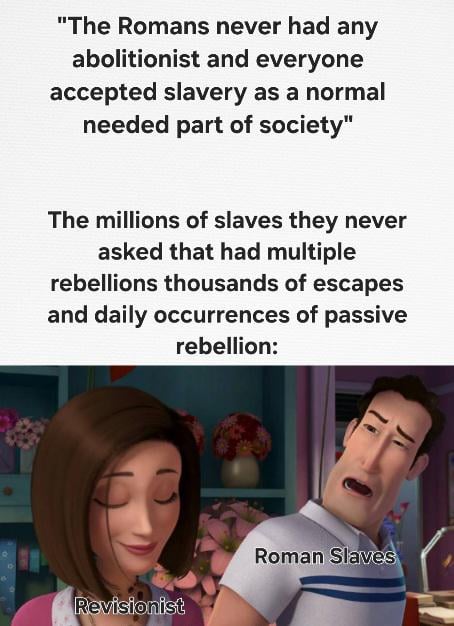
context: The earliest slave uprisings occurred during, and in the immediate aftermath of, the Second Punic War, when many slaves held by the Romans would have been soldiers captured from the armies of Hannibal, and when at times as many as half the Roman male population of fighting age would have been away serving in the military.\616]) The Augustan historian Livy is the main but not always a clear source for these uprisings.\616])
The first recorded rebellion comes in 217 BC, when an informer reported that twenty-five slaves were conspiring on the Campus Martius; they were punished in the earliest securely attested instance of crucifixion among the Romans.\617])\618]) In 198 BC, Carthaginian captives rebelled at Setia, which they may have held briefly before being met with force and fleeing, though two thousand were captured and executed. They next made an attempt on Praeneste but were again defeated, resulting in the execution of another five hundred.\619]) This uprising prompted more policing of the streets and the building of places of confinement.\620]) Two years later, it took a full legion to quell an uprising in Etruria, after which the leaders were flogged and crucified.\621])
The last rebellion of this period broke out in 185 BC in Apulia among herdsman, who were also to play a leading role in the first two Servile Wars. The Apulian shepherds were accused of banditry (latrocinium), and 7,000 were condemned to death; some escaped.\622])
The Greek historian Diodorus Siculus (1st century BC) chronicled the three major slave rebellions of the Roman Republic known as the Servile Wars, the first two of which originated in Rome's first province, Sicily.\623]) Diodorus gives the total number of slaves participating in the first rebellion as 200,000 (elsewhere, the figure is given as 60,000–70,000), and 40,000 in the second.\am]) While these large round numbers in ancient sources seem inflated, their significance here lies in indicating the scope of rebellion
The last slave rebellion of the Republic was put down at Thurii in southern Italy by Gaius Octavius), the father of the future emperor Augustus. In 60 BC, Octavius received a commission from the senate to hunt down fugitives who were alleged (emphasis on "alleged") to be the remnants of Spartacus's men and slaves who had been drawn into the Catilinarian conspiracy.\652])
Though they failed, the Servile Wars left Romans with a deep-seated fear of slave uprisings\653]) that resulted in stricter laws regulating the keeping of slaves and harsher measures and punishments to keep enslaved people under control.\654]) In AD 10, the senate decreed that if a master was killed by one or a group of his slaves, all the slaves "under the same roof" were to be tortured and executed.\655]) In the early Imperial period, the slave uprisings against Lucius Pedanius Secundus, who was killed by one of his household slaves (all 400 were executed), and Larcius Maceo, a praetor who was murdered in his private bath, occasioned panic among slaveholders but failed to catch fire as the Sicilian rebellions had.\627])\655]) None of the sporadic attempts at rebellion over the next centuries encompassed nearly as much territory as that led by Spartacus
Reports of mass suicide or suicide by an individual to avoid enslavement or submission as a result of war are not rare in the Roman world.\745]) In one incident, a group of captive Germanic women told Caracalla that they would rather be executed than enslaved. When he ordered them sold anyway, they committed suicide en masse, some of them first killing their children.\746])
Roman law recognized that slaves might be driven to suicidal despair. A suicide attempt was one of the pieces of information about a slave that had to be disclosed on a bill of sale, indicating that such attempts occurred often enough to be of concern. However, the law did not always regard slaves as criminally fugitive if they ran away in despair and attempted suicide. The jurist Paulus wrote, "A slave acts to commit suicide when he seeks death out of wickedness or evil ways or because of some crime that he has committed, but not when he is able no longer to bear his bodily pain."\75)|Vivianus]]),21.1.17.6([[GnaeusArulenus_Caelius_Sabinus|Caelius]]),_and_21.1.43.4([[Julius_Paulus|Paulus]]).-794)
In a society where slavery was not based on race, a slave who escaped could hope to blend in and go unnoticed among the free.\660]) Certain temples in Greece had long offered asylum to slaves who ran away, and in the Imperial era, a fugitive could claim asylum at the foot of the emperor's statue.\661])
by Salty_Strain3313
18 Comments
“bUt ThE RoManS…”
who fkn cares
Both of these things can be true. The slaves can be angry that they’re slaves instead of somebody else. That doesn’t make them abolitionists.
[deleted]
Obviously the slaves don’t want to be slaves and think slavery is bad. It’s the people who weren’t slaves that thought slavery was a good and necessary institution.
Wow, slaves didn’t want to be slaves. No shit, Sherlock!
That is not what people mean when they talk about abolitionism.
Hey OP, was there much of a distinction between debt slavery, slavery by conquest, and slavery by birth?
I can imagine the last one being unpopular more broadly, the second less so, and the first being quite accepted. Is there much data in that way?
Is a slave revolt the same as an abolition movement?
Genuine question: do we know whether the slaves viewed slavery as wrong and immoral, or were they just upset that _they_ were slaves?
The difference between slave rebels and an abolitionist is between a homeless guy who wants to take the rich guy’s place, and one who wants to abolish capitalism for good. Everybody wants freedom, but back then, before the concept that “slavery is evil!”, slavery was just seen as the normal consequence of being dominated. The goal was to dominate them back. Like how the concept of “an eye for an eye” was still a thing until pretty recently (and still popular in many parts of the world), and it makes sense to genocide their people in revenge for them genociding our people.
“I don’t want to be a slave” and “I don’t think anyone should be a slave” are two very, very different propositions.
Yeah, everyone agreed it sucked to be a slave. And there was a general understanding slaves would rebel, since again, *it sucked to be a slave*, but that’s not the same thing as people thinking slavery ought to be abolished.
We know from grave markers of many Freedmen who saved up money to buy their freedom, which of course they did, because, again, *it sucks to be a slave*. But we also know a lot of those Freemen then went out… and bought slaves. One such grave marker has a Freedman claiming he owned 1300+ slaves at the time of his death. Dude went and bought himself a damned plantation. Because slavery was seen as natural and normal and yes, essential for economy and state.
I’m Spartacus, bitch
Oh you could have just posted the Wikipedia link, considering it’s just a copy and paste job and no real opinion piece of your own on the issue.
That doesn’t mean abolitionism. Freed slaves would happily get slaves themselves
By this logic, Frank Morris must have been a prison abolitionist because he broke out of Alcatraz.
If we’re doing when in Rome, ask them about sexuality in Rome, their views on Christianity, what they did to rich people when the state needed money and so on.
They abolished slavery after adopting Christianity
Commom Church W
🎶Sing, sing, sing to the slaves. Sing to the slaves AS ROME BUURRRRNNNSSSSSSSSSSS🎶
OP is a little confused….