Everything below regarding the artefact description is from my accumulated understanding of Korean culture as well as assisted Google Translate.
This was a *yangban* family heirloom, which was usually the case for Korean female jewelry: a hand-me-down cycle from mother to daughter and mother-in-law to daughter-in-law, which adds sentimental value to such artefacts.
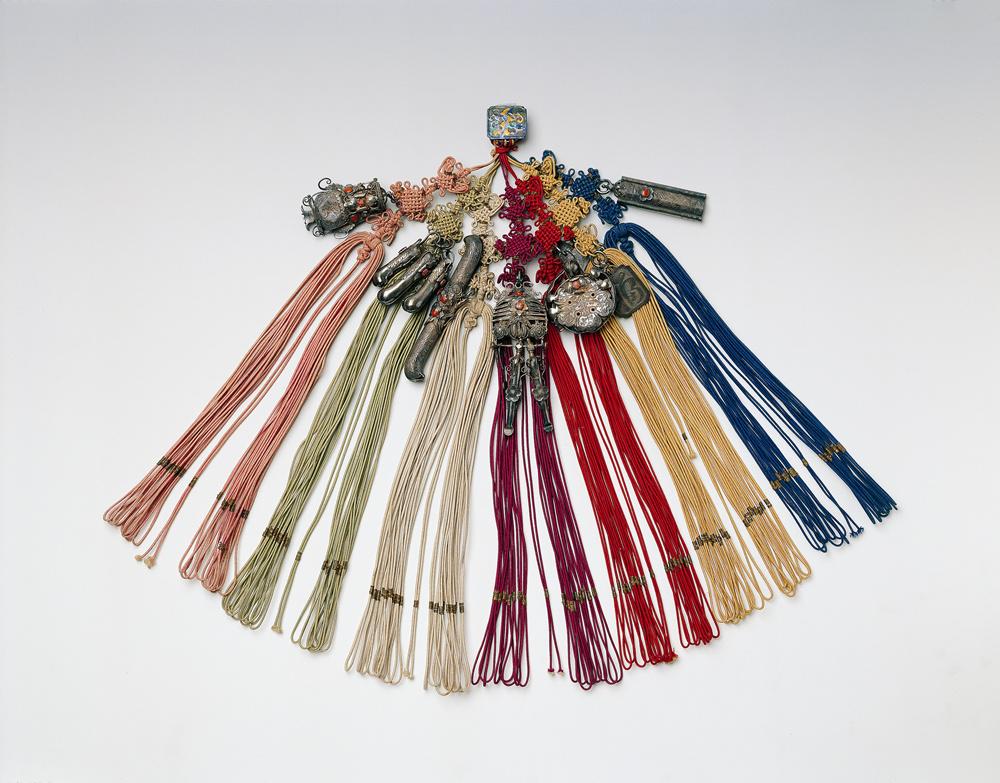
Though the most common form of *norigae* was the *samjak* (삼작 三作 common translation “three-part”) *norigae*, *chiljak* (칠작 七作) *norigae* are extremely rare (IMO this artefact is currently the only specimen of its kind in public display), and also not practical for either everyday or special wear.
However, there are supposedly extant photographs depicting women from the northwestern region^(1) wearing *chiljak norigae* similar to this artefact, meaning such ornaments are possible.^(2)
This artefact is composed of 7 *norigae* made up of knotted cotton cord wrapped in dyed silk threads in the traditional 5 colors (오방색 五方色) of Korea (red, yellow, blue, green, & violet/purple) plus 2 commonly used colors for ornaments. The knots are both symbolic & ornamental, and the *norigae* is finished in the traditional octopus feet tassel (낙지발술) with gold threads for structure.
From left to right, the main ornaments (composed of silver & coral or imitation-coral beads) are:
1. a **pitch-pot** (*tuho* 투호 投壺) symbolizing good luck
2. **3 small eggplants** (phallic talismans) symbolizing the desire for many sons (다남 多男)
3. an **ornamental silver dagger** (*eunjangdo* 은장도 銀粧刀) doubling as a symbol of female chastity as well as a multi-purpose knife
4. a ***bang’adari***^(3) (방아다리) with 2 earpicks symbolizing the desire for sons
5. a **dragon face** talisman to ward off evil spirits
6. a ***gilsangmun*** (길상문 吉祥文) with an engraved “fortune” (福) character (self-explanatory), and
7. an **acupuncture needle case** (*chimtong* 침통 針筒) doubling as a symbol of womanly virtue as well as an emergency kit
—–
Notes:
1 – it’s not elaborated what constitutes “서북지방” (*seobuk jibang*), but basing on the translation and on the map of the Korean peninsula, could probably refer to North Korea’s North Pyongan Province
2 – one of my hobbies is *norigae* making, and believe me I have tried recreating this exact artefact with just Chinese cord, and minus the ornaments, the 7 *norigae* plus hook is already a weighty item
3 – supposedly a farming implement composed of mortars for splitting grain, which became a euphemism for the male sexual aspect, and ultimately the “desire for sons”

1 Comment
Currently in the collection of [Sookmyung Women’s University Museum](https://home.sookmyung.ac.kr/museum/6757/subview.do?enc=Zm5jdDF8QEB8JTJGYmJzJTJGbXVzZXVtJTJGODQ2JTJGNjg4NjMlMkZhcnRjbFZpZXcuZG8lM0ZwYWdlJTNEMiUyNnNyY2hDb2x1bW4lM0QlMjZzcmNoV3JkJTNEJTI2YmJzQ2xTZXElM0QlMjZiYnNPcGVuV3JkU2VxJTNEJTI2cmdzQmduZGVTdHIlM0QlMjZyZ3NFbmRkZVN0ciUzRCUyNmlzVmlld01pbmUlM0RmYWxzZSUyNnBhc3N3b3JkJTNEJTI2).
Everything below regarding the artefact description is from my accumulated understanding of Korean culture as well as assisted Google Translate.
This was a *yangban* family heirloom, which was usually the case for Korean female jewelry: a hand-me-down cycle from mother to daughter and mother-in-law to daughter-in-law, which adds sentimental value to such artefacts.
Though the most common form of *norigae* was the *samjak* (삼작 三作 common translation “three-part”) *norigae*, *chiljak* (칠작 七作) *norigae* are extremely rare (IMO this artefact is currently the only specimen of its kind in public display), and also not practical for either everyday or special wear.
However, there are supposedly extant photographs depicting women from the northwestern region^(1) wearing *chiljak norigae* similar to this artefact, meaning such ornaments are possible.^(2)
This artefact is composed of 7 *norigae* made up of knotted cotton cord wrapped in dyed silk threads in the traditional 5 colors (오방색 五方色) of Korea (red, yellow, blue, green, & violet/purple) plus 2 commonly used colors for ornaments. The knots are both symbolic & ornamental, and the *norigae* is finished in the traditional octopus feet tassel (낙지발술) with gold threads for structure.
From left to right, the main ornaments (composed of silver & coral or imitation-coral beads) are:
1. a **pitch-pot** (*tuho* 투호 投壺) symbolizing good luck
2. **3 small eggplants** (phallic talismans) symbolizing the desire for many sons (다남 多男)
3. an **ornamental silver dagger** (*eunjangdo* 은장도 銀粧刀) doubling as a symbol of female chastity as well as a multi-purpose knife
4. a ***bang’adari***^(3) (방아다리) with 2 earpicks symbolizing the desire for sons
5. a **dragon face** talisman to ward off evil spirits
6. a ***gilsangmun*** (길상문 吉祥文) with an engraved “fortune” (福) character (self-explanatory), and
7. an **acupuncture needle case** (*chimtong* 침통 針筒) doubling as a symbol of womanly virtue as well as an emergency kit
—–
Notes:
1 – it’s not elaborated what constitutes “서북지방” (*seobuk jibang*), but basing on the translation and on the map of the Korean peninsula, could probably refer to North Korea’s North Pyongan Province
2 – one of my hobbies is *norigae* making, and believe me I have tried recreating this exact artefact with just Chinese cord, and minus the ornaments, the 7 *norigae* plus hook is already a weighty item
3 – supposedly a farming implement composed of mortars for splitting grain, which became a euphemism for the male sexual aspect, and ultimately the “desire for sons”