Context: We all know who the Janissaries are. They were once the elite guard of the Ottoman sultans, originally taken from Christian families, only to go full-Praetorian and revolt & depose any sultan that they didn’t like, eventually turning from soldiers to a social class and contributing to the decline of the Ottoman Empire.
However, lesser known were the Sipahi – professional cavalrymen of the Ottoman Empire, granted lands called “Timars.” Contrasting to the Janissaries, they mainly Turkmen.
And throughout their history, the Sipahi and the Janissaries had a rivalry with one another. As both became more of a social class within the Ottoman Empire, they both competed with each other for dominance in the empire’s bureaucracy, economy, and politics, and army.
By the 19th century, when Ottoman sultans such as Mahmud II wanted to modernize the Ottoman Empire in an attempt to prevent its decline, the fates of the Janissaries and Sipahi were sealed, yet both went out different.
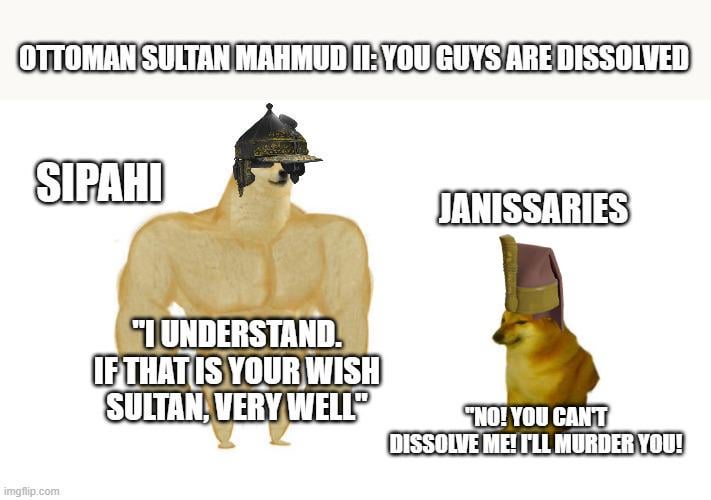
The Janissaries revolted against these reforms and were brutally put down in the Auspicious Incident. It was actually the Sipahi who played role in their disbandment, as they supported Mahmud II.
Two years later, Mahmud II would revoke their privileges and dismissed them in favor of a more modern military structure. Unlike the Janissaries before them, the Sipahi retired honorably, peacefully, and without bloodshed into new Ottoman cavalry divisions who followed modern military doctrines. Older sipahis were allowed to retire and keep their lands until they died, and younger sipahis joined the new modern cavalry

1 Comment
Context: We all know who the Janissaries are. They were once the elite guard of the Ottoman sultans, originally taken from Christian families, only to go full-Praetorian and revolt & depose any sultan that they didn’t like, eventually turning from soldiers to a social class and contributing to the decline of the Ottoman Empire.
However, lesser known were the Sipahi – professional cavalrymen of the Ottoman Empire, granted lands called “Timars.” Contrasting to the Janissaries, they mainly Turkmen.
And throughout their history, the Sipahi and the Janissaries had a rivalry with one another. As both became more of a social class within the Ottoman Empire, they both competed with each other for dominance in the empire’s bureaucracy, economy, and politics, and army.
By the 19th century, when Ottoman sultans such as Mahmud II wanted to modernize the Ottoman Empire in an attempt to prevent its decline, the fates of the Janissaries and Sipahi were sealed, yet both went out different.
The Janissaries revolted against these reforms and were brutally put down in the Auspicious Incident. It was actually the Sipahi who played role in their disbandment, as they supported Mahmud II.
Two years later, Mahmud II would revoke their privileges and dismissed them in favor of a more modern military structure. Unlike the Janissaries before them, the Sipahi retired honorably, peacefully, and without bloodshed into new Ottoman cavalry divisions who followed modern military doctrines. Older sipahis were allowed to retire and keep their lands until they died, and younger sipahis joined the new modern cavalry