
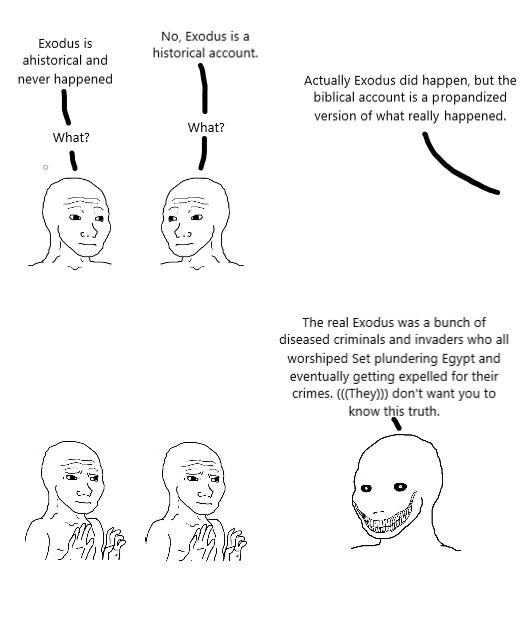
Context: Manetho was an Egyptian historian and high priest of Ra who lived during the Ptolemaic period, more specifically sometime in the early 3rd century BC. He’s most famous for his Greek-language work detailing the history of Egypt titled the Aegyptiaca (Αἰγυπτιακά). While this work is lost and its contents are only known from summaries and quotations, we do know that it apparently contained an account of Exodus that was radically different from the biblical account.
According to Manetho, the historical basis for Moses was “Osarseph,” a renegade priest of Set (though since this work was written in Greek, Set is referred to as Typhon who was equated with Set via Interpretatio Graeca) who during the reign of a Pharaoh named “Amenophis” (likely referring to either Amenhotep II or Amenhotep IV) led a revolt of “lepers and unclean people” and allied with the Hyksos, foreign invaders from the Levant who identified their chief god Baal with Set. Osarseph and the Hyksos drove Amenophis from Egypt and occupied the country for 13 years. They set up their capital at Avaris and according to Manetho, Osarseph changed his name to “Moses.” During their 13-year occupation of Egypt, they committed sacrilege by destroying cult images and “treating the gods as if they were men” (I.E. forbidding their worship). They did this to the temples of all gods except of course for Set, whom Osarseph, the “unclean peoples and lepers,” and the Hyksos all worshipped. Eventually Pharaoh Amenophis returned to Egypt and expelled Osarseph, the “unclean peoples and lepers,” and the Hyksos from the country.
It should be said that most modern historians do not view Manetho’s account of Exodus as reliable at all. He didn’t completely make everything up, but what he did do was erroneously conflate multiple unrelated events often set apart by centuries like the Amarna Period, the Hyksos occupation of Egypt, and the rebellion of Irsu all into a single event while trying to link it to Moses.
by TheIronzombie39
12 Comments
Filtering out maximum possible agendas, what works of rational neutral historians give an accurate account on condition if Jewish community throughout history? Like the exodus from various countries, the genocide for sure and later accounts on Israel?
It’s so funny to me that people today actually believe in something that’s basically ancient propaganda
We actually don’t know what Manetho said because his work has been lost; we essentially have fragments, and a few pieces referenced by other historians, most famously Josephus (who was ironically Jewish himself). In his piece “Against Apion” (essentially a big rebuttal to another sophist named Apion), he claims that Matheno gave this account connecting Osarseph to Moses, and that according to Matheno, the “Hyksos” went onto establish Jerusalem , but since we don’t have a comprehensive edition of Matheno, we don’t know what for certain he was referencing.
It is known that Amenhotep IV established monotheism in Egypt which was forbidden after his death and Egypt returned to worshiping their old Gods. Many ancient and modern historians do argue that Moses was exiled priest of Amenhotep IV god called Aten who escaped to Canaan. First Egyptian mention of Israel is from 150 years after Amenhotep IV in 1208. Archeological evidence suggests that people of Canaan still practiced polytheism at that time but still…
The Egyptians were really pissed about their depiction in Exodus. From Manetho’s point of view, he was punching back, fighting slander with more slander.
Manetho when he realizes what god Ramesses II’s family worshipped…
Wasn’t there archeological evidence to suggest no exodus from Egypt, but instead a religious civil war among the Israeli peoples about the monotheistic worship of El Vs the previous politheistic pantheon in which he merely was a god among many.
That’s kind of giving some of the genocides in the old testament a whole new level of messed up since it was pretty much against their neighbours
*SO LET IT BE WRITTEN*
*SO LET IT BE DONE*
The idea of Akhenaten being the pharaoh of the Exodus also popped up into Eusebius’ account of Egyptian history. He mentioned a ruler named Akenhkheres and in his reign the Exodus happened. Manetho also mentions that this pharaoh Amenophis had a son named Ramesses (named after his grandfather)who drove the Israelites out.
BY THE POWER OF RA.
My personal view is that maybe there was an Osarseph dude and his rebellion amidst the Asiatic residents of Avaris was what motivated the post-Hyksos pharaohs to try genociding its remaining residents, leading to *their* exodus
THUS SAYETH THE LORD!