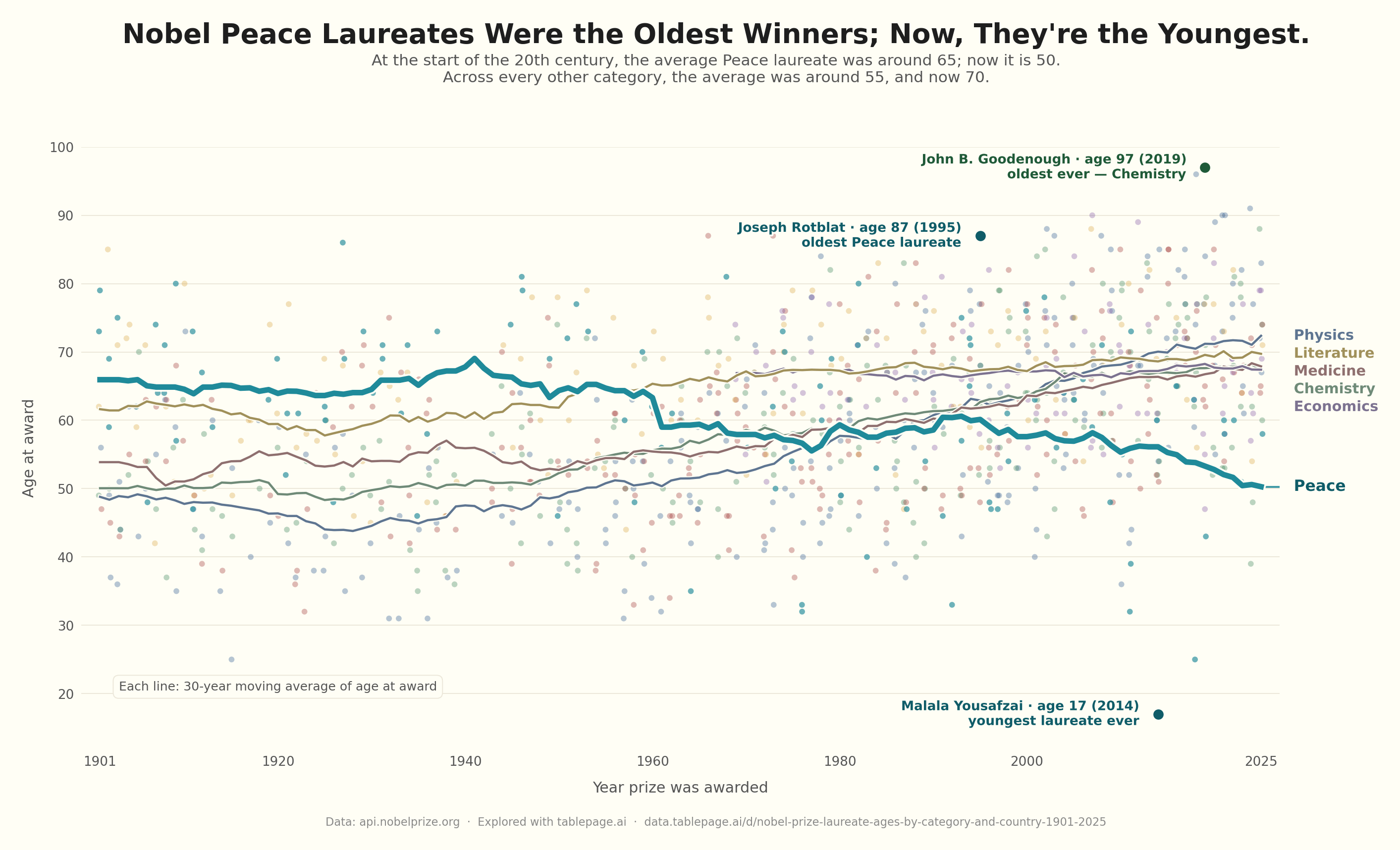
My understanding is that scientific discovery accelerated, which created a backlog of work that deserves recognition, and that led to a larger gap between when the discovery was made and when the prize is awarded.
I don’t have an explanation for why peace prize got younger though.
The Nobel prize in Physics usually requires decades until said discovery is either experimental observed or appreciated. Seems like the peace prize would benefit from a similar longevity criterion, evaluating the winners cumulative impact on global peace throughout their lives.
kettal on
Johnny B. Goodenough. his parents had a sense of humor.
SisterOfBattIe on
The peace prize is a political prize, it’s not knowledge based. Qualifications to get it keeps bein diluted, the winner doesn’t even need to achieve standing peace with decades of standing, just vibe for it.
Low hanging fruits of knowledge have been picked. One has to spec really deep to make nobel discoveries.
Reasonable_Hotel9996 on
i like your graphic! and is very good visualization comparing to ai claude
runehawk12 on
My uneducated guess going through the [list](https://en.wikipedia.org/wiki/List_of_Nobel_Peace_Prize_laureates)of Nobel Peace Laureates is that early prizes seemed to mostly go towards people who had been working for decades to certain causes (a mix of politicians, diplomats philanthropist).
Whereas from the 60s ownwards they mostly go towards leaders that bring the end to wars (primarily colonial or civil) and activists (Human rights, anti-apartheid, press freedom etc); this latter group tends to be younger on average than the first.

6 Comments
My understanding is that scientific discovery accelerated, which created a backlog of work that deserves recognition, and that led to a larger gap between when the discovery was made and when the prize is awarded.
I don’t have an explanation for why peace prize got younger though.
Data: Nobel Prize [Public API](https://api.nobelprize.org/2.1/laureates)
Tools: Python + matplotlib
The Nobel prize in Physics usually requires decades until said discovery is either experimental observed or appreciated. Seems like the peace prize would benefit from a similar longevity criterion, evaluating the winners cumulative impact on global peace throughout their lives.
Johnny B. Goodenough. his parents had a sense of humor.
The peace prize is a political prize, it’s not knowledge based. Qualifications to get it keeps bein diluted, the winner doesn’t even need to achieve standing peace with decades of standing, just vibe for it.
Low hanging fruits of knowledge have been picked. One has to spec really deep to make nobel discoveries.
i like your graphic! and is very good visualization comparing to ai claude
My uneducated guess going through the [list](https://en.wikipedia.org/wiki/List_of_Nobel_Peace_Prize_laureates)of Nobel Peace Laureates is that early prizes seemed to mostly go towards people who had been working for decades to certain causes (a mix of politicians, diplomats philanthropist).
Whereas from the 60s ownwards they mostly go towards leaders that bring the end to wars (primarily colonial or civil) and activists (Human rights, anti-apartheid, press freedom etc); this latter group tends to be younger on average than the first.