
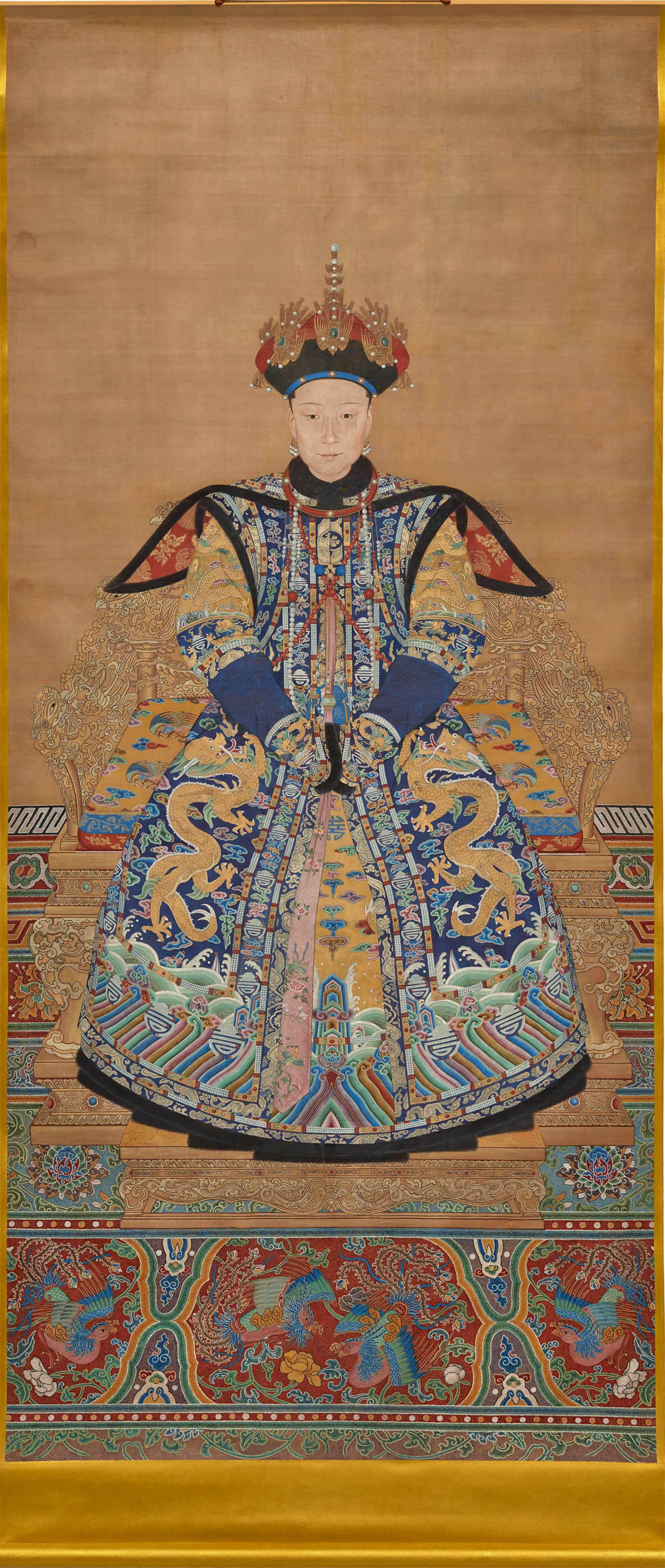
Formal portrait of Empress Xiaoxianchun. Collaboration between Ignatius Sichelbarth (Ai Qimeng), Yi Lantai, & possibly Wang Ruxue. China, Qing Dynasty, 1777. [2000×4714]
by No_Stay_6006
Formal portrait of Empress Xiaoxianchun. Collaboration between Ignatius Sichelbarth (Ai Qimeng), Yi Lantai, & possibly Wang Ruxue. China, Qing Dynasty, 1777. [2000×4714]
by No_Stay_6006
1 Comment
Currently part of the [Chinese Art collection of the Peabody Essex Museum](https://www.pem.org/the-pem-collection/chinese-art).
Though the artefact (a posthumous portrait as Empress Xiaoxianchun died in 1748) contains no inscription to denote the subject’s identity, comparing her facial features with 2 of her portraits in The Palace Museum (one in similar winter *chaofu* & one in imperial yellow *jifu*, the latter possibly painted by Jean Denis Attiret) & her individual portrait from [“Portraits of the Qianlong Emperor and His Twelve Consorts”](https://www.clevelandart.org/art/1969.31) in The Cleveland Museum of Art, the similarities are undeniable.
Signs of retouch painting visible on the face, and could’ve possibly been a 19th-century intervention. No public information available as to how the artefact got out of China, but later ended up on the hands of Elizabeth Sturgis Hinds, who later gifted the artefact in 1956.