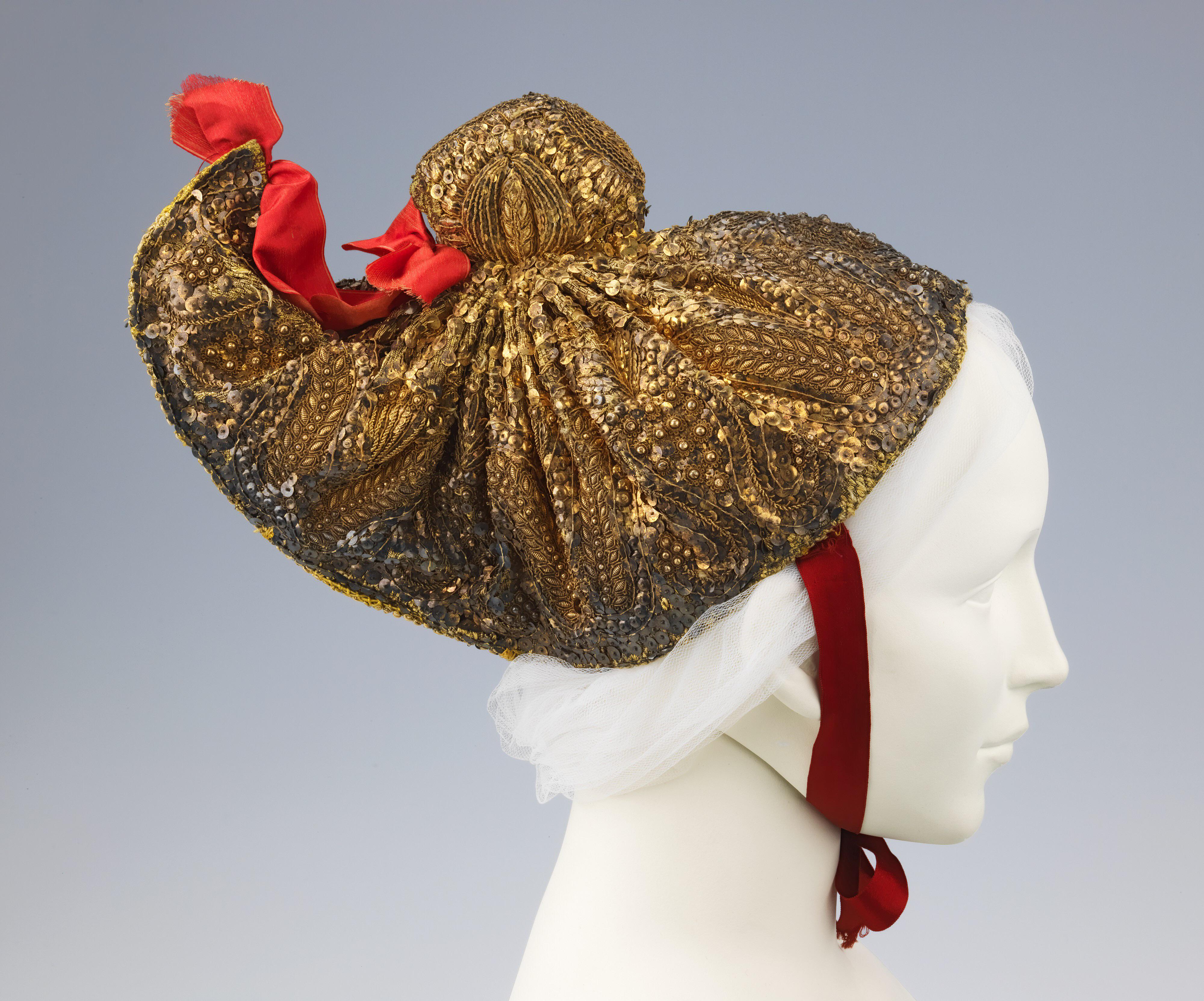
“This is a very good example of the type of headdress particular to the area around the city of Linz in Upper Austria called a ‘Golden Hood’ or ‘Goldhaube’ variations of which women have worn since the 13th Century on holy days and feast days. An internal wire frame is covered with woven gilded metallic threads on which sparkling sequins and spangles mark out elaborate foliate patterns.
This particular form, with its distinctive pommel and swooping peak at the back– perhaps initially inspired by Turkish fashions– is associated with the first half of the nineteenth century. Given the cultural significance of such Linzer Goldhauben, their making and wearing is on the UNESCO Intangible Cultural Heritage list.” [The MET](https://www.metmuseum.org/art/collection/search/156873)

2 Comments
“This is a very good example of the type of headdress particular to the area around the city of Linz in Upper Austria called a ‘Golden Hood’ or ‘Goldhaube’ variations of which women have worn since the 13th Century on holy days and feast days. An internal wire frame is covered with woven gilded metallic threads on which sparkling sequins and spangles mark out elaborate foliate patterns.
This particular form, with its distinctive pommel and swooping peak at the back– perhaps initially inspired by Turkish fashions– is associated with the first half of the nineteenth century. Given the cultural significance of such Linzer Goldhauben, their making and wearing is on the UNESCO Intangible Cultural Heritage list.” [The MET](https://www.metmuseum.org/art/collection/search/156873)
It reminds me a bit of the Phrygian cap