The Battle of Stalingrad proved to be one of the worst (perhaps the worst) battles of World War II. Soldiers lived in fear daily, witnessed horrific sights, and made questionable moral decisions even against their own people. And among the greatest enemies were hunger and frost. This enemy attacked the Germans most fiercely and demonstrated what a man pushed to the limit is capable of doing to survive.
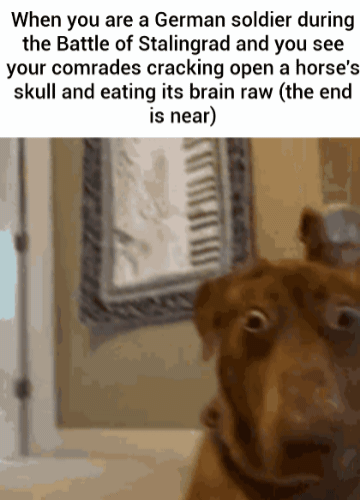
These are the words of Wehrmacht General (and later Field Marshal) Friedrich Paulus: “The last horses have been eaten. Can you imagine this: soldiers throwing themselves at an old horse carcass, smashing its skull, and devouring its brain raw? (…) What can I, as an army commander, respond when a soldier approaches me and begs: ‘Mr. Colonel General, a slice of bread?’ (…)”
Quotes from soldiers:
“In those final days of the disaster, daily food rations no longer exceeded 3.5 decagrams of bread, 5 decagrams of canned meat, and 1.5 decagrams of wheat grains for soup. The water for the soup was melted from snow contaminated with shrapnel and debris, which had to be collected on tent sheets.”
“Upon returning to the bunker, I found a peculiar scene. My bread bag was lying on the table and being emptied by one of the Romanian soldiers, an ally, a Soviet soldier we had captured, and my orderly. When I saw these three quietly chewing my bread, and the Russian still had a gun (!), I burst out laughing, and the four of us devoured the remains of the food from my bread bag. This little episode proves that hunger and cold were sometimes worse than the enemy!”
“Fifteen of us huddled in a bunker, a hole in the ground the size of a kitchen […], each with all his belongings. You can imagine the terrible cramped conditions. Now, another picture. One is washing (if there’s water), another is delousing, a third is eating, a fourth is frying something, another is sleeping, etc. This is what our environment looks like.”
“It’s hard to imagine more inhumane conditions! Soldiers were collapsing en masse from exhaustion. They wanted to help, but there was no way. Everywhere, the wounded lay in the snow, moaning in pain. And on top of that, the merciless frost and lack of shelter, the lack of bandages and medicine, the overcrowded dressing stations, and on top of that, hunger…”
“In the camps, wounded lay on multi-tiered beds, unable to move on their own. Urine, feces, pus, and blood dripped from the upper floors onto those lying below, who no longer knew where they were or what was happening around them. […] The stench was unbearable from the completely frostbitten body parts; bones were sticking out on their legs and arms. Soldiers were even seen, frantic with pain, biting off pieces of their own flesh.”
“Anyone who was sick or wounded had little chance of survival in the cauldron. Therefore, every wounded man, if he could move, tried at all costs, even by force, to get a seat on a plane. Scenes of horror unfolded at the airport.”
“A group of silent and resigned wounded crowded around the steps of our plane. Two months ago, still from Pitomnik Airport, we were initially allowed to take only six wounded, according to a thoughtless order. In reality, we disregarded this absurd order and usually took nine. […] I was aware that I was only saving the life of whomever I pointed. This is a cruel power!”
It’s worth noting that approximately 25,000 soldiers were rescued by air, and not one of the 600 front-line doctors left their posts until the end of the battle.
“We were aware of our decline! Perhaps that’s why officers and privates, accustomed to discipline, committed such acts without orders, acts that are not and will never be mentioned in any report. […] It was a time of desperate escapes into the endless, snow-covered steppes of Russia, a time of the most incredible rumors and ideas. Many, for example, believed […] that radio stations would be dropped, using which groups of up to 30 soldiers could call in planes. But no radio station was dropped […] I couldn’t help but recall the sight of a slaughtered chicken: it had already lost its head, but it still flapped its wings and moved its legs as if it could still change its fate […] And it was similar with the remnants of our troops. Convulsive, involuntary movements foreshadowed imminent death.”
“Since we had no airfield at our disposal for a week, the Ju-52s only flew in at night. A cleared area marked with red lights was designated in Red Square in Stalingrad, and the planes dropped supply packages and parachute containers into this illuminated square in a slashing flight. Naturally, many of them fell nearby. Occasionally, and this was met with outrage, these dropped supply packages contained toilet paper and condoms!”
“On the evening of January 30, I went with Sergeant Stiller to the communications bunker, where there was still a radio. Hermann Goring’s speech was being broadcast […] He said: ‘The battle for Stalingrad is coming to an end. The 6th Army fought heroically to the last soldier and to the last bullet […]’. At that moment, someone threw a shoe at the receiver and the voice fell silent. A soldier’s voice was heard: ‘These pigs think we’re already dead, and we, 100,000 soldiers, are still sitting here, hoping for rescue!’
At some point, Paulus was promoted to field marshal, and Hitler made it clear: since 1871, no Field Marshal had been captured, and if he wanted to avoid disgrace, he had to kill himself or fight to the end and not surrender. Finally, something changed in Paulus. He looked at his Führer with adoration and loyalty, but the situation in Stalingrad was beyond any limits. Instead of shooting himself, Paulus was escorted by the Soviets to sign the act of surrender.
Over 90,000 Axis soldiers were captured by the Soviets, half of whom would die within a few months due to lack of food and medicine. The number of prisoners surprised the Soviets, who had no rations for the enemy. Around 500,000 Axis soldiers died or were captured in the battle (the Soviet army had twice that number).
Information from the BBC was already reaching the German population. News of defeat stirred thoughts that the war was already lost. The Reich authorities even tried to transform the 6th Army into martyrs, and Propaganda Minister Joseph Goebbels spoke at the Sports Palace, asking, “Do you want total war?” The audience responded, “Yes!” Although, as it later turned out, the audience was carefully selected, composed of the most ardent Nazis.
DrHolmes52 on
I read of the airport scenes (damn, I wish I could remember the book) before. Disturbing stuff.
ColonialBarbarian on
I think the only other modern battle that might come close in terms of brutality and scale is Verdun.
KAMEKAZE_VIKINGS on
Mfw you surrender after 3 weeks eating bugs and leaves and your American captors just casually hands you Ice cream on Chocolate cake because it’s their captain’s birthday:
Middcore on
“Without causing undue alarm, would you say it’s time for the men to begin cracking open the skulls of pack animals and feasting on the goo inside?”
“Yes I would, *kamerad*.”
Iron_Cavalry on
For anyone interested, Beevor’s book on the subject is one of the best reads. Just utter madness on the ground.
Soviet troops would have to cross the icy Volga under artillery fire and disembark onto riverbanks full of thousands of unevacuated wounded men screaming into the wind, dead fish, and Katyushas driving from hidden positions and firing.
Or Red Army sappers charging Panzers with explosives. Or Panzers breaking down factory walls and the Soviet workers inside immediately throwing down with rifles and grenades.
Or German hospitals hacking off limbs without anesthetic because their supplies were shot.
Or Siberians patrolling the streets at night with daggers and pistols to capture Germans for NKVD interrogations.
SparklingSofia on
Nothing says ‘Master Race’ like being outmaneuvered by the Russian winter and a complete lack of soup.
liberalhellhole on
We started a war, killed and raped millions, pillaged and stole like there’s no tomorrow but we lost.
Please feel bad for us.
Calm-Street-7513 on
Its insane how by late 1941 the German “invincibility” Had been broken to a point where soldiers were cussing the shit out of Goering and the administration themselves for already making them martyrs when they were literally alive and waiting for evacuation
TraditionalClub6337 on
This meme traumatized me
Lilfozzy on
Fun fact, my “insert nationality here” grandpa knew the war was over as soon as they saw the “insert nationality here” rations were full of “remark on ration size”.
PianistNegative8758 on
Also POV : You’re a german soldier at battle of stalingrad and you hear at the radio the heads of the nazi party chanting an “funerary oration for the brave soldiers at stalingrad” before any retreat order.

12 Comments
The Battle of Stalingrad proved to be one of the worst (perhaps the worst) battles of World War II. Soldiers lived in fear daily, witnessed horrific sights, and made questionable moral decisions even against their own people. And among the greatest enemies were hunger and frost. This enemy attacked the Germans most fiercely and demonstrated what a man pushed to the limit is capable of doing to survive.
These are the words of Wehrmacht General (and later Field Marshal) Friedrich Paulus: “The last horses have been eaten. Can you imagine this: soldiers throwing themselves at an old horse carcass, smashing its skull, and devouring its brain raw? (…) What can I, as an army commander, respond when a soldier approaches me and begs: ‘Mr. Colonel General, a slice of bread?’ (…)”
Quotes from soldiers:
“In those final days of the disaster, daily food rations no longer exceeded 3.5 decagrams of bread, 5 decagrams of canned meat, and 1.5 decagrams of wheat grains for soup. The water for the soup was melted from snow contaminated with shrapnel and debris, which had to be collected on tent sheets.”
“Upon returning to the bunker, I found a peculiar scene. My bread bag was lying on the table and being emptied by one of the Romanian soldiers, an ally, a Soviet soldier we had captured, and my orderly. When I saw these three quietly chewing my bread, and the Russian still had a gun (!), I burst out laughing, and the four of us devoured the remains of the food from my bread bag. This little episode proves that hunger and cold were sometimes worse than the enemy!”
“Fifteen of us huddled in a bunker, a hole in the ground the size of a kitchen […], each with all his belongings. You can imagine the terrible cramped conditions. Now, another picture. One is washing (if there’s water), another is delousing, a third is eating, a fourth is frying something, another is sleeping, etc. This is what our environment looks like.”
“It’s hard to imagine more inhumane conditions! Soldiers were collapsing en masse from exhaustion. They wanted to help, but there was no way. Everywhere, the wounded lay in the snow, moaning in pain. And on top of that, the merciless frost and lack of shelter, the lack of bandages and medicine, the overcrowded dressing stations, and on top of that, hunger…”
“In the camps, wounded lay on multi-tiered beds, unable to move on their own. Urine, feces, pus, and blood dripped from the upper floors onto those lying below, who no longer knew where they were or what was happening around them. […] The stench was unbearable from the completely frostbitten body parts; bones were sticking out on their legs and arms. Soldiers were even seen, frantic with pain, biting off pieces of their own flesh.”
“Anyone who was sick or wounded had little chance of survival in the cauldron. Therefore, every wounded man, if he could move, tried at all costs, even by force, to get a seat on a plane. Scenes of horror unfolded at the airport.”
“A group of silent and resigned wounded crowded around the steps of our plane. Two months ago, still from Pitomnik Airport, we were initially allowed to take only six wounded, according to a thoughtless order. In reality, we disregarded this absurd order and usually took nine. […] I was aware that I was only saving the life of whomever I pointed. This is a cruel power!”
It’s worth noting that approximately 25,000 soldiers were rescued by air, and not one of the 600 front-line doctors left their posts until the end of the battle.
“We were aware of our decline! Perhaps that’s why officers and privates, accustomed to discipline, committed such acts without orders, acts that are not and will never be mentioned in any report. […] It was a time of desperate escapes into the endless, snow-covered steppes of Russia, a time of the most incredible rumors and ideas. Many, for example, believed […] that radio stations would be dropped, using which groups of up to 30 soldiers could call in planes. But no radio station was dropped […] I couldn’t help but recall the sight of a slaughtered chicken: it had already lost its head, but it still flapped its wings and moved its legs as if it could still change its fate […] And it was similar with the remnants of our troops. Convulsive, involuntary movements foreshadowed imminent death.”
“Since we had no airfield at our disposal for a week, the Ju-52s only flew in at night. A cleared area marked with red lights was designated in Red Square in Stalingrad, and the planes dropped supply packages and parachute containers into this illuminated square in a slashing flight. Naturally, many of them fell nearby. Occasionally, and this was met with outrage, these dropped supply packages contained toilet paper and condoms!”
“On the evening of January 30, I went with Sergeant Stiller to the communications bunker, where there was still a radio. Hermann Goring’s speech was being broadcast […] He said: ‘The battle for Stalingrad is coming to an end. The 6th Army fought heroically to the last soldier and to the last bullet […]’. At that moment, someone threw a shoe at the receiver and the voice fell silent. A soldier’s voice was heard: ‘These pigs think we’re already dead, and we, 100,000 soldiers, are still sitting here, hoping for rescue!’
At some point, Paulus was promoted to field marshal, and Hitler made it clear: since 1871, no Field Marshal had been captured, and if he wanted to avoid disgrace, he had to kill himself or fight to the end and not surrender. Finally, something changed in Paulus. He looked at his Führer with adoration and loyalty, but the situation in Stalingrad was beyond any limits. Instead of shooting himself, Paulus was escorted by the Soviets to sign the act of surrender.
Over 90,000 Axis soldiers were captured by the Soviets, half of whom would die within a few months due to lack of food and medicine. The number of prisoners surprised the Soviets, who had no rations for the enemy. Around 500,000 Axis soldiers died or were captured in the battle (the Soviet army had twice that number).
Information from the BBC was already reaching the German population. News of defeat stirred thoughts that the war was already lost. The Reich authorities even tried to transform the 6th Army into martyrs, and Propaganda Minister Joseph Goebbels spoke at the Sports Palace, asking, “Do you want total war?” The audience responded, “Yes!” Although, as it later turned out, the audience was carefully selected, composed of the most ardent Nazis.
I read of the airport scenes (damn, I wish I could remember the book) before. Disturbing stuff.
I think the only other modern battle that might come close in terms of brutality and scale is Verdun.
Mfw you surrender after 3 weeks eating bugs and leaves and your American captors just casually hands you Ice cream on Chocolate cake because it’s their captain’s birthday:
“Without causing undue alarm, would you say it’s time for the men to begin cracking open the skulls of pack animals and feasting on the goo inside?”
“Yes I would, *kamerad*.”
For anyone interested, Beevor’s book on the subject is one of the best reads. Just utter madness on the ground.
Soviet troops would have to cross the icy Volga under artillery fire and disembark onto riverbanks full of thousands of unevacuated wounded men screaming into the wind, dead fish, and Katyushas driving from hidden positions and firing.
Or Red Army sappers charging Panzers with explosives. Or Panzers breaking down factory walls and the Soviet workers inside immediately throwing down with rifles and grenades.
Or German hospitals hacking off limbs without anesthetic because their supplies were shot.
Or Siberians patrolling the streets at night with daggers and pistols to capture Germans for NKVD interrogations.
Nothing says ‘Master Race’ like being outmaneuvered by the Russian winter and a complete lack of soup.
We started a war, killed and raped millions, pillaged and stole like there’s no tomorrow but we lost.
Please feel bad for us.
Its insane how by late 1941 the German “invincibility” Had been broken to a point where soldiers were cussing the shit out of Goering and the administration themselves for already making them martyrs when they were literally alive and waiting for evacuation
This meme traumatized me
Fun fact, my “insert nationality here” grandpa knew the war was over as soon as they saw the “insert nationality here” rations were full of “remark on ration size”.
Also POV : You’re a german soldier at battle of stalingrad and you hear at the radio the heads of the nazi party chanting an “funerary oration for the brave soldiers at stalingrad” before any retreat order.