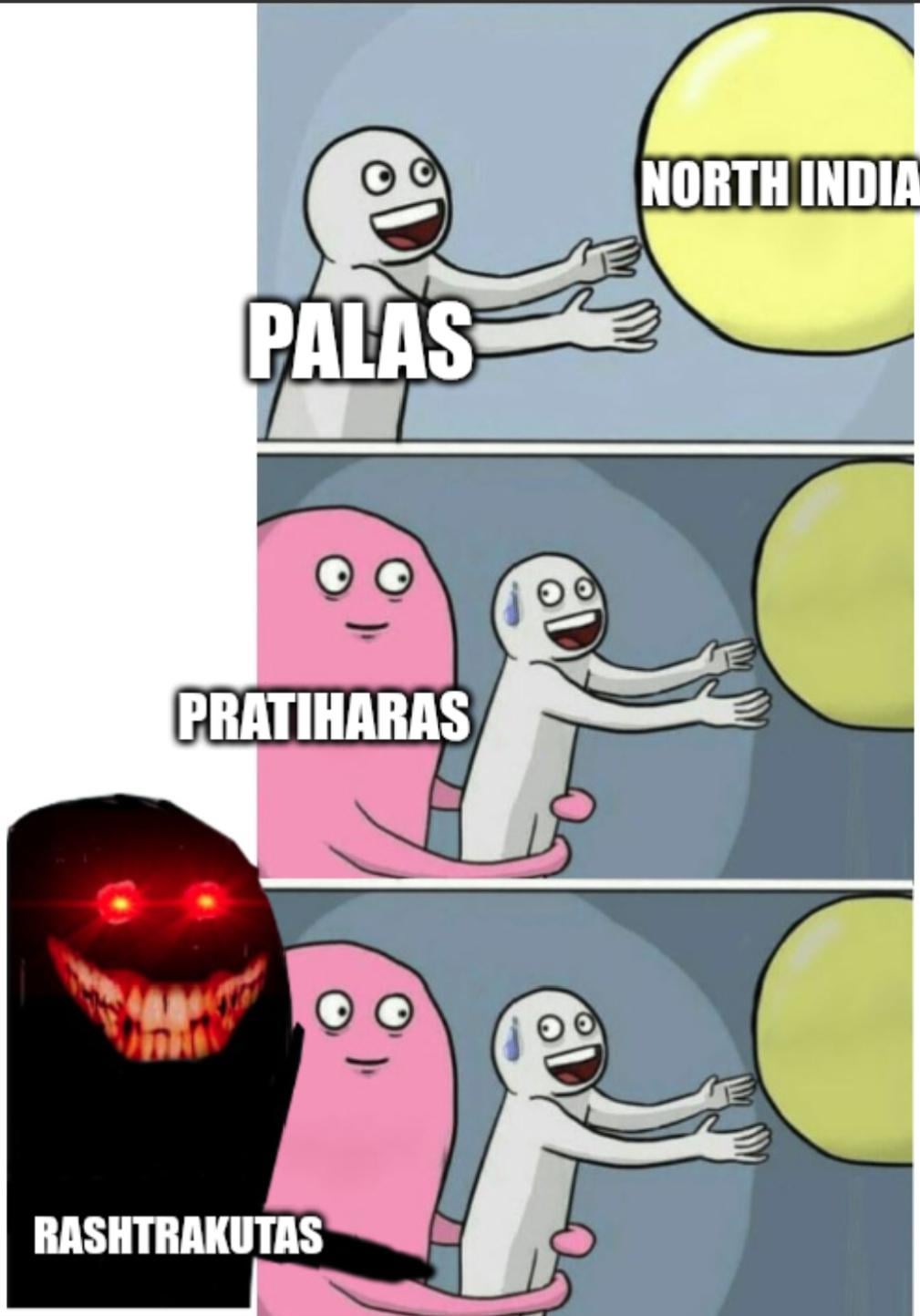
The Tripartite Struggle was a three-way contest for control over Kannauj, the most prestigious political center in northern India. The Palas of Bengal and the Pratiharas of western and northern India were locked in a continuous back-and-forth struggle, each trying to assert dominance over the region but never fully securing it for long.
What made this struggle particularly striking was the repeated intervention of the Rashtrakutas from Karnataka. Launching powerful northern expeditions, they would march deep into the heart of the conflict, defeat the dominant northern power of the moment, and take control of Kannauj. Though they did not always hold it permanently, these decisive incursions repeatedly disrupted the balance, demonstrating their military reach and turning the contest into a true three-sided struggle rather than just a regional rivalry.
SatynMalanaphy on
What? The Rashtrakutas didn’t particularly care about north Indian territory per se; invading and holding Kannauj for the symbolic value was the main goal. Their main rivals were closer to home. In South Asian history, the natural zones tended to limit the realistic possibilities of governing more than one or two zones beyond the home turf.

2 Comments
Context:
The Tripartite Struggle was a three-way contest for control over Kannauj, the most prestigious political center in northern India. The Palas of Bengal and the Pratiharas of western and northern India were locked in a continuous back-and-forth struggle, each trying to assert dominance over the region but never fully securing it for long.
What made this struggle particularly striking was the repeated intervention of the Rashtrakutas from Karnataka. Launching powerful northern expeditions, they would march deep into the heart of the conflict, defeat the dominant northern power of the moment, and take control of Kannauj. Though they did not always hold it permanently, these decisive incursions repeatedly disrupted the balance, demonstrating their military reach and turning the contest into a true three-sided struggle rather than just a regional rivalry.
What? The Rashtrakutas didn’t particularly care about north Indian territory per se; invading and holding Kannauj for the symbolic value was the main goal. Their main rivals were closer to home. In South Asian history, the natural zones tended to limit the realistic possibilities of governing more than one or two zones beyond the home turf.