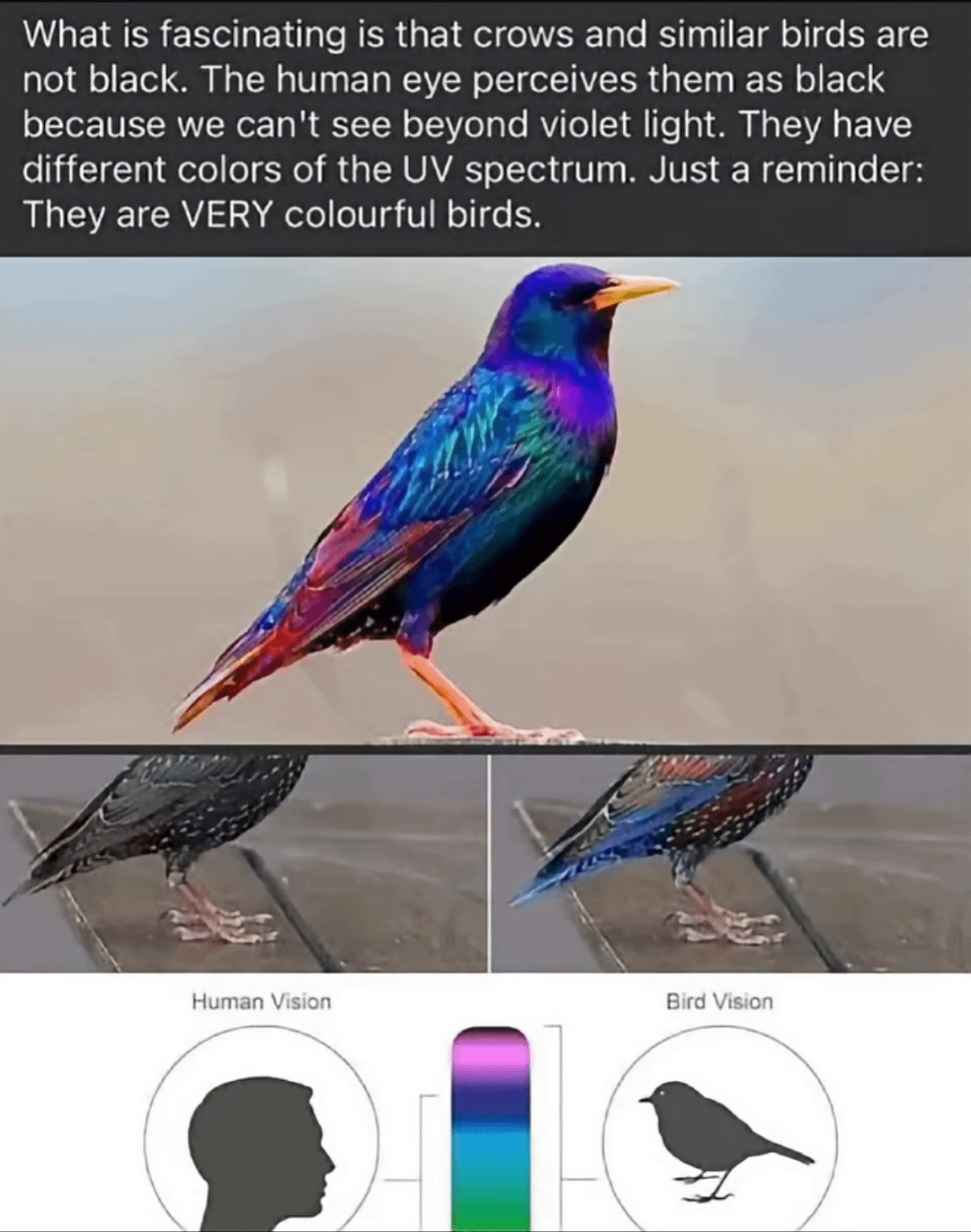
The bird on the bottom looks like a European starling more than crow. Starling are already somewhat colorful. Not saying that crows aren’t colorful in UV, but it feels a bit misleading if those are starling
MsStormyTrump on
Well, from today, I’m choosing to see them colorfully!
joelfarris on
Turns out Eric Draven really was robbed of everything, and we had no idea.
ceebeefour on
It’s like a fairy tale curse, to be so beautiful but no one can see or appreciate it.
billboardsingerbts on
I don’t believe this at all! My eyes are capable of seeing the TRUTH!
RocketCat921 on
You can see small glimpses of these colors on the birds if the sun is shining just right.
I’ve always explained it as looking like an oil sheen
ParmesanSkis on
Is my black cat a rainbow cat?
Cicer on
Talks about crows. Shows a starling.
holytriplem on
How would Claude Monet have seen them?
Spacegirl-Alyxia on
Is this actually true? I mean so much color variation? I can imagine them having more vibrant spots here and there in UV as if a bird was mostly dark cyan (but dark gray for any species that has only green and blue vision) but with bright red spots all over, yknow? And for them it would be in spots all over? Or do they actually see so much color variation? If so, How?
decomposition_ on
A WiFi router actually isn’t a monochrome box! If you were able to see in the wavelength it emits, it would look like manmade horrors beyond our comprehension
CombinationNo4926 on
So now it’s my fault i can’t see in uv spectrum
RoninRunePriest on
Reminds me of how timelessly truthful the words of Obi-wan Kenobi always will be. “What I told you was true, from a certain point of view.”
I love stuff like this.
Pain_Monster on
What’s fascinating about this is that the crows’ color is actually magnetic and color-shifts based on what kind of a diet is has. If a crow eats more iron-rich foods, it can change to a highly magnetized reddish color under UV light filters and can actually sustain the weight of a paper clip on its feathers as a result of the magnetic force. If you want to try this for yourself, just grab a bunch of paperclips and shove them directly up my ass, which is where I pulled this fact from.
Havsham on
Hella cool, but isn’t it the same with practically everything in the universe? Be it animals or things, I’m pretty sure everything gives off outside-of-the-human-visible-spectrum light.
possibly_oblivious on
What do we look like to birds tho

Arkaium on
They look like my favorite pog slammer from grade school
BootsOfProwess on
Two of those pictures are a starling.
Rayces on
This just in: humans still suck ass at basically everything. More at 11!
Striking-water-ant on
The Emperor’s new clothes – here we go again…
BackPsychological705 on
Get out!!!!
Clone_Gear on
Imagine thats how they see each other but whenever they see themselves in human-made camera photos, they’re a different color – all black!
RhetoricalOrator on
Do people not notice that crows are covered in rainbows? I’ve never questioned that this was what everyone else sees, too. Yes. They are black, but they are also very clearly rainbow colored.
polar_souls on
Rainbow chicken get
zeus-fox on
Sometimes less is more
whiskey_the_spider on
I need someone to debunk this asap
ResplendentShade on
So.. several issues here. First this isn’t a crow, it’s a European Starling, which is already iridescent on the visible light spectrum.
Second, the saturated colors in the top image aren’t what birds see in UV. It’s artistic embellishment.. they’re a digitally enhanced/heavily post-processed image with the saturation cranked way up. There’s no camera that can show you “bird UV vision” by taking a photo, you’d need a UV-sensitive spectrometer and even then you’d have to map those wavelengths onto colors that humans can see, which is an inherently artificial translation.
Third, the core claim that crows are secretly very colorful in UV and we just can’t see it: as far as we know crows specifically lack UV-reflective patches.
The kernel of truth is that many bird species DO have UV-reflective plumage patches that aren’t visible to humans. But crows are specifically one of the exceptions. So it’s a case where the interesting fact is real but got attached to the wrong animal because “black bird is secretly rainbow” is a compelling narrative.
But there are some really neat things about avian UV patches and biological uses for avian UV vision. Like distinguishing individuals: you have two siblings in a nest that look identical to humans, but their UV patches look very different. There’s age signals, as these patches change with age. There’s egg recognition, in which they use UV to evaluate eggs in the nest and detect brood parasites like cuckoos. Even with hunting and foraging: kestrels can see UV-reflecting urine trails left by rodents to help locating them, and many fruit loving birds use it to spot reflectance on waxy coating on fruits in dense foliage.
Another interesting tidbit is that crows and most raptors are not actually very sensitive to UV light. So a lot of the birds who raptors prey on have UV patches that are highly conspicuous to each other, but don’t make them stand out to predators. Bit of a private communication line.
Salmonman4 on
But since we can’t see the colors, how can we even perceive what the colors are like? This thought was brought to you by Discworld octarine

29 Comments
In bird culture this is considered a sick look
The bird on the bottom looks like a European starling more than crow. Starling are already somewhat colorful. Not saying that crows aren’t colorful in UV, but it feels a bit misleading if those are starling
Well, from today, I’m choosing to see them colorfully!
Turns out Eric Draven really was robbed of everything, and we had no idea.
It’s like a fairy tale curse, to be so beautiful but no one can see or appreciate it.
I don’t believe this at all! My eyes are capable of seeing the TRUTH!
You can see small glimpses of these colors on the birds if the sun is shining just right.
I’ve always explained it as looking like an oil sheen
Is my black cat a rainbow cat?
Talks about crows. Shows a starling.
How would Claude Monet have seen them?
Is this actually true? I mean so much color variation? I can imagine them having more vibrant spots here and there in UV as if a bird was mostly dark cyan (but dark gray for any species that has only green and blue vision) but with bright red spots all over, yknow? And for them it would be in spots all over? Or do they actually see so much color variation? If so, How?
A WiFi router actually isn’t a monochrome box! If you were able to see in the wavelength it emits, it would look like manmade horrors beyond our comprehension
So now it’s my fault i can’t see in uv spectrum
Reminds me of how timelessly truthful the words of Obi-wan Kenobi always will be. “What I told you was true, from a certain point of view.”
I love stuff like this.
What’s fascinating about this is that the crows’ color is actually magnetic and color-shifts based on what kind of a diet is has. If a crow eats more iron-rich foods, it can change to a highly magnetized reddish color under UV light filters and can actually sustain the weight of a paper clip on its feathers as a result of the magnetic force. If you want to try this for yourself, just grab a bunch of paperclips and shove them directly up my ass, which is where I pulled this fact from.
Hella cool, but isn’t it the same with practically everything in the universe? Be it animals or things, I’m pretty sure everything gives off outside-of-the-human-visible-spectrum light.
What do we look like to birds tho

They look like my favorite pog slammer from grade school
Two of those pictures are a starling.
This just in: humans still suck ass at basically everything. More at 11!
The Emperor’s new clothes – here we go again…
Get out!!!!
Imagine thats how they see each other but whenever they see themselves in human-made camera photos, they’re a different color – all black!
Do people not notice that crows are covered in rainbows? I’ve never questioned that this was what everyone else sees, too. Yes. They are black, but they are also very clearly rainbow colored.
Rainbow chicken get
Sometimes less is more
I need someone to debunk this asap
So.. several issues here. First this isn’t a crow, it’s a European Starling, which is already iridescent on the visible light spectrum.
Second, the saturated colors in the top image aren’t what birds see in UV. It’s artistic embellishment.. they’re a digitally enhanced/heavily post-processed image with the saturation cranked way up. There’s no camera that can show you “bird UV vision” by taking a photo, you’d need a UV-sensitive spectrometer and even then you’d have to map those wavelengths onto colors that humans can see, which is an inherently artificial translation.
Third, the core claim that crows are secretly very colorful in UV and we just can’t see it: as far as we know crows specifically lack UV-reflective patches.
The kernel of truth is that many bird species DO have UV-reflective plumage patches that aren’t visible to humans. But crows are specifically one of the exceptions. So it’s a case where the interesting fact is real but got attached to the wrong animal because “black bird is secretly rainbow” is a compelling narrative.
But there are some really neat things about avian UV patches and biological uses for avian UV vision. Like distinguishing individuals: you have two siblings in a nest that look identical to humans, but their UV patches look very different. There’s age signals, as these patches change with age. There’s egg recognition, in which they use UV to evaluate eggs in the nest and detect brood parasites like cuckoos. Even with hunting and foraging: kestrels can see UV-reflecting urine trails left by rodents to help locating them, and many fruit loving birds use it to spot reflectance on waxy coating on fruits in dense foliage.
Another interesting tidbit is that crows and most raptors are not actually very sensitive to UV light. So a lot of the birds who raptors prey on have UV patches that are highly conspicuous to each other, but don’t make them stand out to predators. Bit of a private communication line.
But since we can’t see the colors, how can we even perceive what the colors are like? This thought was brought to you by Discworld octarine