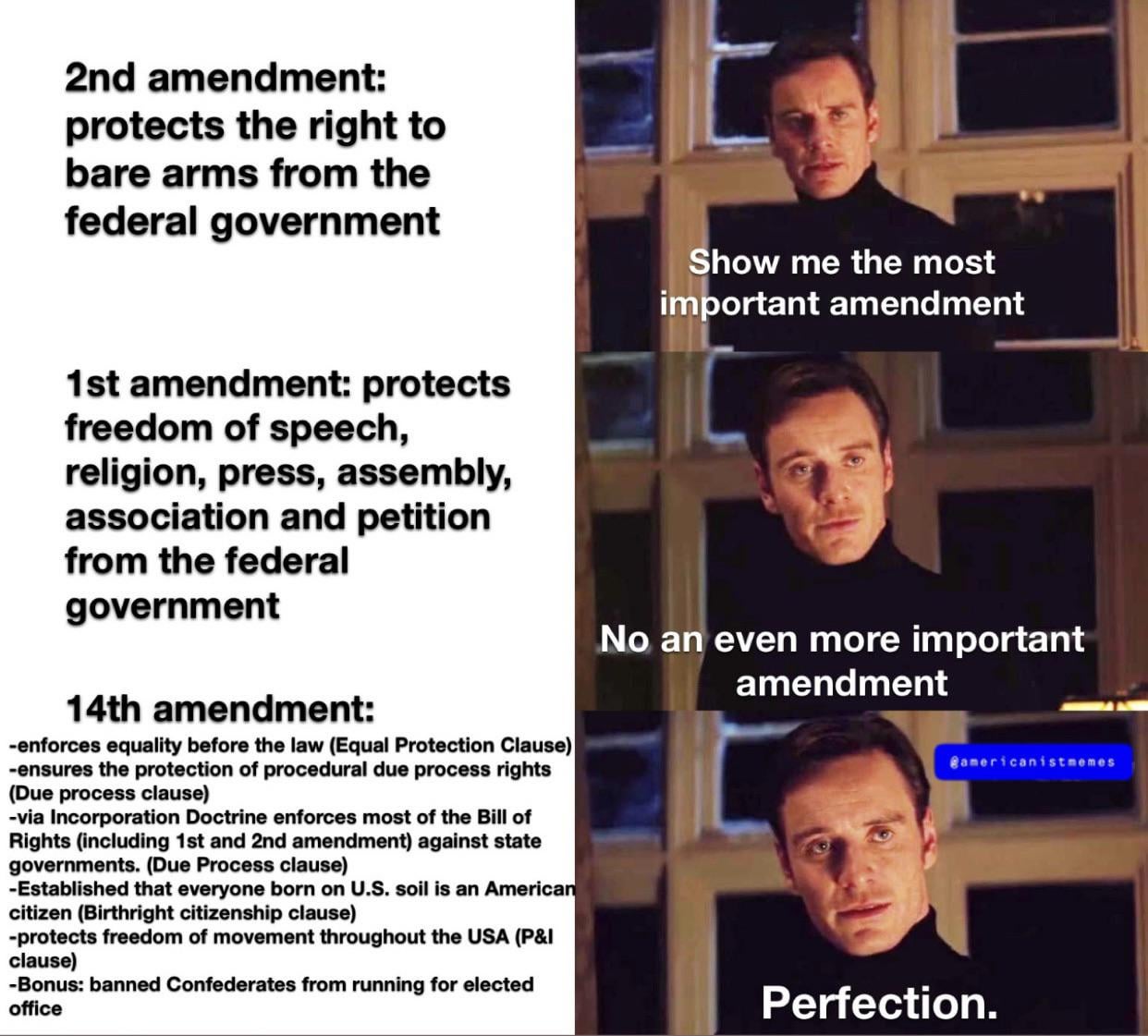
Equity under the law. Not like such abuses still don’t happen.
Procedural not like fat cats get off all the time and government overreach still happens.
We needed the Indian Citizenship Act of 1924 to actually make Native Americans citizens. And this was during the time they lived on American soil, not when they were living on Sovereign States.
The Amnesty act of 1872 overturned the Confederate ban.
PM_ME_DIRTY_DANGLES on
2nd amendment protects the right to bear arms. The “Sun’s out, Guns out” clause of the tenth amendment protects the right to bare arms.
[deleted] on
[removed]
HelpfulPug on
Nah man, the 1st, 2nd, and 13th are the most important amendments bar none, they are the foundation of a function Republic, without them it is not a Republic.
Everything else is a matter of philosophy or preference (many of them are my preference), but those three are so important that they would be better suited as the first three articles of the constitution. The abolition of the practice of slavery by *any name* (yeah I know, I know), the freedom to call slavery out, and the means to do something about it.
DrHolmes52 on
Three groups you never want to gather together in large numbers:
1. People all too willing to discuss the Constitution.
2. Economists.
3. Relay protection engineers.
An argument is sure to start.
(I know there are more)
MechanicOk2445 on
2nd amendment is under appreciated for about half the country. Those dumbasses
generation_fish on
14th is worthless if you’re all equally oppressed.
MattisaCat1918 on
I literally had a whole class on this amendment in college
Bad_Idea_Hat on
Whew, that 14th Amendment Section 3 could be a problem for some people.
Distryer on
It really is a great amendment too bad its incorporation clause is selectively enforced.
whistleridge on
Alternately: all that is just later-day bullshit, to hide the fact that the Second solely existed to allow the north to maintain militias, and slave owners in the South to be able to suppress slave rebellions.
The Second Amendment reads in full thus:
> A well regulated Militia, being necessary to the security of a free State, the right of the people to keep and bear Arms, shall not be infringed.
As written, the sentence cites the necessity of a well regulated militia as the basis for the right to keep and bear arms not being infringed. So the key word is ‘militia’. This is supported analysis of the documentation of the period:
> Nowhere in the debate [about ratification] is there the slightest hint about a private or individual right to own a weapon. This should not surprise us, for as one of the leading military historians of the period notes, in all the discussion and debates” over the Second Amendment, “from the Revolution to the eve of the Civil War, there is precious little evidence that advocates of local control of the militia showed an equal or even a secondary concern for gun ownership as a personal right. ” The records of the state courts and legislatures for this period reflect this conclusion, as numerous courts accepted the notion that to “bear arms” was a term solely connected to the militia and the military. As the Tennessee Supreme Court noted in 1840, reflecting years of experience in the American colonies and states, “the object, then, for which the right of keeping and bearing arms is secured is the defence of the public. ” The term “bear arms” had a “reference to their military use.
The court further noted that
> A man in the pursuit of deer, elk, and buffaloes might carry his rifle every day for forty years, and yet it would never be said of him that he had borne arms; much less could it be said that a private citizen bears arms because he has a dirk or pistol concealed under his clothes, or a spear in a cane.
> Despite the failure of the House to explore the meaning of the term “bear arms,” this first draft does give us an important insight into the meaning of the term to “bear arms.” Some modern commentators try to separate this term from the first clause of the Second Amendment-“A well regulated Militia, being necessary to the security of a free States”-and argue for an independent federal right to carry (bear) guns. But, the text of the initial draft shows that this is not what the term “bear arms” meant at the time. Rather, **the term can only have meaning if it is connected to militia service**. [emphasis added] (Paul Finkelman, “A Well Regulated Militia”: The Second Amendment in Historical Perspective”, https://scholarship.kentlaw.iit.edu/cgi/viewcontent.cgi?article=3291&context=cklawreview&httpsredir=1)
In the modern context, the term “militia” evokes images of a sort of National Guard – an ad hoc assemblage of citizen-soldiers, who band together from patriotism to protect the republic from invaders.
But that’s not all the word meant in the 18th century. At the time the Bill of Rights was written – and, importantly, at the time that Southern and Northern states were deal-making to get the constitution passed – ‘militia’ had a second, very different and far more sinister meaning:
> Slavery was not only an economic and industrial system,” one scholar noted, “but more than that, it was a gigantic police system.” Over time the South had developed an elaborate system of slave control. The basic instrument of control was the slave patrol, armed groups of white men who made regular rounds. The patrols made sure that blacks were not wandering where they did not belong, gathering in groups, or engaging in other suspicious activity.
> Equally important, however, was the demonstration of constant vigilance and armed force. The basic strategy was to ensure and impress upon the slaves that whites were armed, watchful, and ready to respond to insurrectionist activity at all times. The state required white men and female plantation owners to participate in the patrols and to provide their own arms and equipment, although the rich were permitted to send white servants in their place. Virginia, South Carolina, and Georgia all had regulated slave patrols. By the mid-eighteenth century, the patrols had become the responsibility of the militia. Georgia statutes enacted in 1755 and 1757, for example, carefully divided militia districts into discrete patrol areas and specified when patrols would muster. The Georgia statutes required patrols, under the direction of commissioned militia officers, to examine every plantation each month and authorized them to search “all Negro Houses for offensive Weapons and Ammunition” and to apprehend and give twenty lashes to any slave found outside plantation grounds.
> In the South, therefore, the patrols and the militia were largely synonymous. The Stono Rebellion had been quickly suppressed because the white men worshiping at the Wiltown Presbyterian church on that Sunday morning had, as required by law, gone to church armed. Some of the accounts of Stono refer to the body of white men who attacked the black insurrectionists as the “militia” while others refer to them as “planters.” This is a distinction without a difference; the two groups were one and the same. Virtually all able-bodied white men were part of the militia, which primarily meant that they had slave control duties under the direction and discipline of the local militia officers.
> The militia was the first and last protection from the omnipresent threat of slave insurrection or vengeance. The War for Independence had placed the South in a precarious position: sending the militia to the war against the British would leave Southern communities vulnerable to slave insurrection. The Southern states, therefore, often refused to commit their militia to the Revolution, reserving them instead for slave control. (Carl Bogus, “The Hidden History of the Second Amendment”, https://lawreview.law.ucdavis.edu/issues/31/2/Articles/DavisVol31No2_Bogus.pdf)
So: the Second may not solely be about militia service, and it may not have been about racism in the modern meaning of the word, but it absolutely had a major component that was about militia service, and was at least in part specifically about the preservation of slavery. And there’s no point in pretending otherwise.
TheMainEffort on
Erm ackshually the 14th amendment has a privileges or immunities clause, P&I is in article IV.
Also, SDP would be way cooler if we could agree on what it means.
GB_Alph4 on
The amendment that made America truly American. We all get the same rights and protections and have a shot at the world.
OnCallPartisan on
Thaddeus Stevens is underrated in American history.
mylsotol on
Stop telling people about it before the Republicans srart trying to repeal it. They will never know it exists if you don’t tell them
0masterdebater0 on
I’m not a constitutional scholar so I could be wrong, but from my reading of the 14th amendment it could be stronger if it guaranteed voting rights instead of just punishing states that disenfranchise people with fewer representatives (something which doesn’t seem to actually happen)
Lews-Therin-Telamon on
The 14th Amendment isn’t underrated by anyone who knows anything about American Constitutional law. It is (one of) the most litigated Amendments, and aspects of the Constitution in general. The First wouldn’t even apply to the States if it wasn’t for the Fourteenth, neither would some other Amendments.
qchisq on
9th amendment is more underrated. “There’s a bunch of rights people obviously are entitled to. We couldn’t be bothered to write down them all, but you’ll know them when you see them”
SomeNotTakenName on
Honestly the rest of them is worthless without equal protection for everyone…
CodePandorumxGod on
And it’s why the current admin desperately wants to strike down the 14th. It’s not just Birthright Citizenship, it’s a whole list of things which Republicans hate (and are necessary for a functioning democracy).
dionpadilla1 on
It’s a tent pole
Subject_Driver_7822 on
I mean without the second amendment you have no guarantee of any other amendment other than trusting the government won’t suspend them.
Buck726 on
Equal Protection go brr
Awesomeuser90 on
Australia has basically no civil rights in their constitution nor do they have separation of powers and in fact ministers must be drawn from among senators and MPs. Almost everything relevant to human rights comes from treaties, court rulings, and statutory regulations. They have typical broad elections to make it work instead. The main things that undermined Australian human rights were the lack of suffrage or respect to Aboriginees, women before suffrage, although that was one of the few places women had it before world war one, and ill treatment of Asian immigrants.
dennismfrancisart on
The banning of Confederate from running for office needs to be updated.
ConceptJunkie on
“Bare” arms
mods_are_morons on
`Before the 14th, state and local law enforcement would routinely ignore needing a warrant.

27 Comments
Not really.
Equity under the law. Not like such abuses still don’t happen.
Procedural not like fat cats get off all the time and government overreach still happens.
We needed the Indian Citizenship Act of 1924 to actually make Native Americans citizens. And this was during the time they lived on American soil, not when they were living on Sovereign States.
The Amnesty act of 1872 overturned the Confederate ban.
2nd amendment protects the right to bear arms. The “Sun’s out, Guns out” clause of the tenth amendment protects the right to bare arms.
[removed]
Nah man, the 1st, 2nd, and 13th are the most important amendments bar none, they are the foundation of a function Republic, without them it is not a Republic.
Everything else is a matter of philosophy or preference (many of them are my preference), but those three are so important that they would be better suited as the first three articles of the constitution. The abolition of the practice of slavery by *any name* (yeah I know, I know), the freedom to call slavery out, and the means to do something about it.
Three groups you never want to gather together in large numbers:
1. People all too willing to discuss the Constitution.
2. Economists.
3. Relay protection engineers.
An argument is sure to start.
(I know there are more)
2nd amendment is under appreciated for about half the country. Those dumbasses
14th is worthless if you’re all equally oppressed.
I literally had a whole class on this amendment in college
Whew, that 14th Amendment Section 3 could be a problem for some people.
It really is a great amendment too bad its incorporation clause is selectively enforced.
Alternately: all that is just later-day bullshit, to hide the fact that the Second solely existed to allow the north to maintain militias, and slave owners in the South to be able to suppress slave rebellions.
The Second Amendment reads in full thus:
> A well regulated Militia, being necessary to the security of a free State, the right of the people to keep and bear Arms, shall not be infringed.
As written, the sentence cites the necessity of a well regulated militia as the basis for the right to keep and bear arms not being infringed. So the key word is ‘militia’. This is supported analysis of the documentation of the period:
> Nowhere in the debate [about ratification] is there the slightest hint about a private or individual right to own a weapon. This should not surprise us, for as one of the leading military historians of the period notes, in all the discussion and debates” over the Second Amendment, “from the Revolution to the eve of the Civil War, there is precious little evidence that advocates of local control of the militia showed an equal or even a secondary concern for gun ownership as a personal right. ” The records of the state courts and legislatures for this period reflect this conclusion, as numerous courts accepted the notion that to “bear arms” was a term solely connected to the militia and the military. As the Tennessee Supreme Court noted in 1840, reflecting years of experience in the American colonies and states, “the object, then, for which the right of keeping and bearing arms is secured is the defence of the public. ” The term “bear arms” had a “reference to their military use.
The court further noted that
> A man in the pursuit of deer, elk, and buffaloes might carry his rifle every day for forty years, and yet it would never be said of him that he had borne arms; much less could it be said that a private citizen bears arms because he has a dirk or pistol concealed under his clothes, or a spear in a cane.
> Despite the failure of the House to explore the meaning of the term “bear arms,” this first draft does give us an important insight into the meaning of the term to “bear arms.” Some modern commentators try to separate this term from the first clause of the Second Amendment-“A well regulated Militia, being necessary to the security of a free States”-and argue for an independent federal right to carry (bear) guns. But, the text of the initial draft shows that this is not what the term “bear arms” meant at the time. Rather, **the term can only have meaning if it is connected to militia service**. [emphasis added] (Paul Finkelman, “A Well Regulated Militia”: The Second Amendment in Historical Perspective”, https://scholarship.kentlaw.iit.edu/cgi/viewcontent.cgi?article=3291&context=cklawreview&httpsredir=1)
In the modern context, the term “militia” evokes images of a sort of National Guard – an ad hoc assemblage of citizen-soldiers, who band together from patriotism to protect the republic from invaders.
But that’s not all the word meant in the 18th century. At the time the Bill of Rights was written – and, importantly, at the time that Southern and Northern states were deal-making to get the constitution passed – ‘militia’ had a second, very different and far more sinister meaning:
> Slavery was not only an economic and industrial system,” one scholar noted, “but more than that, it was a gigantic police system.” Over time the South had developed an elaborate system of slave control. The basic instrument of control was the slave patrol, armed groups of white men who made regular rounds. The patrols made sure that blacks were not wandering where they did not belong, gathering in groups, or engaging in other suspicious activity.
> Equally important, however, was the demonstration of constant vigilance and armed force. The basic strategy was to ensure and impress upon the slaves that whites were armed, watchful, and ready to respond to insurrectionist activity at all times. The state required white men and female plantation owners to participate in the patrols and to provide their own arms and equipment, although the rich were permitted to send white servants in their place. Virginia, South Carolina, and Georgia all had regulated slave patrols. By the mid-eighteenth century, the patrols had become the responsibility of the militia. Georgia statutes enacted in 1755 and 1757, for example, carefully divided militia districts into discrete patrol areas and specified when patrols would muster. The Georgia statutes required patrols, under the direction of commissioned militia officers, to examine every plantation each month and authorized them to search “all Negro Houses for offensive Weapons and Ammunition” and to apprehend and give twenty lashes to any slave found outside plantation grounds.
> In the South, therefore, the patrols and the militia were largely synonymous. The Stono Rebellion had been quickly suppressed because the white men worshiping at the Wiltown Presbyterian church on that Sunday morning had, as required by law, gone to church armed. Some of the accounts of Stono refer to the body of white men who attacked the black insurrectionists as the “militia” while others refer to them as “planters.” This is a distinction without a difference; the two groups were one and the same. Virtually all able-bodied white men were part of the militia, which primarily meant that they had slave control duties under the direction and discipline of the local militia officers.
> The militia was the first and last protection from the omnipresent threat of slave insurrection or vengeance. The War for Independence had placed the South in a precarious position: sending the militia to the war against the British would leave Southern communities vulnerable to slave insurrection. The Southern states, therefore, often refused to commit their militia to the Revolution, reserving them instead for slave control. (Carl Bogus, “The Hidden History of the Second Amendment”, https://lawreview.law.ucdavis.edu/issues/31/2/Articles/DavisVol31No2_Bogus.pdf)
So: the Second may not solely be about militia service, and it may not have been about racism in the modern meaning of the word, but it absolutely had a major component that was about militia service, and was at least in part specifically about the preservation of slavery. And there’s no point in pretending otherwise.
Erm ackshually the 14th amendment has a privileges or immunities clause, P&I is in article IV.
Also, SDP would be way cooler if we could agree on what it means.
The amendment that made America truly American. We all get the same rights and protections and have a shot at the world.
Thaddeus Stevens is underrated in American history.
Stop telling people about it before the Republicans srart trying to repeal it. They will never know it exists if you don’t tell them
I’m not a constitutional scholar so I could be wrong, but from my reading of the 14th amendment it could be stronger if it guaranteed voting rights instead of just punishing states that disenfranchise people with fewer representatives (something which doesn’t seem to actually happen)
The 14th Amendment isn’t underrated by anyone who knows anything about American Constitutional law. It is (one of) the most litigated Amendments, and aspects of the Constitution in general. The First wouldn’t even apply to the States if it wasn’t for the Fourteenth, neither would some other Amendments.
9th amendment is more underrated. “There’s a bunch of rights people obviously are entitled to. We couldn’t be bothered to write down them all, but you’ll know them when you see them”
Honestly the rest of them is worthless without equal protection for everyone…
And it’s why the current admin desperately wants to strike down the 14th. It’s not just Birthright Citizenship, it’s a whole list of things which Republicans hate (and are necessary for a functioning democracy).
It’s a tent pole
I mean without the second amendment you have no guarantee of any other amendment other than trusting the government won’t suspend them.
Equal Protection go brr
Australia has basically no civil rights in their constitution nor do they have separation of powers and in fact ministers must be drawn from among senators and MPs. Almost everything relevant to human rights comes from treaties, court rulings, and statutory regulations. They have typical broad elections to make it work instead. The main things that undermined Australian human rights were the lack of suffrage or respect to Aboriginees, women before suffrage, although that was one of the few places women had it before world war one, and ill treatment of Asian immigrants.
The banning of Confederate from running for office needs to be updated.
“Bare” arms
`Before the 14th, state and local law enforcement would routinely ignore needing a warrant.