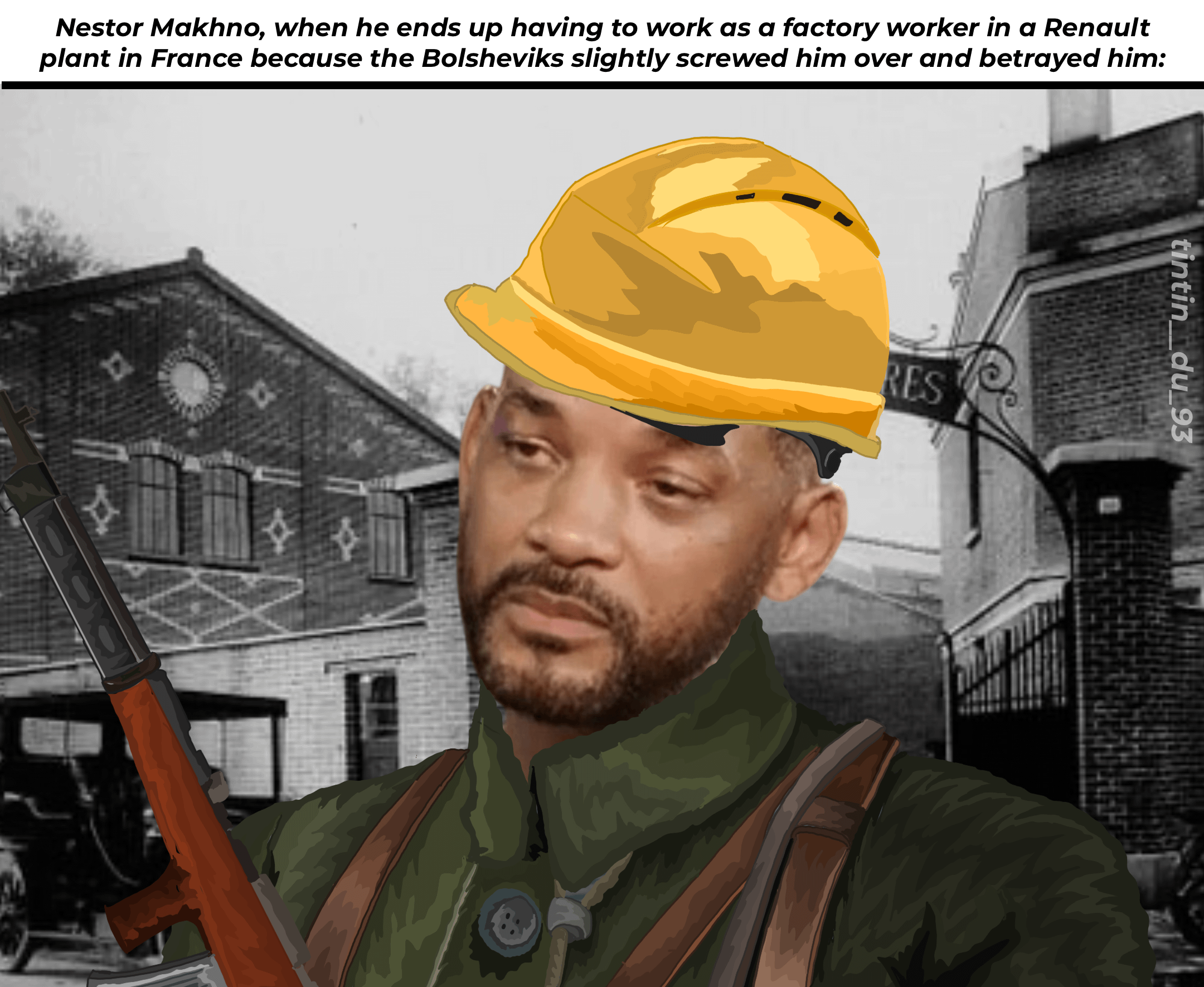
Nestor Makhno was a Ukrainian anarchist leader who allied with the Bolsheviks during the Russian Civil War. From 1919 to 1920, his Insurgent Revolutionary Army fought alongside the Red Army against Denikin’s and Wrangel’s White armies, contributing to decisive victories on the southern front, such as in Crimea. These pacts remained purely opportunistic: Makhno categorically refused Bolshevik centralized control and championed an autonomous peasant revolution based on free soviets without a single party.
As early as November 1920, once the White armies were sufficiently weakened, Lenin and Trotsky broke the alliance and declared Makhno an outlaw. The Red Army launched a massive offensive against the Makhnovshchina, that Ukrainian territory administered by the anarchists. The Bolsheviks accused the anarchists of “banditry” and “counter-revolution,” all to impose Soviet power in Ukraine.
Militarily defeated in August 1921, Makhno fled to Romania, then successively through Poland and Germany before settling in Paris in 1924. He lived in precarious conditions, working as a simple factory worker. He devoted part of his time to writing his memoirs and maintaining contacts with international anarchist circles. The Bolsheviks had definitively sidelined him, forcing him into a life of anonymity until his death from tuberculosis in 1934.
AndalBrask__ on
Makhno helped defeat the Whites and the Bolsheviks thanked him with exile. Peak tankie stuff
AgenceElysium on
Backstabbing is the trademark of the whole Bolshevik movement
hindu_muslim_goodbye on
Batko makhno, smotrit v okno
Thelordofprolapse on
Bolsheviks and backstabbing each other name a more iconic duo
inokentii on
Rephrasing Mykola Hohol: what’s up kiddo, have your moscals helped you enough?
Dominarion on
Why don’t the Ukrainians trust the Russians, exhibit 2458:
The5Theives on
Some people don’t realize violent revolutions often don’t end pretty, and even now in the 21st century, we can see the same things happening all across the world. Sometimes it feels like history is a circle
kahn_noble on
YAYYYY! A Makhno meme! Dude was the realest.
johnfireblast on
I’m not sure I’d really call it betrayal; from what Ive read it was a very well known “Alliance of Circumstances.”
Not that he was unaware he’d end up fighting the Bolsheviks.

10 Comments
Nestor Makhno was a Ukrainian anarchist leader who allied with the Bolsheviks during the Russian Civil War. From 1919 to 1920, his Insurgent Revolutionary Army fought alongside the Red Army against Denikin’s and Wrangel’s White armies, contributing to decisive victories on the southern front, such as in Crimea. These pacts remained purely opportunistic: Makhno categorically refused Bolshevik centralized control and championed an autonomous peasant revolution based on free soviets without a single party.
As early as November 1920, once the White armies were sufficiently weakened, Lenin and Trotsky broke the alliance and declared Makhno an outlaw. The Red Army launched a massive offensive against the Makhnovshchina, that Ukrainian territory administered by the anarchists. The Bolsheviks accused the anarchists of “banditry” and “counter-revolution,” all to impose Soviet power in Ukraine.
Militarily defeated in August 1921, Makhno fled to Romania, then successively through Poland and Germany before settling in Paris in 1924. He lived in precarious conditions, working as a simple factory worker. He devoted part of his time to writing his memoirs and maintaining contacts with international anarchist circles. The Bolsheviks had definitively sidelined him, forcing him into a life of anonymity until his death from tuberculosis in 1934.
Makhno helped defeat the Whites and the Bolsheviks thanked him with exile. Peak tankie stuff
Backstabbing is the trademark of the whole Bolshevik movement
Batko makhno, smotrit v okno
Bolsheviks and backstabbing each other name a more iconic duo
Rephrasing Mykola Hohol: what’s up kiddo, have your moscals helped you enough?
Why don’t the Ukrainians trust the Russians, exhibit 2458:
Some people don’t realize violent revolutions often don’t end pretty, and even now in the 21st century, we can see the same things happening all across the world. Sometimes it feels like history is a circle
YAYYYY! A Makhno meme! Dude was the realest.
I’m not sure I’d really call it betrayal; from what Ive read it was a very well known “Alliance of Circumstances.”
Not that he was unaware he’d end up fighting the Bolsheviks.