TL;DR: Source is [Dawum.de](http://Dawum.de) which aggregates opinion polls. I added the values of certain parties in Excel to compare the development since 2016.
As one of the global middle powers, I can imagine that long-term political alignment of the german society is of interest to the general public here. With Dawum, we have a website that aggregates polls of all the major pollsters in Germany, and has been doing this since 2016.
What they don’t do (and that is understandable) is watch the long-term trends in political alignment of the “generally left/center-left” vs. “generally right/center-right” blocs of parties in the german political system.
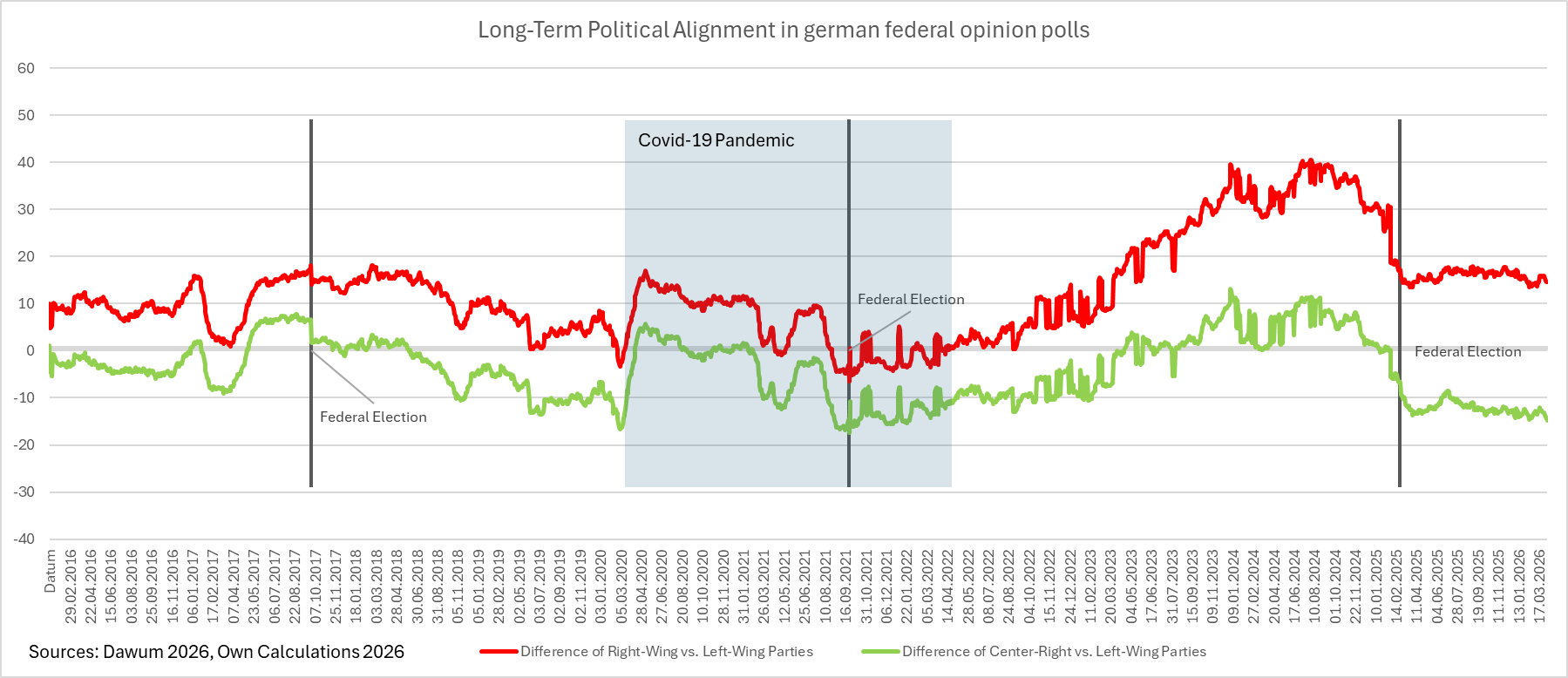
With this post I want to give a quick overview how the balance has shifted between the blocs of parties during the past 11 years. The dataset starts in January 2016 (so already after the foundation of the AfD, after the start of the Crimean War, after the euro crisis and after the increased arrival of refugees in Summer 2015). It spans the last part of the government Merkel III (CDU/CSU-SPD), Merkel IV fully (CDU/CSU-SPD), Scholz fully (SPD-Greens-FDP), and Merz up until today (CDU/CSU-SPD). Included are markers for the federal elections, and the Covid-19 pandemic (limited by the first public health mandates in March 2020 as the start, and May 2022 with pretty much all mandates lifted as the end).
The parties have been grouped by their general alignment ( I am aware that this is certainly contentious. For the purpose of this excercise and the question “which general bloc is currently stronger” grouping them that way and without deciding which parties are rather centrist is more useful in my opinion), with Die Linke, Bündnis 90/Die Grünen, SPD as left-wing parties, and CDU/CSU, FDP, BSW and AfD as right-wing parties. CDU/CSU+FDP are also classified as center-right parties. (See the bottom for a bit more detailed comment concerning this).
The graph (made with Excel) shows the poll results for the two groupings, with the red line showing how much the overall group of right-wing parties is ahead of the overall group of left-wing parties. The green line shows the same thing, but with the right-wing parties reduced to just their center-right part.
Parties below the 5-%-hurdle in the polls (so theoretically not in parliament) have been removed from the dataset at that point, so Linke, FDP and BSW are only partially represented here.
Concerning the political alignment: I know that I poked a nest of wasps with the general question of how to align the parties for this dataset. The general idea of this post was “how did the major alliances evolve over the last 11 years”. Historically (and in a lot of states still today) the alliances have been SPD-Grüne vs. CDU/CSU-FDP, therefore those have been my basis for this analysis. As those are generally viewed as “the centre-left alliance vs. the centre-right alliance” I used those as naming base too. I am well aware of the debates of “is party X still left of the center. Is party Y still somewhat centrist?”, I think that those don’t get us anywhere for this analysis though. The SPD-Grüne alliance has since about the start of this dataset been expanded to include Die Linke too. The AfD entered the political arena as an euro-critical right-wing offshoot of the FDP and the CDU/CSU, but has since drifted further right, and is in general seen as right-wing-extremist these days (debate is still ongoing, but they without a question are anti-sytem-rightwing), as they are against the current system I left them out of the centre-right alliance. The question where to put BSW is probably the hardest. While they are an offshoot from Die Linke, their general right-wing outlook on refugees, queer people and their closeness to the AfD led me to dropping them into the “right-wing anti-system”-tank. As they are only above 5% in the polls between January 2024 and February 2025, their effect is small anyway.
Nur_so_ein_Kerl on
Are ten years really considered “Long-term”? Especially for political alignment.
Loki-L on
Given that the various parties don’t really act like a block, looking at it like this is not very helpful.
A stacked view of all the parties arranged by political spectrum over time would show the information more clearly.
PandaDerZwote on
Honestly, the SPD would probably rather coalition with the CDU until they are done before they would coalition with the left federally.
SunflowerMoonwalk on
This is really unclear to read. Is it right *minus* left or left *minus* right, this needs to be explicitly stated or it’s impossible to understand.
I’d also love to see a total right vs total left line.
Also, which parties are in which group? I don’t remember Die Linke polling higher than the AfD in 2021?

5 Comments
TL;DR: Source is [Dawum.de](http://Dawum.de) which aggregates opinion polls. I added the values of certain parties in Excel to compare the development since 2016.
As one of the global middle powers, I can imagine that long-term political alignment of the german society is of interest to the general public here. With Dawum, we have a website that aggregates polls of all the major pollsters in Germany, and has been doing this since 2016.
What they don’t do (and that is understandable) is watch the long-term trends in political alignment of the “generally left/center-left” vs. “generally right/center-right” blocs of parties in the german political system.
With this post I want to give a quick overview how the balance has shifted between the blocs of parties during the past 11 years. The dataset starts in January 2016 (so already after the foundation of the AfD, after the start of the Crimean War, after the euro crisis and after the increased arrival of refugees in Summer 2015). It spans the last part of the government Merkel III (CDU/CSU-SPD), Merkel IV fully (CDU/CSU-SPD), Scholz fully (SPD-Greens-FDP), and Merz up until today (CDU/CSU-SPD). Included are markers for the federal elections, and the Covid-19 pandemic (limited by the first public health mandates in March 2020 as the start, and May 2022 with pretty much all mandates lifted as the end).
The parties have been grouped by their general alignment ( I am aware that this is certainly contentious. For the purpose of this excercise and the question “which general bloc is currently stronger” grouping them that way and without deciding which parties are rather centrist is more useful in my opinion), with Die Linke, Bündnis 90/Die Grünen, SPD as left-wing parties, and CDU/CSU, FDP, BSW and AfD as right-wing parties. CDU/CSU+FDP are also classified as center-right parties. (See the bottom for a bit more detailed comment concerning this).
The graph (made with Excel) shows the poll results for the two groupings, with the red line showing how much the overall group of right-wing parties is ahead of the overall group of left-wing parties. The green line shows the same thing, but with the right-wing parties reduced to just their center-right part.
Parties below the 5-%-hurdle in the polls (so theoretically not in parliament) have been removed from the dataset at that point, so Linke, FDP and BSW are only partially represented here.
Concerning the political alignment: I know that I poked a nest of wasps with the general question of how to align the parties for this dataset. The general idea of this post was “how did the major alliances evolve over the last 11 years”. Historically (and in a lot of states still today) the alliances have been SPD-Grüne vs. CDU/CSU-FDP, therefore those have been my basis for this analysis. As those are generally viewed as “the centre-left alliance vs. the centre-right alliance” I used those as naming base too. I am well aware of the debates of “is party X still left of the center. Is party Y still somewhat centrist?”, I think that those don’t get us anywhere for this analysis though. The SPD-Grüne alliance has since about the start of this dataset been expanded to include Die Linke too. The AfD entered the political arena as an euro-critical right-wing offshoot of the FDP and the CDU/CSU, but has since drifted further right, and is in general seen as right-wing-extremist these days (debate is still ongoing, but they without a question are anti-sytem-rightwing), as they are against the current system I left them out of the centre-right alliance. The question where to put BSW is probably the hardest. While they are an offshoot from Die Linke, their general right-wing outlook on refugees, queer people and their closeness to the AfD led me to dropping them into the “right-wing anti-system”-tank. As they are only above 5% in the polls between January 2024 and February 2025, their effect is small anyway.
Are ten years really considered “Long-term”? Especially for political alignment.
Given that the various parties don’t really act like a block, looking at it like this is not very helpful.
A stacked view of all the parties arranged by political spectrum over time would show the information more clearly.
Honestly, the SPD would probably rather coalition with the CDU until they are done before they would coalition with the left federally.
This is really unclear to read. Is it right *minus* left or left *minus* right, this needs to be explicitly stated or it’s impossible to understand.
I’d also love to see a total right vs total left line.
Also, which parties are in which group? I don’t remember Die Linke polling higher than the AfD in 2021?
**Edit:** Nevermind, just saw your comment.