
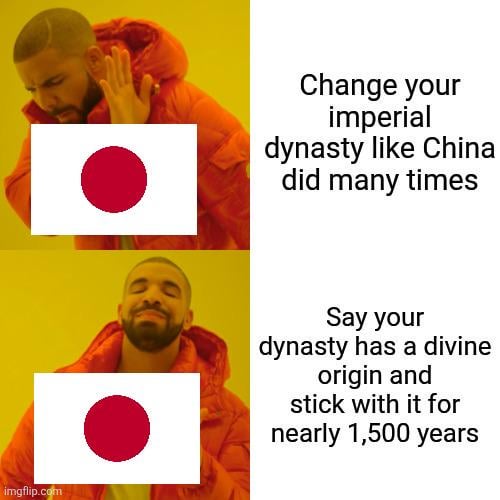
Emperor Kinmei, who reigned from 539 to 571, is considered the oldest historically verifiable Japanese emperor. The Imperial House of Japan has never been deposed, making it one of the longest-reigning dynasties in history, and the oldest currently reigning dynasty.
Despite adapting Chinese institutions to consolidate itself, Japan rejected the Chinese concept of the mandate of heaven, claiming that the emperor's authority derived from his descent from the goddess Amaterasu, not from his fairness as a ruler. From the late 12th century onwards, dynastic strife increased, but it focused on offices such as that of shogun, while the Imperial Family remained in the Chrysanthemum Throne.
by GustavoistSoldier
13 Comments
Frankly the fact the line hasn’t died out from inbreeding is the most impressive part to Me. Isn’t marriage for the Emperors restricted to certain noble families?
It probably helps when you essentially have no presence in affairs of state.
This is Southern Court erasure
Historically speaking the emperors had no presence in state affairs except as figureheads.
Japan was either ruled by a Shogun or everyone lived under the mercy of feudal samurai lords.
It was one or the other of those two poisons.
I mean, isn’t one of the issues that led to the genpai was was the emperor had no apparent heir after both he and his son ate it leading to a huge succession crisis? Or am I misremembering?
Edit: ah, thank you for the corrections.
>Japan rejected the Chinese concept of the mandate of heaven, claiming that the emperor’s authority derived from his descent from the goddess Amaterasu, not from his fairness as a ruler.
This is what led to the Shogunate being a thing. While they adopted China’s Imperial systems during the Sui Dynasty and initially did run their country like China did, the Mandate of Heaven allowed the Chinese to overthrow and replace incompetent administration.
This couldn’t happen in Japan, where the emperor was genuinely seen as a living god. So, when the imperial court eventually got too busy doing poetry instead of running the country, the Japanese people couldn’t just overthrow them and install a competent government. Instead, the military seized control of the government and ruled on “behalf” of the emperors, who they basically placed on house arrest for the next several centuries
But yeah, they do owe their longevity to the fact that they were mostly powerless for most of their existence. Even during periods of strife like the Sengoku period, overthrowing the emperor would change absolutely nothing so there was no need to do it.
The Mandate of Heaven wasn’t really about fairness, it was about performing the rituals correctly. If there were plagues and famines, the Chinese just assumed that they were somehow performing the rituals incorrectly.
It’s mainly because the emperors had no major political power. So they’re just a figurehead.
I for one find it disappointing that King Charles III does not present himself as a direct descendant of Woden.
The current Imperial line is invalid.
Justice for my man Go-Daigo.
I think it is because the position of the emperor in Japan in most of period is powerless. The Shogun and Daimyo has the real authority to function the state.
For the Chinese emperor, who was son of heavens, and as the legacy of ancient Zhou dynasty, could be replaced if he failed to fulfil his duty to people and consequently the heaven will grant the new dynasty to rise.
*laughs in Shogun**
Interestingly, this may explain why modern Japan has an almost *perfect* Westminster parliamentary system, which not even the British have because the Lords are quite restricted in their powers. I’ve looked at it carefully and I’m actually impressed how closely they follow the model (most Westminster systems are variations one way or another).
China (in either guise) has a strong executive in comparison, because their power is based entirely upon their ability to act for the people.