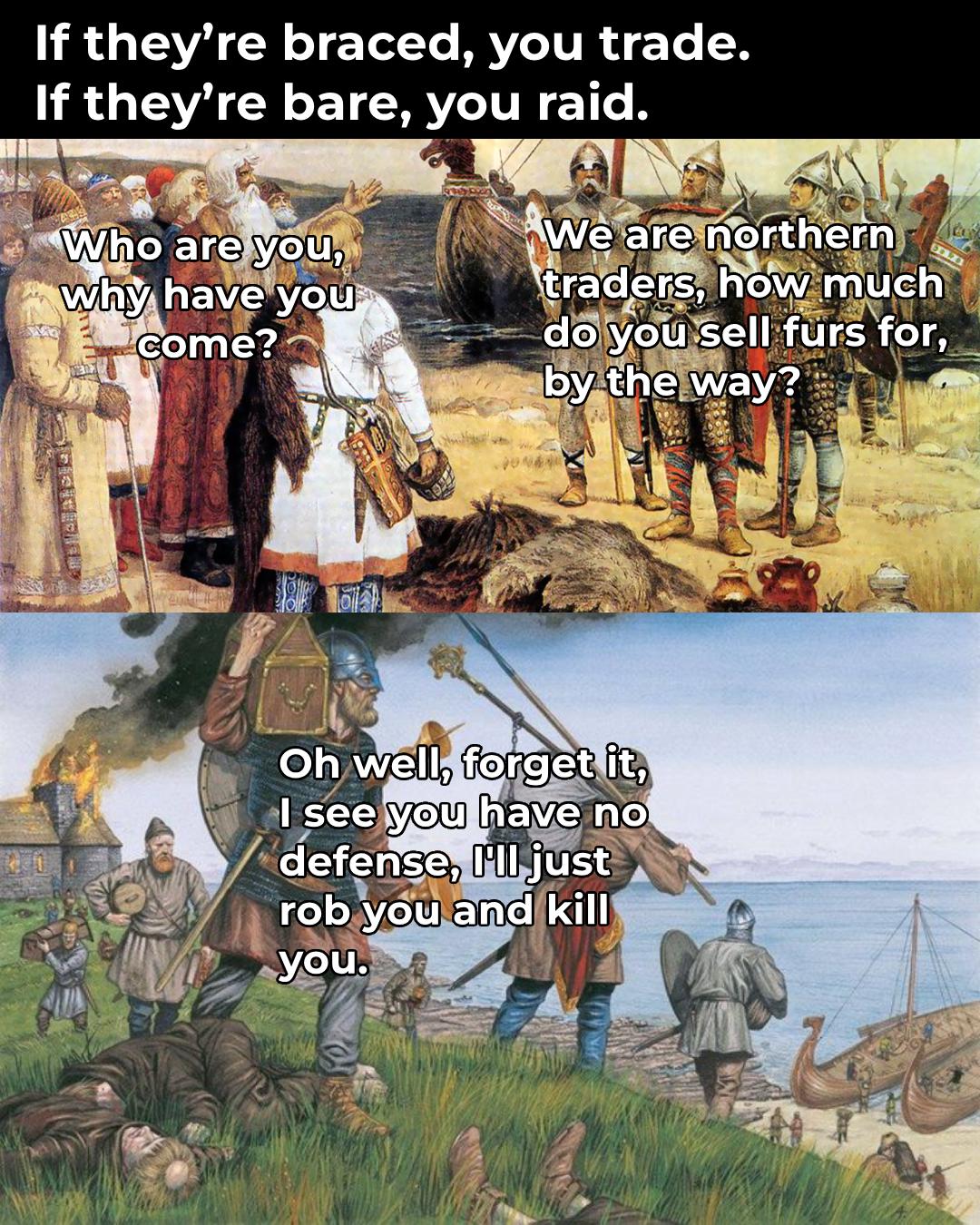
As much as vikings are known for their raiding they actually didnt like to kill everyone in their path. You can always come back later you know…
Leading-Morning7550 on
I’ve never heard that axiom
Pndapetzim on
These ideas were old in tribal groups. Allies, ones worth having, needed to be prepared. It wasn’t universal, obviously, but for many tribes, attacking people you just met who appeared unprepared was understood as “what are you even doing out here so unprepared?” – you’re out in unfamiliar territory, no one knows you here: are you stupid?
The vikings, mongols, and certain north american tribes show similar frameworks(interestingly, even in ‘war-like’ groups many bands did have an apparent policy of ‘yeah, we don’t really do that’)
Groups that understood this, were prepared, and polite usually got respect. Ones that weren’t… got raided until they learned. Once some parity was established, they’d make terms.
In many warrior mindsets, if you possess something valuable and lack the means credibly defend it: you really don’t deserve it in the first place. (It’s like violent socialism)
In many cases your perceived strength/weakness was an important facet of the trade business: if you’re weak, you’re going to end up paying more or giving less. If you’re really weak, you might have to just… give up stuff just for passage or the right to trade.
During Roman times, ‘barbarian trader’ was basically understood to be synonymous with ‘part-time trader, part-time pirate/raider’ and the Roman fleet spent a lot of time and effort keeping a lid on this sort of activity.
SunsBreak on
“Are you friendly?”
“Depends, is that a gun?”
“Yes. Is that a gun?”
“Yes. So I guess I am friendly!”
doug1003 on
It *looks like* the trade at the beggining works like scouting: it wss a way to see and study the defenses of the place you want it to sansack latter. The only place they diddnt ransacked were the ones too strong to worth the risk

5 Comments
As much as vikings are known for their raiding they actually didnt like to kill everyone in their path. You can always come back later you know…
I’ve never heard that axiom
These ideas were old in tribal groups. Allies, ones worth having, needed to be prepared. It wasn’t universal, obviously, but for many tribes, attacking people you just met who appeared unprepared was understood as “what are you even doing out here so unprepared?” – you’re out in unfamiliar territory, no one knows you here: are you stupid?
The vikings, mongols, and certain north american tribes show similar frameworks(interestingly, even in ‘war-like’ groups many bands did have an apparent policy of ‘yeah, we don’t really do that’)
Groups that understood this, were prepared, and polite usually got respect. Ones that weren’t… got raided until they learned. Once some parity was established, they’d make terms.
In many warrior mindsets, if you possess something valuable and lack the means credibly defend it: you really don’t deserve it in the first place. (It’s like violent socialism)
In many cases your perceived strength/weakness was an important facet of the trade business: if you’re weak, you’re going to end up paying more or giving less. If you’re really weak, you might have to just… give up stuff just for passage or the right to trade.
During Roman times, ‘barbarian trader’ was basically understood to be synonymous with ‘part-time trader, part-time pirate/raider’ and the Roman fleet spent a lot of time and effort keeping a lid on this sort of activity.
“Are you friendly?”
“Depends, is that a gun?”
“Yes. Is that a gun?”
“Yes. So I guess I am friendly!”
It *looks like* the trade at the beggining works like scouting: it wss a way to see and study the defenses of the place you want it to sansack latter. The only place they diddnt ransacked were the ones too strong to worth the risk