Early in April, Wilson asked Congress for the war declaration Roosevelt thought was long overdue. Congress granted the president his request. Finally, Roosevelt thought, America was doing the heroic thing. And he would do the same—if only that wretched creature in the White House would let him. Up to this point his discussions with the administration about a volunteer division had been essentially hypothetical; now that the country was actually at war, a different set of calculations would come into play. With the nation’s honor committed, the public would rally to the flag and would support all who were willing to serve. Wilson wouldn’t dare stand in the way of a popular outpouring of patriotism. Such were Roosevelt’s hopes on the train to Washington a few days after the war declaration. Nothing besides sheer desperation to fight could have compelled him to make a personal appeal to the man he so hated and despised.
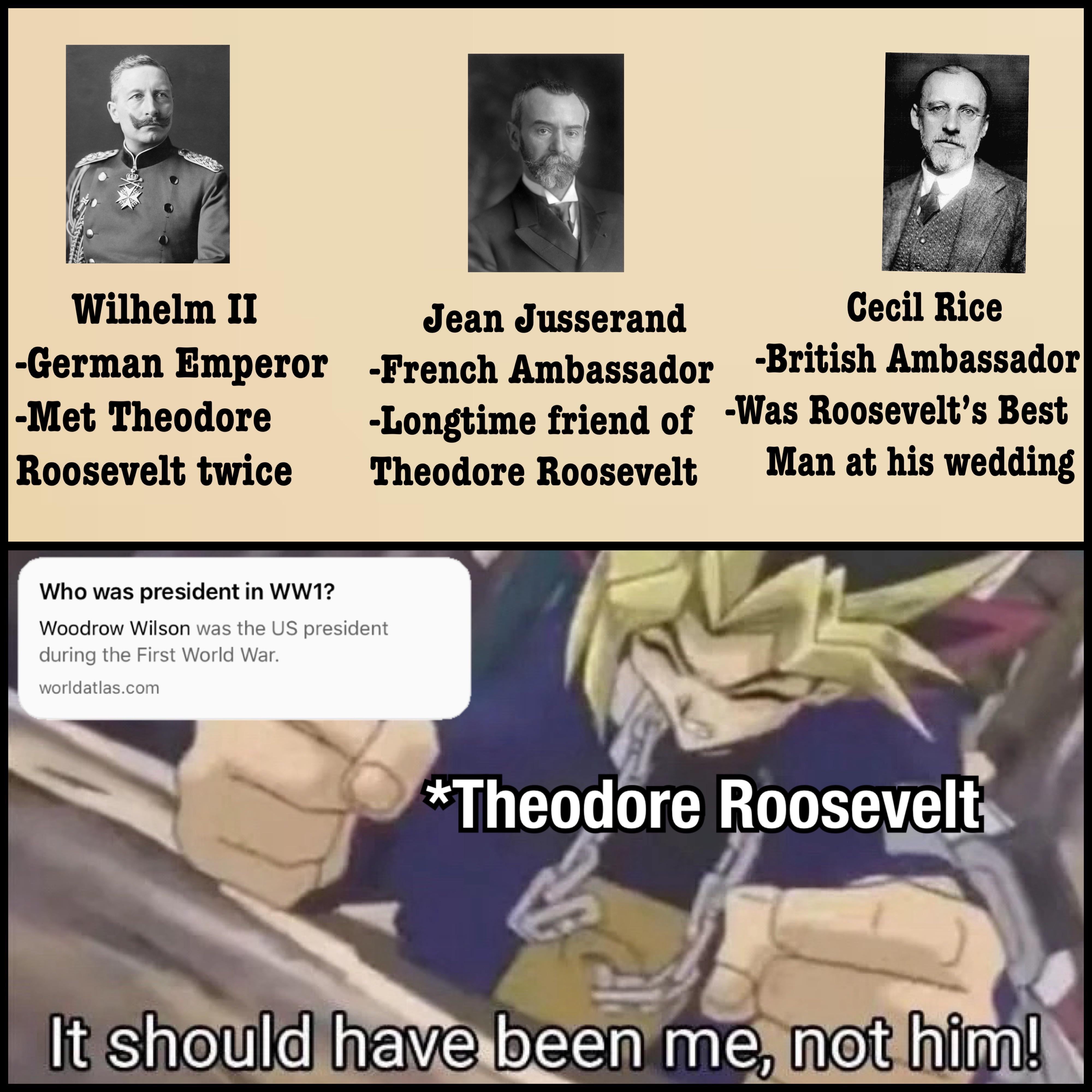
He had long ago learned that political effectiveness required tactical trimming; he had appeased Platt and Hanna and others of their ilk when necessary to achieve his goals. But Wilson was another matter. Platt and Hanna he had come to respect, in a grudging way; they were principled, after their own lights. Not Wilson-that hypocrite, liar, coward. It took all of Roosevelt’s moral self-discipline to propel himself through the door of the White House on the morning of April 10. His return to the seat of power could only have intensified the feeling he had had ever since the war broke out in Europe: that at this moment of world peril, he should be the one leading the nation, not Wilson. He knew the [kaiser](https://www.reddit.com/r/HistoryMemes/s/7pLSCVk0vc); he understood what power was for. On this same visit to the capital he conferred with the French and British ambassadors: [Jusserand](https://www.reddit.com/r/HistoryMemes/s/OGKtDemko0), his old friend, and [Spring Rice](https://www.reddit.com/r/HistoryMemes/s/B9h6Y4eHbB), his best man and onetime [housemate](https://www.reddit.com/r/HistoryMemes/s/Ugn1l2ieqt).
He knew these people, and they knew him.
Who was this impostor, this pretender to the throne? He was, of course, the president of the United States, the commander in chief and, consequently, the one who would determine whether Roosevelt fulfilled his desire for a return to battle. So the old colonel swallowed his pride and with hat in hand went calling to ask for what only Wilson could give.
Source: T.R., The Last Romantic, pages 779-781
nothingtodo0 on
This wasn’t just a personal grudge, it was the death of the ‘Rough Rider’ era. TR wanted to lead a volunteer charge while Wilson was busy inventing the modern, bureaucratic draft.
Fabulous-Big8779 on
I think the true tragedy was him losing his son in a war he eagerly called for the US to join.
I’ll say this for him, while most politicians clamor for war while saving themselves and their kin from its horrors Roosevelt dove into the fray himself.
Warmongering is never good, but it’s at least more palatable when the war mongerer gets in the fight themselves.
Slatedtoprone on
This dude wanted to go Europe to fight in the war and the US government really didn’t want a former president in a theater of war. He sure was one a kind when it came to politicians.
Dominarion on
Roosevelt had an impressive international aura. If he had been president in 1914, he might have been able to throw a wrench into the war machine. Keep the war between AH and Serbia localized, convinced the Germans not to give a blank check to AH. Also, the Russians owed him a solid for the treaty of Portsmouth. There’s a lot of etc going after that.
I’m getting a little bit sick at the stomach thinking about this.
Successful_Gas_5122 on
Teddy would be horrified to see the Republican Party taken over by such an incurious geriatric schlub.

6 Comments
Early in April, Wilson asked Congress for the war declaration Roosevelt thought was long overdue. Congress granted the president his request. Finally, Roosevelt thought, America was doing the heroic thing. And he would do the same—if only that wretched creature in the White House would let him. Up to this point his discussions with the administration about a volunteer division had been essentially hypothetical; now that the country was actually at war, a different set of calculations would come into play. With the nation’s honor committed, the public would rally to the flag and would support all who were willing to serve. Wilson wouldn’t dare stand in the way of a popular outpouring of patriotism. Such were Roosevelt’s hopes on the train to Washington a few days after the war declaration. Nothing besides sheer desperation to fight could have compelled him to make a personal appeal to the man he so hated and despised.
He had long ago learned that political effectiveness required tactical trimming; he had appeased Platt and Hanna and others of their ilk when necessary to achieve his goals. But Wilson was another matter. Platt and Hanna he had come to respect, in a grudging way; they were principled, after their own lights. Not Wilson-that hypocrite, liar, coward. It took all of Roosevelt’s moral self-discipline to propel himself through the door of the White House on the morning of April 10. His return to the seat of power could only have intensified the feeling he had had ever since the war broke out in Europe: that at this moment of world peril, he should be the one leading the nation, not Wilson. He knew the [kaiser](https://www.reddit.com/r/HistoryMemes/s/7pLSCVk0vc); he understood what power was for. On this same visit to the capital he conferred with the French and British ambassadors: [Jusserand](https://www.reddit.com/r/HistoryMemes/s/OGKtDemko0), his old friend, and [Spring Rice](https://www.reddit.com/r/HistoryMemes/s/B9h6Y4eHbB), his best man and onetime [housemate](https://www.reddit.com/r/HistoryMemes/s/Ugn1l2ieqt).
He knew these people, and they knew him.
Who was this impostor, this pretender to the throne? He was, of course, the president of the United States, the commander in chief and, consequently, the one who would determine whether Roosevelt fulfilled his desire for a return to battle. So the old colonel swallowed his pride and with hat in hand went calling to ask for what only Wilson could give.
Source: T.R., The Last Romantic, pages 779-781
This wasn’t just a personal grudge, it was the death of the ‘Rough Rider’ era. TR wanted to lead a volunteer charge while Wilson was busy inventing the modern, bureaucratic draft.
I think the true tragedy was him losing his son in a war he eagerly called for the US to join.
I’ll say this for him, while most politicians clamor for war while saving themselves and their kin from its horrors Roosevelt dove into the fray himself.
Warmongering is never good, but it’s at least more palatable when the war mongerer gets in the fight themselves.
This dude wanted to go Europe to fight in the war and the US government really didn’t want a former president in a theater of war. He sure was one a kind when it came to politicians.
Roosevelt had an impressive international aura. If he had been president in 1914, he might have been able to throw a wrench into the war machine. Keep the war between AH and Serbia localized, convinced the Germans not to give a blank check to AH. Also, the Russians owed him a solid for the treaty of Portsmouth. There’s a lot of etc going after that.
I’m getting a little bit sick at the stomach thinking about this.
Teddy would be horrified to see the Republican Party taken over by such an incurious geriatric schlub.