In the mid-17th century, the nomadic Manchu people overthrew China’s ruling Ming dynasty, sparking the beginning of the Qing dynasty. It ruled over a sprawling empire that survived nearly three centuries, and formed the territorial base for modern China.
In these politically fraught times, what you wore mattered. Clothes were designed to indicate rank and status, becoming so distinct that the wearer’s position in court could be ascertained at a glance.
By the time of the Qianlong Emperor’s reign, strict sartorial rules had been outlined in an official guide: The Illustrated Catalogue of Ritual Paraphernalia.
Yellow was considered to be the most auspicious shade, and was reserved for the royal family. Minor princes or noblemen were permitted to wear blue (the Qing dynasty’s official colour) or brown, while blue-black fabric indicated the wearer was a court official.
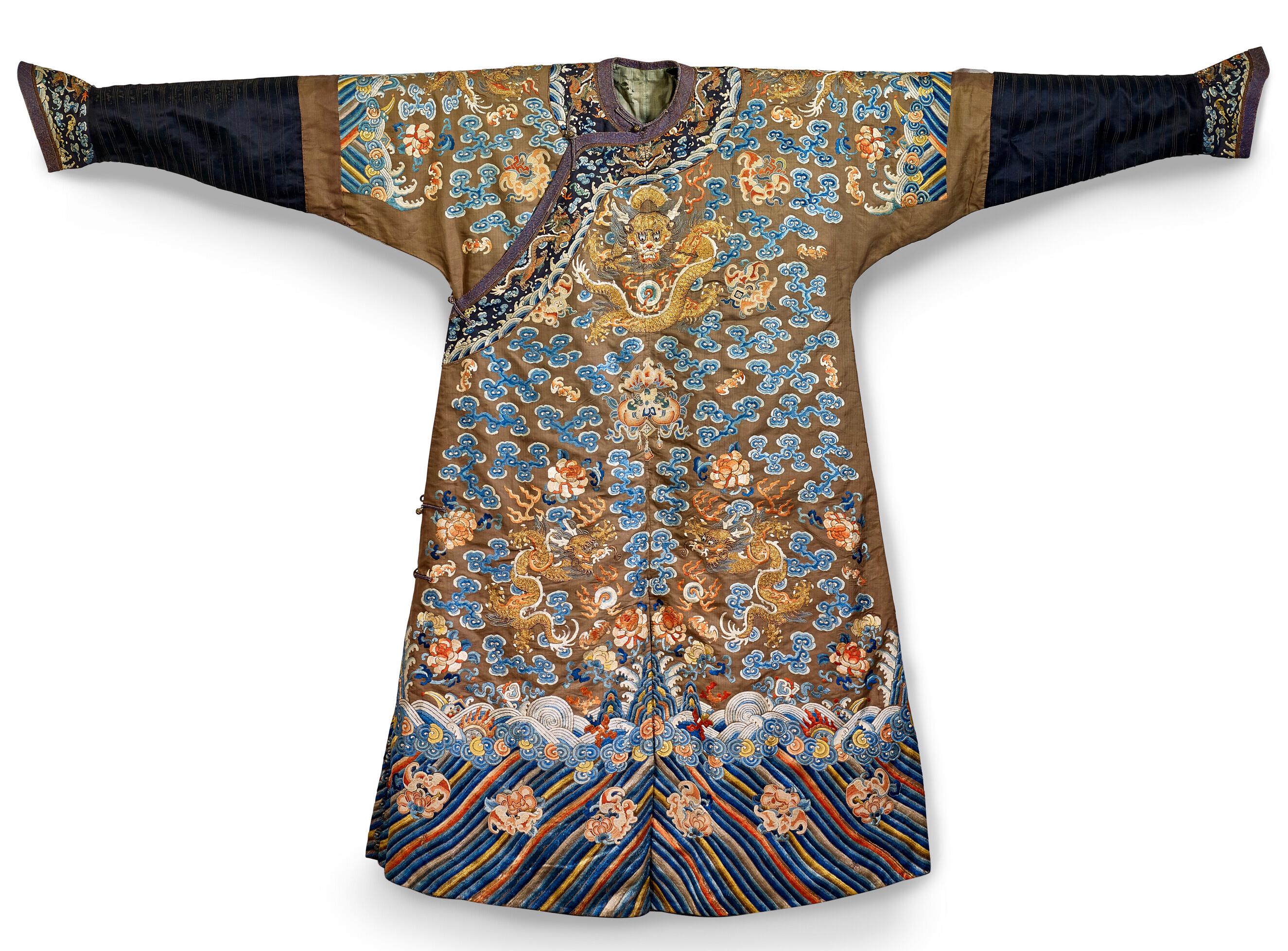
Semi-official clothing was expected for government business, including the well-known jifu, or dragon robe, which was worn with a collar and outer coat. Like the most official attire, this long, side-fastening garment featured ‘horse shoe’ cuffs, first designed to protect the wearer’s hands when riding in bad weather.
Jifu robes were rich in symbolic meaning, representing the entire universe in their design — from the lishui waves at the base, anchored by a central mountain, to the dragons among clouds that swirled above, denoting authority. At the height of the Qing dynasty, medium-ranking officials wore robes with eight four-clawed dragons — but at court, high-ranking officials’ robes featured a ninth dragon, hidden inside a front flap.

1 Comment
In the mid-17th century, the nomadic Manchu people overthrew China’s ruling Ming dynasty, sparking the beginning of the Qing dynasty. It ruled over a sprawling empire that survived nearly three centuries, and formed the territorial base for modern China.
In these politically fraught times, what you wore mattered. Clothes were designed to indicate rank and status, becoming so distinct that the wearer’s position in court could be ascertained at a glance.
By the time of the Qianlong Emperor’s reign, strict sartorial rules had been outlined in an official guide: The Illustrated Catalogue of Ritual Paraphernalia.
Yellow was considered to be the most auspicious shade, and was reserved for the royal family. Minor princes or noblemen were permitted to wear blue (the Qing dynasty’s official colour) or brown, while blue-black fabric indicated the wearer was a court official.
Semi-official clothing was expected for government business, including the well-known jifu, or dragon robe, which was worn with a collar and outer coat. Like the most official attire, this long, side-fastening garment featured ‘horse shoe’ cuffs, first designed to protect the wearer’s hands when riding in bad weather.
Jifu robes were rich in symbolic meaning, representing the entire universe in their design — from the lishui waves at the base, anchored by a central mountain, to the dragons among clouds that swirled above, denoting authority. At the height of the Qing dynasty, medium-ranking officials wore robes with eight four-clawed dragons — but at court, high-ranking officials’ robes featured a ninth dragon, hidden inside a front flap.