
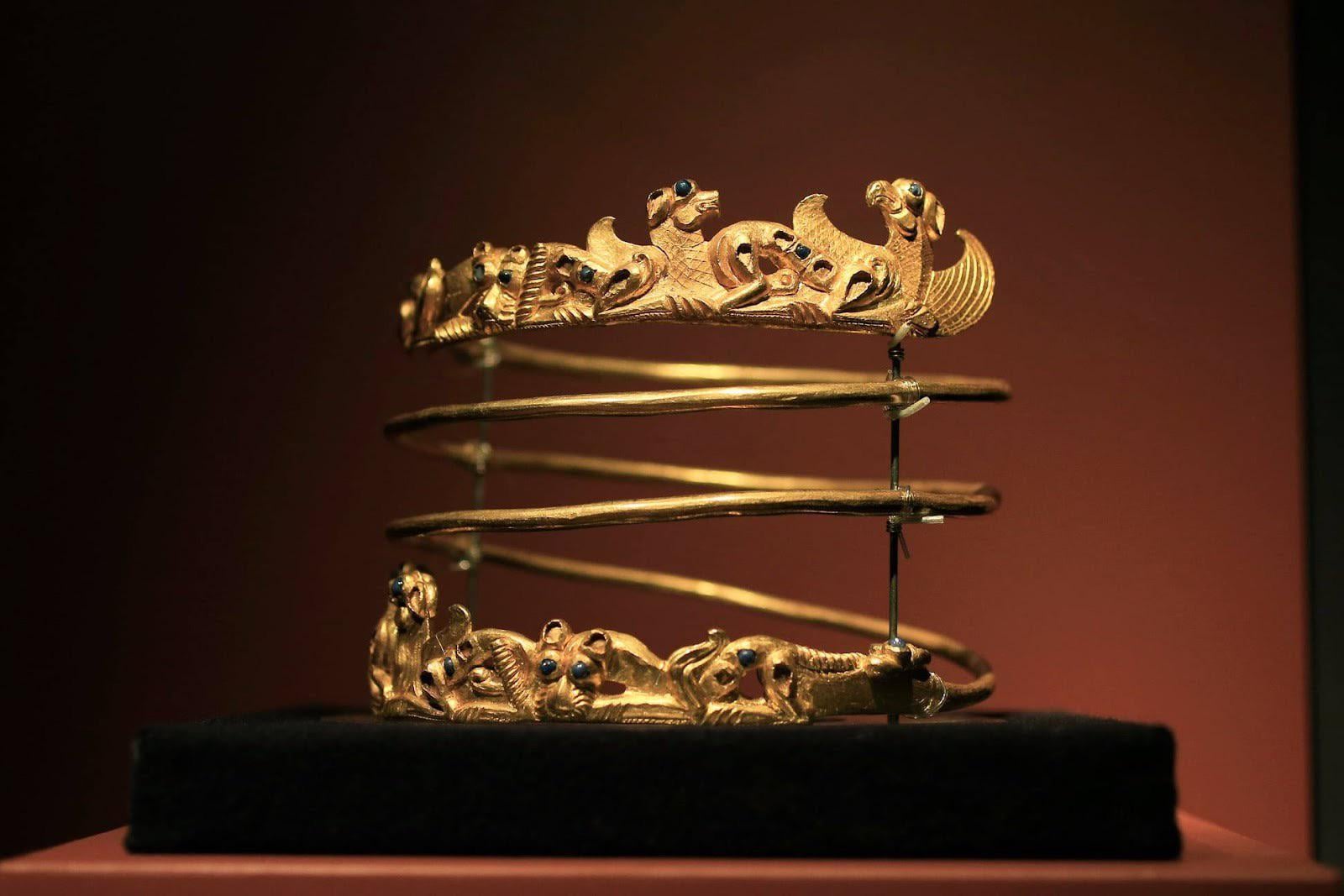
Sarmatians (2nd century BC – 4th century AD) Spiral hryvnia – an ornament worn around the neck. From the Nogaichynsky mound near the village of Chervone, Crimea, Ukraine. [1600×1067]
by RecordingOverall6978
Sarmatians (2nd century BC – 4th century AD) Spiral hryvnia – an ornament worn around the neck. From the Nogaichynsky mound near the village of Chervone, Crimea, Ukraine. [1600×1067]
by RecordingOverall6978
4 Comments
I hope this artefact is in the collection of Ukraine and not the murderous russian invaders of Crimea!
How does one put this on?
I hope people realize this artifact has nothing to do with Ukraine and even the name of the artifact is just a modern version, derived from an old word for the neck, we don’t know actually what it was called.
Grivna (or hryvna under Khazar rule) was a unit of weight adopted by Norse traders in Rus. Western Slavs like Poland also used griwna as a unit of weights since the proto Slavic root is the same. Though they also used Roman units (e.g. libra) given the Western trade was going to Rome not Miklagard (Constantinople) but thats irrelevant here…
However, there are no widely accepted, clear narrative passages in surviving Old East Slavic chronicles where “grivna” unambiguously describes a neck ornament in context (e.g., “he wore a grivna on his neck”).
That name in the “neck ornament” sense is reconstructed and lexically preserved by 20th century assumptions in Russian dictionary (specifically Max Vasmer’s Etymological Dictionary of the Russian Language), not richly attested in surviving narrative sources.
Those sources (like the 11th century Russkaya Pravda legal code) only use *grivna* as unit of weight and because Russian scholars thought that neck ornaments seemed to have fairly standard weight they derived that name.
So it is a word used by Russian scholars to describe an object based on its proposed weight in a culture that had nothing to do with current country in its place (similar example would be an Etruscan object being named after its color by German scholars using Italian vocabulary )
Also, given ornamentation on this object, we can hardly say it had some standard weight, ornament to ornament. And grivna/grzywna/hryvna as used in trade was practically always describing a weight of a silver ingot or wire pieces. There are norse horde finds that clearly show such ingots and wire and they were almost never ornamental. You could weigh anything opposite them, including this neck ornament but then you would call it “an ornament weighing a grivna of silver”.
Tldr, grivna is a weight/price not an actual name of this object its contemporaries used
I have a question…