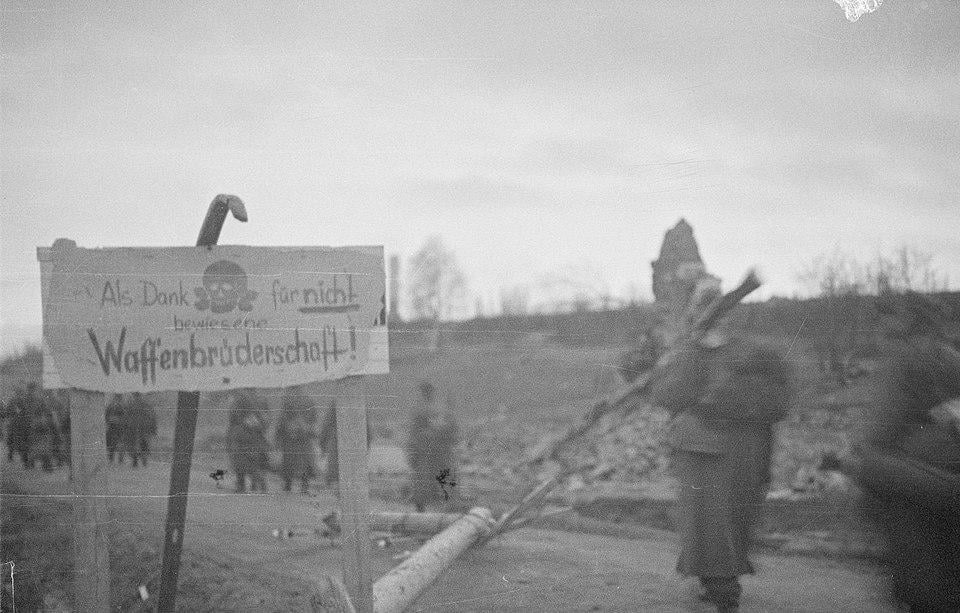
Picture of a sign the Germans left for their former Finnish allies, reading “As a thanks for NOT demonstrating brotherhood in arms.” Muonio, Lapland, Finland. October 31, 1944 [800×511]
by Johannes_P

Picture of a sign the Germans left for their former Finnish allies, reading “As a thanks for NOT demonstrating brotherhood in arms.” Muonio, Lapland, Finland. October 31, 1944 [800×511]
by Johannes_P
1 Comment
On September 19, 1944, Finland signed the Moscow Armistice demanding the break of diplomatic relations with Germany, with which it was cobelligerant, and the expulsion or disarment of German soldiers in Finland.
*Wehrmacht* units in Finland first withdrew to Norway, then under Nazi occupation but, after Soviet pressure, the Finnish military had to escalate, and, from September to November 1944, Finland and Germany fought the [Lapland War](https://en.wikipedia.org/wiki/Lapland_War).
BEforehand, President Mannerheim wrote to Hitler:
> I deem it my duty to lead my people out of the war. I cannot and I will not turn the arms which you have so liberally supplied us against Germans. I harbour the hope that you, even if you disapprove of my attitude, will wish and endeavour like myself and all other Finns to terminate our former relations without increasing the gravity of the situation.
The last German soldiers left on April 27, 1945; the same day, Finnish soldiers rose the flag at the three-country cairn between Norway, Sweden and Finland.
Finland remained at war with the United Nations until the 1947 Paris Peace Treaty, and it was in 1954 that Finland officialy stated that “the hostilities have ceased and interaction between Finland and Germany since then developed peacefully.”
The reconstruction of LApland lasted until the 1950s, with railway network functional only on 1957. By 1973, over 800,000 cartridges, 70,000 mines and 400,000 other explosives had been demined in Lapland