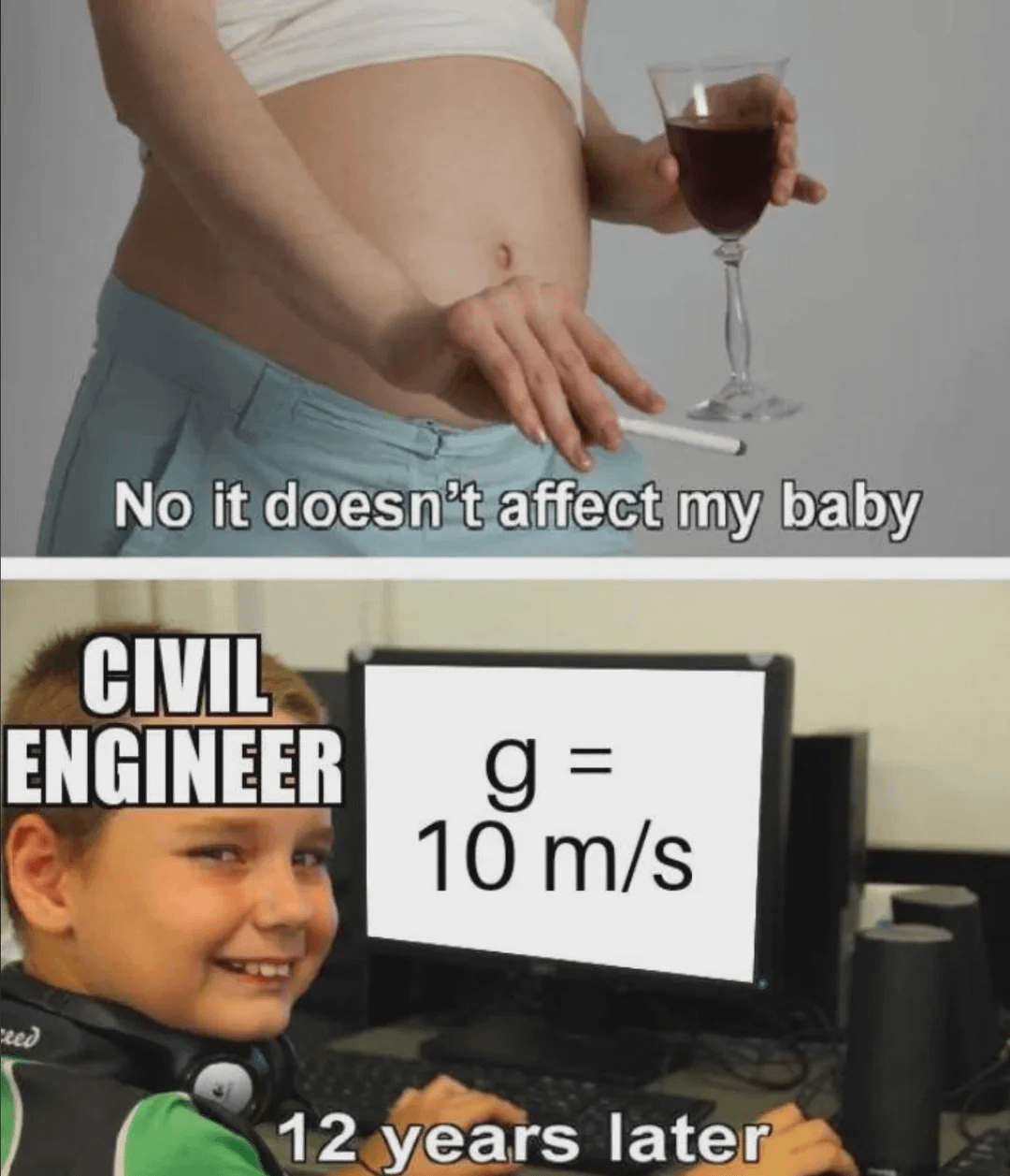
Pi is 3, Gravity is 10, and my will to live is 0. The Engineer’s Trinity.
Tyja136 on
If my offspring was a civil engineer by the age of 11. I’d be pretty impressed.
Nirraaaa on
If the bridge stays up, it was a good approximation. If it falls, it was a ‘statistical anomaly’
OrDuck31 on
Im mechanical engineering student, we sometimes take the g=10 if there are too many calculations in rest of the problem
kai_the_kiwi on
g = 10 is still acceptable, unlike the π = 5 i once saw
catclove on
M/s^2 and it’s 9.8 🫠
Lovablemiranda03 on
Rounding gravity is how you end up with a bridge that is technically safe but feels like a trampoline.
GewalfofWivia on
10 is acceptable, wrong unit is not.
Austenit1392 on
I am studying mechanical engineering. I know 35 digits of pi, but when your diameter is only correct on 2 digits, it doesnt make a better calculation if you take more digits.
When I calculate in my brain to check whether the solution could be correct, I also use pi=3 and g=10, because it is easier to calculate and I do only want to get near my calculator solution.
sentient_coprolite on
Can’t fix a route before it gets designed
desna_svine on
How did he fucked up the m/s2?
GenericSadLoser on
Already on r/peterexplainsthejoke
sentient_coprolite on
Wait wait..
I could use a route canal. Dentists, get in here!
Cute_Prior1287 on
But why is he civil engineer at 12.
AmonGusSus2137 on
It’s close enough, and if something is sturdy enough to not collapse with a gravity of 10m/s², it’ll probably be fine with the real value
chronberries on
Idk about you guys but I’m fine with a civil engineer overestimating gravity. A bridge built for 1.02 G will hold up just fine in 1 G.
Wrong unit though. That’s a problem
jibonto_laas on
Better start burning some astrophage
kadaka80 on
Accuracy depends on the application. If you’re trying to setup your equipment yo detect gravitational waves, it’s not good enough but if you’re laying concrete to repair the sidewalk then its fine
_BreadDenier on
Pi = 3
KenzieTheCuddler on
At what point can that simply be called overconstraints?
Buldozor on
g=pi^2, very close approximation and can simplify with the rest of the equation.
picky-trash-panda on
This pissed me off so much last semester because my physics professor never told us she was grading our calculations with a key where everything was calculated with b=10m/s^2 and it took HALF THE SEMESTER to figure out why my grades were so bad. All in the name of “simplifying the calculations” which is total bs
CraigDCrocodile on
Is the joke in the fact that he’s 12 years old and has to use a font half the size of the screen, as well? Like in Farside’s “school for the mechanically declined”? 🤣
MechaSkippy on
The real joke is that g has the units of velocity, smh.

26 Comments
Pi is 3, Gravity is 10, and my will to live is 0. The Engineer’s Trinity.
If my offspring was a civil engineer by the age of 11. I’d be pretty impressed.
If the bridge stays up, it was a good approximation. If it falls, it was a ‘statistical anomaly’
Im mechanical engineering student, we sometimes take the g=10 if there are too many calculations in rest of the problem
g = 10 is still acceptable, unlike the π = 5 i once saw
M/s^2 and it’s 9.8 🫠
Rounding gravity is how you end up with a bridge that is technically safe but feels like a trampoline.
10 is acceptable, wrong unit is not.
I am studying mechanical engineering. I know 35 digits of pi, but when your diameter is only correct on 2 digits, it doesnt make a better calculation if you take more digits.
When I calculate in my brain to check whether the solution could be correct, I also use pi=3 and g=10, because it is easier to calculate and I do only want to get near my calculator solution.
Can’t fix a route before it gets designed
How did he fucked up the m/s2?
Already on r/peterexplainsthejoke
Wait wait..
I could use a route canal. Dentists, get in here!
But why is he civil engineer at 12.
It’s close enough, and if something is sturdy enough to not collapse with a gravity of 10m/s², it’ll probably be fine with the real value
Idk about you guys but I’m fine with a civil engineer overestimating gravity. A bridge built for 1.02 G will hold up just fine in 1 G.
Wrong unit though. That’s a problem
Better start burning some astrophage
Accuracy depends on the application. If you’re trying to setup your equipment yo detect gravitational waves, it’s not good enough but if you’re laying concrete to repair the sidewalk then its fine
Pi = 3
At what point can that simply be called overconstraints?
g=pi^2, very close approximation and can simplify with the rest of the equation.
This pissed me off so much last semester because my physics professor never told us she was grading our calculations with a key where everything was calculated with b=10m/s^2 and it took HALF THE SEMESTER to figure out why my grades were so bad. All in the name of “simplifying the calculations” which is total bs
Is the joke in the fact that he’s 12 years old and has to use a font half the size of the screen, as well? Like in Farside’s “school for the mechanically declined”? 🤣
The real joke is that g has the units of velocity, smh.
10m/s^2 duh!
Is that why traffic is so bad.