
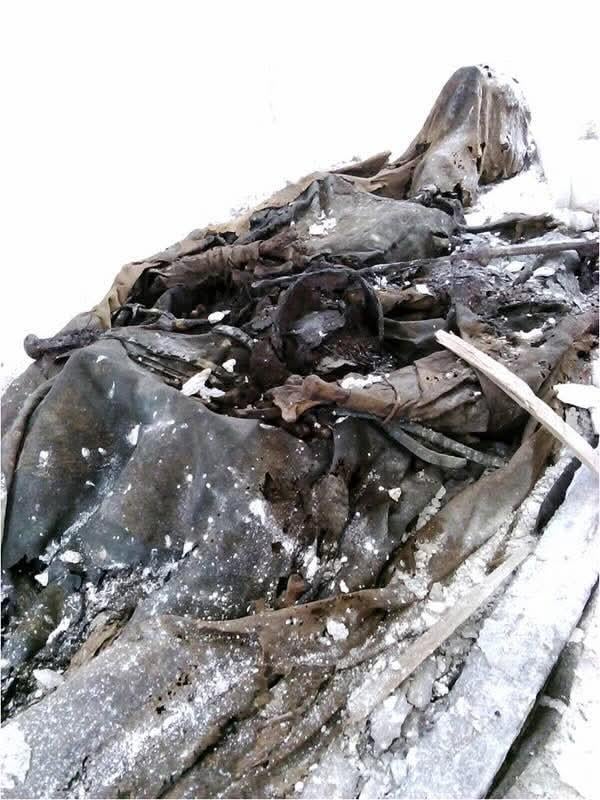
Remains of Polish king Władysław Łokietek (d. 1333) with a sword lying next to them photographed in 2022 inside of his tomb in Wawel Cathedral in Kraków Poland. [600×800]
by Snoo_90160
Remains of Polish king Władysław Łokietek (d. 1333) with a sword lying next to them photographed in 2022 inside of his tomb in Wawel Cathedral in Kraków Poland. [600×800]
by Snoo_90160
3 Comments
>Władysław I Łokietek, in English known as the “Elbow-high” or Ladislaus the Short
___
>Władysław was a skilled military leader, but also an administrator; he conquered Gdańsk Pomerania, and left it to familial governors. For the defense of this territory, he turned to the Teutonic Knights, who then demanded an exorbitant sum, or the land itself as an alternative. This led to an extended conflict with the Knights.
>Perhaps his greatest achievement was gaining papal permission to be crowned king of Poland in 1320, which occurred for the first time at Wawel Cathedral in Kraków. Władysław died in 1333 and was succeeded by his son, Casimir III the Great.
___
>In contemporary historical sources he was nicknamed Łokietek, a diminutive of the word łokieć which means “elbow” or “ell” (a medieval unit of measure similar to a cubit, as in “elbow-high”). However, the origin and the intended meaning of the nickname are not certain. The earliest explanation appeared in a 15th-century chronicle by Jan Długosz, who speculated that the nickname referred to the short stature of the king. In 2019, a team of archeologists endoscopically reached the interior of the king’s tomb and found that the body was laid at the bottom of the burial chamber without a coffin. Subsequently, they were able to determine that Władysław I was 152-155 cm (5’0″-5’1″) tall, which meant that the king’s height was just below that of an average person living in Europe during the Middle Ages
[From Wiki.](https://en.wikipedia.org/wiki/W%C5%82adys%C5%82aw_I_%C5%81okietek)
Lols king jerky.
Krakau sits on very salty soil if i am not mistaken.
They should take care to preserve him and get details from his acoutrements
Here’s a link with some clearer photos:
https://wiadomosci.onet.pl/krakow/jakiego-wzrostu-byl-wladyslaw-lokietek-naukowcy-dokonali-przelomowego-odkrycia/w3sf6pj