
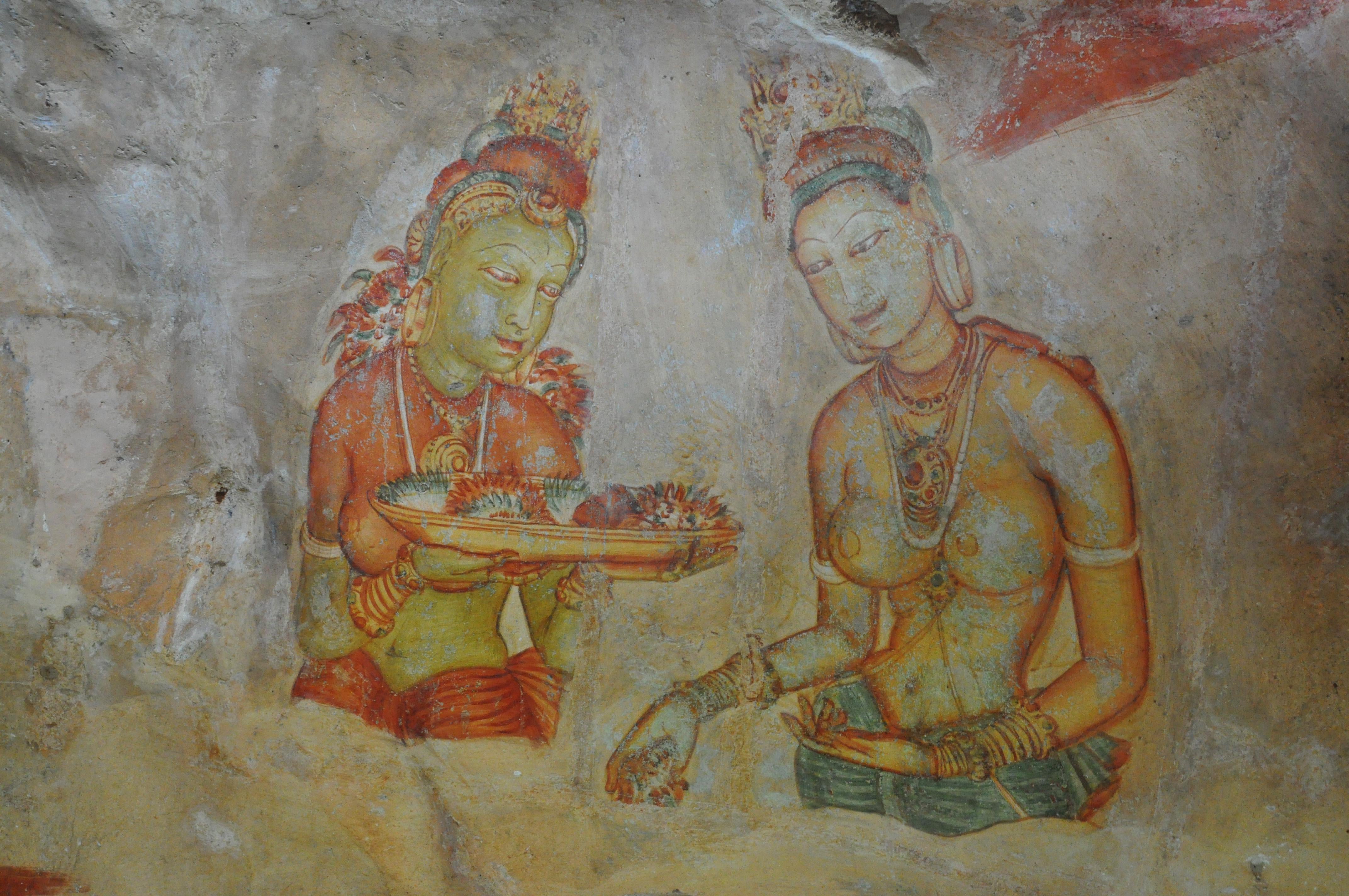
The Sigiriya Frescoes (Apsaras) painted around 480 AD in Sigiriya, Central Province, Sri Lanka [4288×2848]
by DiscussionFun2987
The Sigiriya Frescoes (Apsaras) painted around 480 AD in Sigiriya, Central Province, Sri Lanka [4288×2848]
by DiscussionFun2987
1 Comment
John Still in 1907 wrote, “The whole face of the hill appears to have been a gigantic picture gallery… the largest picture in the world perhaps”. The paintings would have covered most of the western face of the rock, an area 140 m (460 ft) long and 40 m (130 ft) high. There are references in the graffiti to 500 ladies in these paintings. However, most have been lost forever. More frescoes, different from those on the rock face, can be seen elsewhere, for example on the ceiling of the location called the “Cobra Hood Cave”.
Although the frescoes are classified as in the Anuradhapura period, the painting style is considered unique; the line and style of application of the paintings differ from Anuradhapura paintings. The lines are painted in a form which enhances the sense of volume of the figures. The paint has been applied in sweeping strokes, using more pressure on one side, giving the effect of a deeper colour tone towards the edge. Other paintings of the Anuradhapura period contain similar approaches to painting, but do not have the sketchy lines of the Sigiriya style, having a distinct artists’ boundary line. The true identity of the ladies in these paintings still has not been confirmed. There are various ideas about their identity. Some believe that they are the ladies of the kings while others think that they are women taking part in religious observances. These pictures have a close resemblance to paintings seen in the Ajanta Caves in India.
The Mirror Wall (not in the image, but near the frescoes)
Originally this wall was so reflective that the king could see himself as he walked alongside it. Made of brick masonry and covered in highly polished white plaster, the wall is now partially covered with verses scribbled by visitors, some of them dating from as early as the 8th century. Most, however, date from the 9th and 10th century. People of all walks of life, from poets to provincial governors to housewives, wrote on the wall. This is the only evidence of poetry found in the Anuradhapura period.
One example is;
*Aesimi* *dun hasun* *hasun seyin* *vil* *dut*
Like geese who have seen a lake, I listened to the message given by her.
*Mula* *la ma saenaehi* *pul piyuman* *sey* *bamar dut*
Like a bee who has seen full-blown lotuses, the bewildered heart of mine was consoled.
This couplet uses a play on words as in the combination of *hasun* (message) with *hasun* (swans). The poet’s eagerness to hear from his lady love is compared to the bee’s fascination for lotus blooms, whose large petals provide it an easy landing pad to drink its nectar and frolic if it wishes.
Out of the 1500 plus poems, most are addressed to the ladies on the frescoes. Men praised their beauty and women shared their envy. A contemporary female, clearly less enamoured with the frescoes, records different, if equally passionate emotions:
“A deer-eyed maiden of the mountain side arouses anger in my mind. In her hand she holds a string of pearls, and in her eyes she assumes rivalry with me.”
(Extracted from Wikipedia)
Read more: [https://en.wikipedia.org/wiki/Sigiriya](https://en.wikipedia.org/wiki/Sigiriya)