
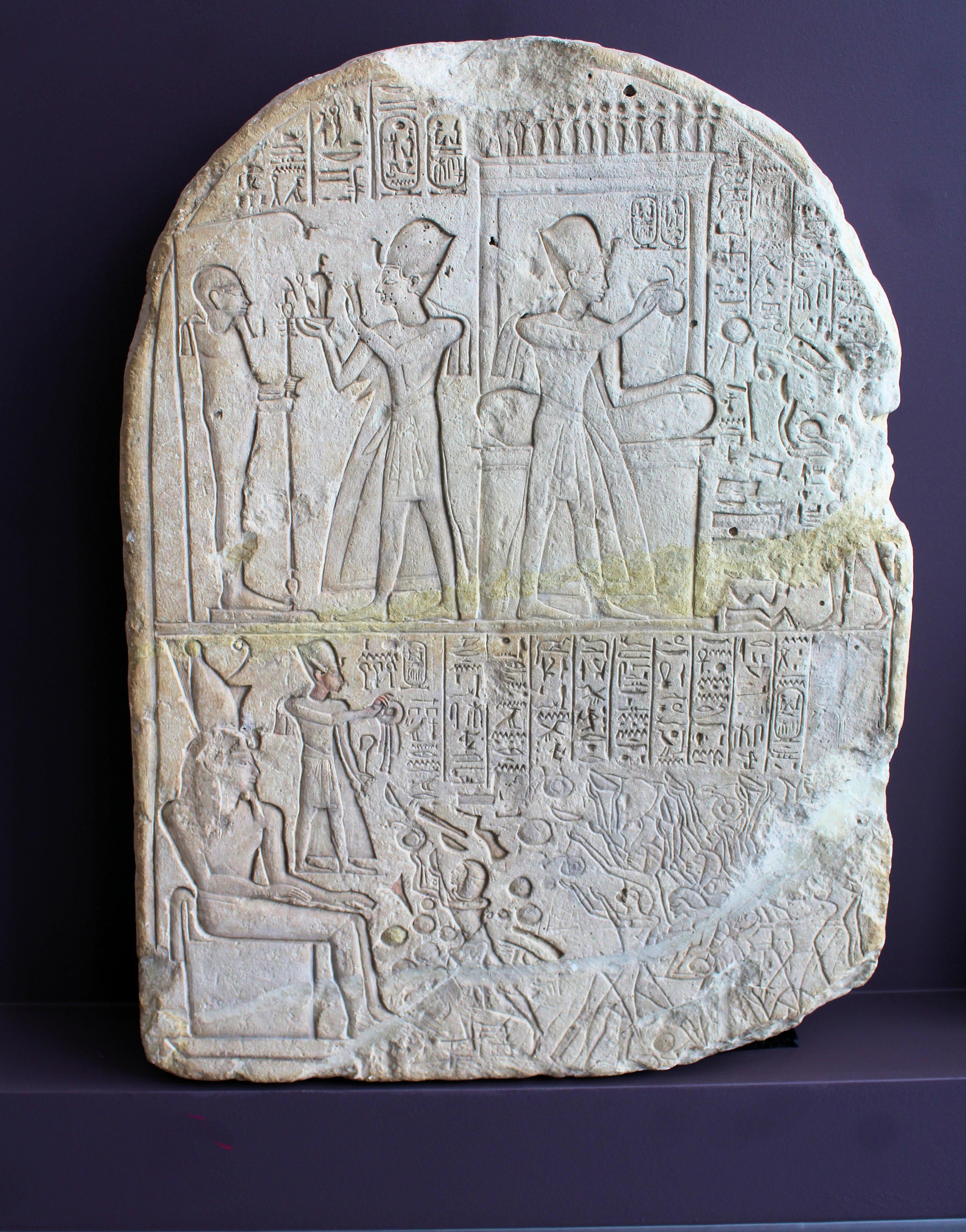
The stela’s three scenes portray the pharaoh in different aspects of his royal self-conception.
In the first scene (upper left), Ramesses II appears before Ptah, the Memphite creator god, depicted mummiform with a close-fitting cap and composite scepter. The king, wearing a helmet and ceremonial cloak, is titled “Lord of Truth, King of the Two Lands, who hears prayers.” As he offers Ptah a figure of Maat—symbol of just rule—Ptah, “who hears petitions,” assures divine favor toward king and people.
In the second scene (upper right), the king, as supreme earthly ruler, leans from the Window of Appearance of his palace and rewards Mose with a golden collar and “all manner of fine objects,” pleased with “the utterances of his mouth.”
The lower register depicts the formal bestowal of the “gold of honor”—collars and jewelry—upon Mose and other soldiers before a colossal seated statue of the king wearing the double crown and royal beard. Ramesses II himself appears beside this statue, casting the precious gifts to jubilant troops who raise their hands in praise, proclaiming: “May you see this and do what his majesty loves!” Mose stands directly before the king, exclaiming: “How beautiful is what he has done! Great, great!” The soldiers acclaim their lord: “You are the sun god Re—you are exactly like him! When you appear, we live from your sight!”
The recipient of the “gold of honor” bears no additional titles, suggesting that Mose was indeed a common soldier elevated by royal favor.
Probably from Pi-Ramesses
19th dynasty
Ca.1290 BC
Hildesheim Museum
Source: egyptology_persian
by Entharo_entho
1 Comment
Is it just me or does the “human king” in the lower register look a lot different?