
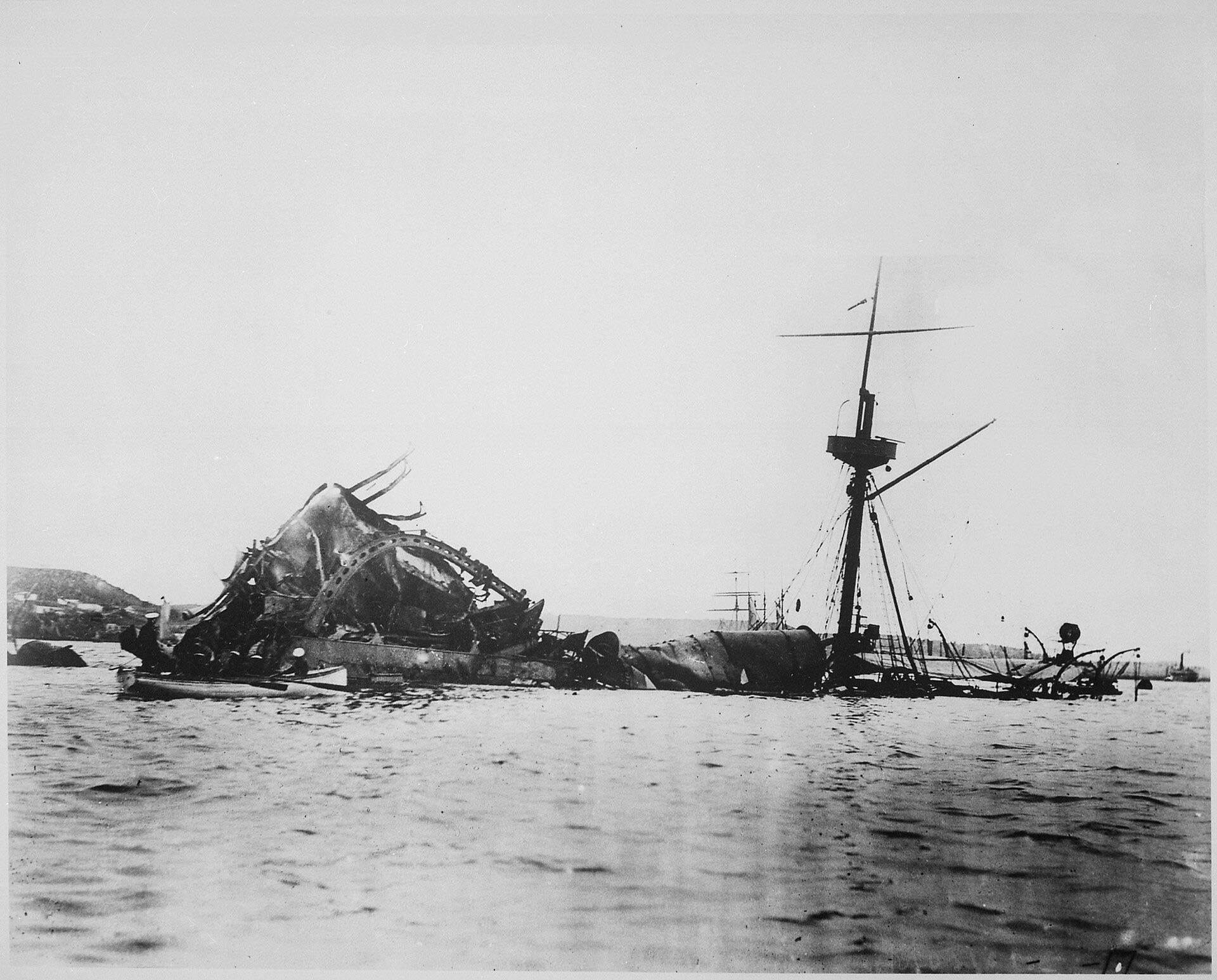
Ordered in 1885 as part of an effort to modernize the outdated U.S. Navy, USS Maine took more than nine years to complete. Nine years is a long time under any circumstances, but in an era of rapid advances in naval technology, it was an eternity.
By the time she was commissioned in 1895, Maine measured 324 feet 4 inches long, 57 feet wide, and displaced 6,682 long tons. She carried two gun turrets arranged en echelon and was powered by triple-expansion steam engines capable of 16.5 knots. Though the United States had never built a ship quite like her, she was already outdated by European standards.
After years of routine service, Maine was sent to Havana Harbor. Earlier that month, riots had broken out when Cubans loyal to Spain destroyed local newspapers that had criticized the very real atrocities committed by Spanish forces during Cuba’s ongoing war for independence. Maine’s deployment was meant to protect American citizens and property in Havana.
On the night of February 15, Captain Charles Sigsbee sat in his quarters writing a letter home as the ship’s bugler played taps. At 9:40 p.m., a massive explosion shattered the calm.
“It was a bursting, rending and crashing sound or roar of immense volume, largely metallic in character,” he later recalled. “It was followed by a succession of heavy, ominous, metallic sounds…”
The lights went out instantly. The deck lurched. Thick, choking smoke poured through the passageways as the ship took on a violent list. With fires racing toward the forward magazine, Sigsbee reluctantly ordered the ship abandoned. Men slipped into the harbor or scrambled into boats amid sparks, darkness, and the groan of twisting steel. Sigsbee was the last to leave.
261 of the 355 men aboard were dead. Among them was the bugler.
The cause of the explosion was immediately disputed. But an outraged public, amplified by a sensationalist press and pro-war voices in government, soon forced President McKinley’s hand. Within weeks, the United States was at war with Spain.
If you’re interested, I cover the sinking of the Maine in more detail here: https://open.substack.com/pub/aid2000/p/hare-brained-history-volume-67-the?r=4mmzre&utm\\\\\\\_medium=ios
by aid2000iscool
1 Comment
In 1976, a team of American naval investigators concluded that the Maine explosion was likely caused by a fire that ignited its ammunition stocks, not by a Spanish mine or act of sabotage.