
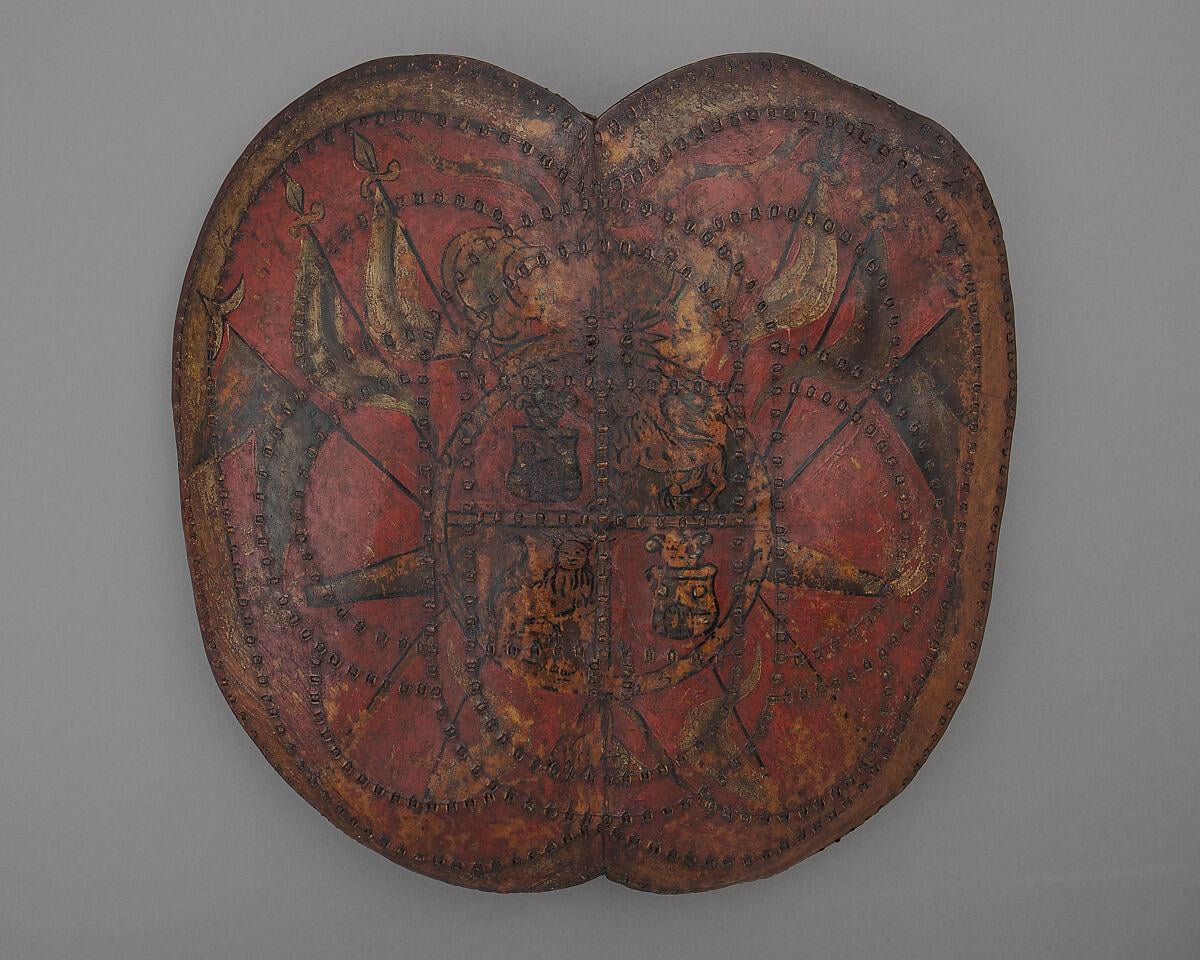
Late 18th century: Already in decline, the Spanish Empire tried to maintain control over the vast territory of "Alta California" by a loose system of Franciscan missions and adobe-fortresses (span. presidios) that were built to subdue native insurrections. Those Colonial military units still had to rely upon basic necessities sent by the Vice-Roy of New Spain in Mexico.
The Spanish Colonial army in modern days US-American Southwest had little resemblence to the contemporary, massed and uniformed armies of European powers: They were usually fighting on horseback, wearing leather armor and a "moorish" shield (span. adarga), armed with a lance, a sword and maybe some pistols. These men reminded to the old feudal days of mounted knights and gendarmes.
What is even more curious in my eyes: Apparently, neither some of the craftsmen who made their shields, nor the soldiers themselves seemed to have a clear grasp of how their own souvereign's coat of arms actually looked like. Since 1715, the Spanish coat of arms is supplemented by the Bourbon fleurs de lys. They are missing quite often. On the other hand, some adargas are absolutely beautiful and highly detailed. Apparently, it always depended on the commissioned artist.
The whole quality of work expresses strong influence of native Mexican and Californian craftsmanship, which make those remaining examples of Colonial heraldic shields absolutely stunning pieces of history! Wish I could own one.
by Ill-Bar1666
1 Comment
That’s one of the more fascinating aspects I’ve learned as I have studied Spanish New Mexico, how ‘medieval’ the society was. Spanish soldiers and settlers defending their fortified haciendas with sword, lance, and bows, protected by leather armor and shields as especially in New Mexico, black powder was too precious and expensive to spend unnecessarily.