
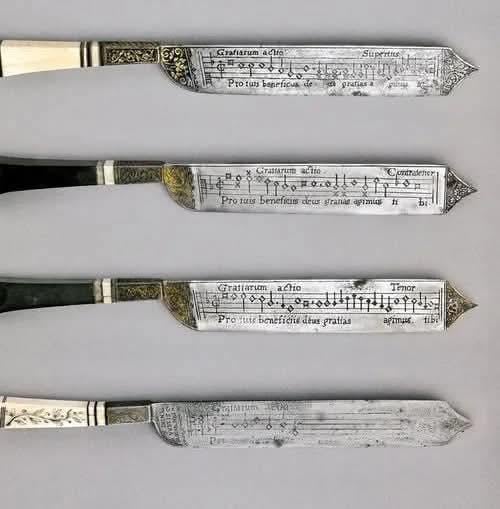
Notation knives are rare 16th Century CE, Renaissance serving knives with musical notation engraved on their blades, used to sing prayers before and after meals… (500×509)
by onwhatcharges
Notation knives are rare 16th Century CE, Renaissance serving knives with musical notation engraved on their blades, used to sing prayers before and after meals… (500×509)
by onwhatcharges
2 Comments
These knives, likely produced in Italy around 1550, were part of sets where each knife represented one voice part in a multi-voiced choral piece. One side of the blade carries the “Benedictio mensae” (blessing of the table), sung before the meal: “Quae sumpturi sumus bene dicat trinus et unus” (“May the three-in-one bless that which we are about to eat”). The other side features the “Gratiarum actio” (saying of grace), sung after: “Pro tuis deus beneficiis gratias agimus tibi” (“We give thanks to you, God, for your generosity”).
The musical notation on the knives is polyphonic, with two known sets: Group A (six voice parts) and Group B (four voice parts). Despite their name, the knives are not a single artifact but a set of specialized cutlery designed to serve as partbooks—musical instruments in a social and spiritual context.
They are extremely rare, with only 20 known examples.
They look like fish knives.
For when the bass drops.