
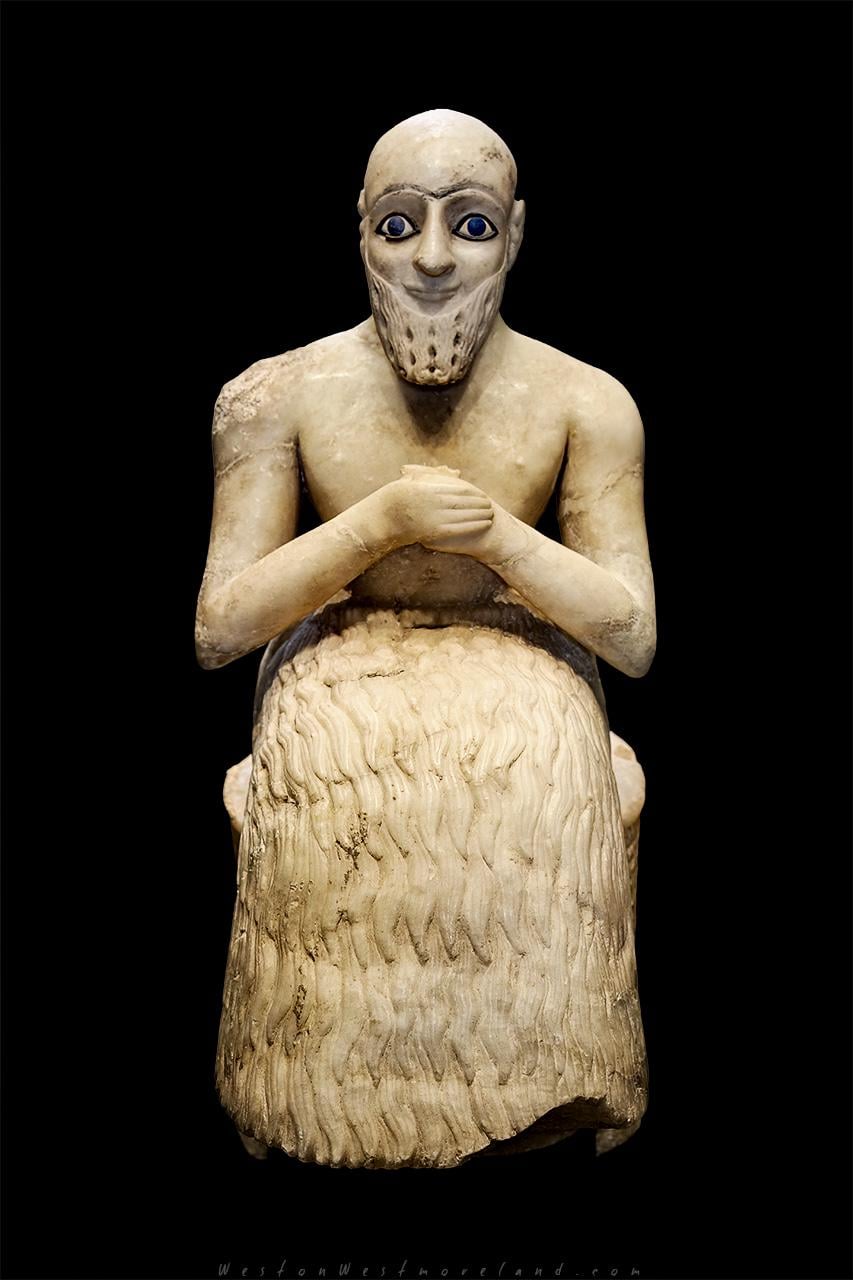
Alabaster statue of Ebih-Il, a votive sculpture from in ancient Mesopotamia, c. 2400 BC, Early Dynastic IIIB period. Ebih-Il was a high-ranking official of the city-state of Mari in modern-day eastern Syria. The statue, with its lapis lazuli eyes, exemplifies Pre-Akkadian artistry… [1280×853] [OC]
by WestonWestmoreland
2 Comments
I read this little guy is the earliest known example of a smile in art
…Ebih-Il held the title nu-banda, a position of considerable authority in Mari’s administrative, military, or religious hierarchy. Mari itself was a prosperous city-state that flourished as a major trade hub between Mesopotamia and the Mediterranean, enjoying strong cultural ties to Sumerian civilization despite its Semitic-speaking population. The statue was commissioned as a votive offering—a practice whereby an official would place his sculptural likeness in a temple to serve as a permanent intercessor with a deity, symbolically standing in for him during prayer and devotion.
This cultural moment was significant. When Ebih-Il commissioned his statue Mari remained independent. Roughly a century later, Sargon of Akkad would conquer Mari and destroy much of the city, though its temples survived. The statue’s survival through this upheaval testifies to its placement within the sacred sanctuary.
The statue exemplifies a transitional moment in Mesopotamian sculpture, occupying the space between Sumerian artistic traditions (which emphasized geometric form and hierarchical representation) and emerging Akkadian aesthetics. The seated pose itself was relatively rare in Syro-Mesopotamian sculpture of this period, distinguishing Ebih-Il’s statue as a mark of exceptional honor and high status. Later comparable examples appear in the Gudea statues of the Neo-Sumerian period (ca. 2100 BC), but the Ebih-Il sculpture predates this tradition.
The technical achievement of the multi-material inlay technique—particularly the sophisticated use of imported lapis lazuli alongside shell and stone—demonstrates Mari’s participation in long-distance trade networks and access to luxury materials. The craftsmanship rivals any contemporary sculpture in technical precision and expressive sophistication, earning it recognition as “a masterpiece by virtue of its craftsmanship, state of preservation, and expressive style.”
The statue measures 52.5 centimeters in height, 20.6 centimeters in width, and 30 centimeters in depth, weighing approximately 32.5 kilograms. It was carved from translucent gypsum (commonly called alabaster), rendered as a three-dimensional figure seated upon a wicker hassock—a portable seat characteristic of the period. The feet and portions of the inlaid eyebrows are missing, though the attachment pieces for the feet remain visible beneath the kaunakès skirt. Despite these losses, the statue’s overall preservation is exceptional, allowing modern viewers to experience its intended emotional and devotional impact nearly 4,400 years after its creation.
The iconography conveys both devotion and status. Ebih-Il is depicted with a shaved head, a common practice in Mesopotamia for both cleanliness and hygiene purposes. His long beard displays vertical curls with drilled holes that once held inlaid material now lost to time. His bare torso and thin waist emphasize youthfulness and vigor, while his sole garment is a Sumerian-style ceremonial kaunakès—an elaborate fleece skirt fashioned from animal hide (likely sheepskin or goatskin), complete with a tail at the back serving as a status marker. Most significantly, his hands are clasped against his chest in a prayer gesture, with the left hand closed and positioned inside the right, expressing reverence and devotion…. (follows in replay)