For More Context: Mussolini saw Austria as in it’s sphere of influence for future domination of Southern Europe and Mediterranean and opposed Anschluss. They eventually switched sides as it became inevitable to secure the security of South Tyrol. Also Mussolini was concerned about France declining and stagnant birth rates and thought Germans were bound to dominant the continent and overall world due to their larger population which was also increasing at faster pace meanwhile UK and France were going to decline further so he wanted to be on winning side
The-marx-channel on
Most of the world at that time just put their heads in the sand. I respect Mexico for standing up against the annexation of Austria when most of the world only gave a muted response.
p_pio on
Tbf. if world closed eyes on annexation of Ethiopia there’s realistic chance that we would avoid WW2 as political isolation that Italy was put in pushed it to ally with Germany and allowed Austrian painter to go home.
EnamelKant on
Every good communist knows fascism is just a matter of taste.
SasquatchMcKraken on
Yeah everyone makes fun of the Italians in WW2 but honestly their hearts were never really in it. Hitler and Mussolini were personally close but that didn’t translate nation-wide.
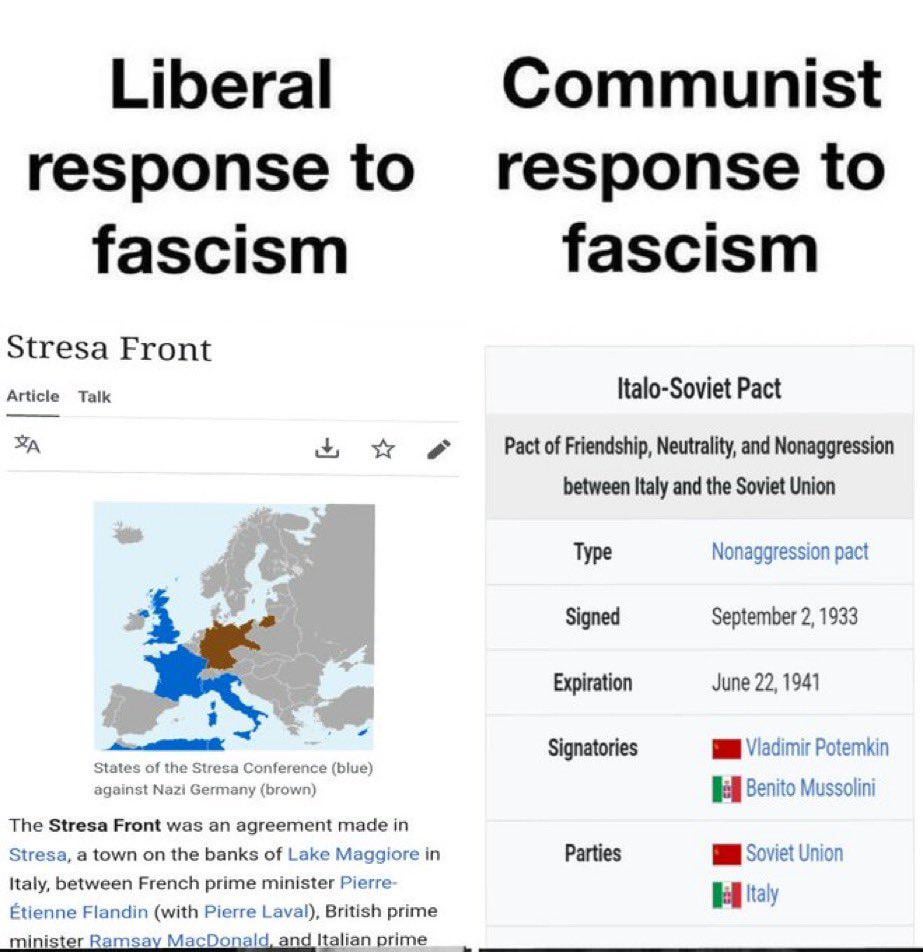
As late as the mid-30s, as we see here, relations with Germany were tense. Anti-German sentiment was widespread anyway thanks to Italy’s fraught history with Austria. The Italian people never got a great reason why they were fighting their WW1 allies. Even many Fascists were thoroughly creeped out by National Socialism, believing it to be overly racialist and downright pagan (not saying the Fascists were nice people, btw).
So of course once the war started to go badly the Italians were like “fuck this,” fired Mussolini and made peace. Can’t blame them, it really was Germany’s war.
MonkeKhan1998 on
Tell that to the Poles at Katyn 🥴
johnfireblast on
Ideology the moment it meets strategy.
Lucky_Pterodactyl on
Nazi Germany sent arms to Ethiopia during the Italian invasion in part to bog Italy down and diplomatically isolate it, effectively ending those pacts and providing favourable conditions for an alliance with Germany.
Gussie-Ascendent on
Communism: stateless classless society
Soviet Union: state, classes, society
1 outta 3 fails any grading system i seen. If society is all it takes, everyone in ww2 was communist lmao.
Communist v communist who wins? The answer may surprise you
Conscious_Archer2658 on
I thought the liberal response to fascism was to let them rearm, remilitarize, take Austria, take Chechoslovakia, and proclaim peace in our time.
Sure seems to be their response today too.
OCCuckoldBull on
The same liberals that caved to Germany?
TeddyNeptune on
Germany sent small arms to Ethiopia to defend against the Italian invasion.
Germany also sent small arms, uniforms, helmets, and light tanks to China to defend against the Japanese invasion. They stopped in 1941, I believe.
Jack_Church on
Fascists’ response to fascism: Vote Mussolini out of office.
Clearly, the only true anti-fascist ideology is fascism. /s
Felix_Dorf on
“Now, splendidly, everything had become clear. The enemy at last was plain in view, huge and hateful, all disguise cast off. It was the Modern Age in arms.” British Writer Evelyn Waugh on the onset of war in 1945. A hater of both communism and fascism he lamented the choice between them so many thought confronted them in the 1930s. The Nazi-Soviet pact made things easy: the evil people were now all on one side.
Alpha413 on
Yeah, interestingly both Italy and the USSR just… continued the historically friendly Italian-Russia relations, reasoning ideological differences were a matter of internal policy, which gets particularly funny, because as this was happening, Palmiro Togliatti, head of the Italian Communist Party, was also one of the leading Comintern Policy makers and his party was actively engaged in building an underground communist network in Italy.
For added oddness, post-ww2 the good relations between the two resumes and despite the Cold War being ongoing (although Italy’s NATO membership was, at the time, half sincere and half a part of a plan to rebuild Italy’s international reputation).

17 Comments
Italy still switching sides I see.
*Laughs in Molotov-Ribbentrop Pact*
For More Context: Mussolini saw Austria as in it’s sphere of influence for future domination of Southern Europe and Mediterranean and opposed Anschluss. They eventually switched sides as it became inevitable to secure the security of South Tyrol. Also Mussolini was concerned about France declining and stagnant birth rates and thought Germans were bound to dominant the continent and overall world due to their larger population which was also increasing at faster pace meanwhile UK and France were going to decline further so he wanted to be on winning side
Most of the world at that time just put their heads in the sand. I respect Mexico for standing up against the annexation of Austria when most of the world only gave a muted response.
Tbf. if world closed eyes on annexation of Ethiopia there’s realistic chance that we would avoid WW2 as political isolation that Italy was put in pushed it to ally with Germany and allowed Austrian painter to go home.
Every good communist knows fascism is just a matter of taste.
Yeah everyone makes fun of the Italians in WW2 but honestly their hearts were never really in it. Hitler and Mussolini were personally close but that didn’t translate nation-wide.
As late as the mid-30s, as we see here, relations with Germany were tense. Anti-German sentiment was widespread anyway thanks to Italy’s fraught history with Austria. The Italian people never got a great reason why they were fighting their WW1 allies. Even many Fascists were thoroughly creeped out by National Socialism, believing it to be overly racialist and downright pagan (not saying the Fascists were nice people, btw).
So of course once the war started to go badly the Italians were like “fuck this,” fired Mussolini and made peace. Can’t blame them, it really was Germany’s war.
Tell that to the Poles at Katyn 🥴
Ideology the moment it meets strategy.
Nazi Germany sent arms to Ethiopia during the Italian invasion in part to bog Italy down and diplomatically isolate it, effectively ending those pacts and providing favourable conditions for an alliance with Germany.
Communism: stateless classless society
Soviet Union: state, classes, society
1 outta 3 fails any grading system i seen. If society is all it takes, everyone in ww2 was communist lmao.
Communist v communist who wins? The answer may surprise you
I thought the liberal response to fascism was to let them rearm, remilitarize, take Austria, take Chechoslovakia, and proclaim peace in our time.
Sure seems to be their response today too.
The same liberals that caved to Germany?
Germany sent small arms to Ethiopia to defend against the Italian invasion.
Germany also sent small arms, uniforms, helmets, and light tanks to China to defend against the Japanese invasion. They stopped in 1941, I believe.
Fascists’ response to fascism: Vote Mussolini out of office.
Clearly, the only true anti-fascist ideology is fascism. /s
“Now, splendidly, everything had become clear. The enemy at last was plain in view, huge and hateful, all disguise cast off. It was the Modern Age in arms.” British Writer Evelyn Waugh on the onset of war in 1945. A hater of both communism and fascism he lamented the choice between them so many thought confronted them in the 1930s. The Nazi-Soviet pact made things easy: the evil people were now all on one side.
Yeah, interestingly both Italy and the USSR just… continued the historically friendly Italian-Russia relations, reasoning ideological differences were a matter of internal policy, which gets particularly funny, because as this was happening, Palmiro Togliatti, head of the Italian Communist Party, was also one of the leading Comintern Policy makers and his party was actively engaged in building an underground communist network in Italy.
For added oddness, post-ww2 the good relations between the two resumes and despite the Cold War being ongoing (although Italy’s NATO membership was, at the time, half sincere and half a part of a plan to rebuild Italy’s international reputation).