Abstract:
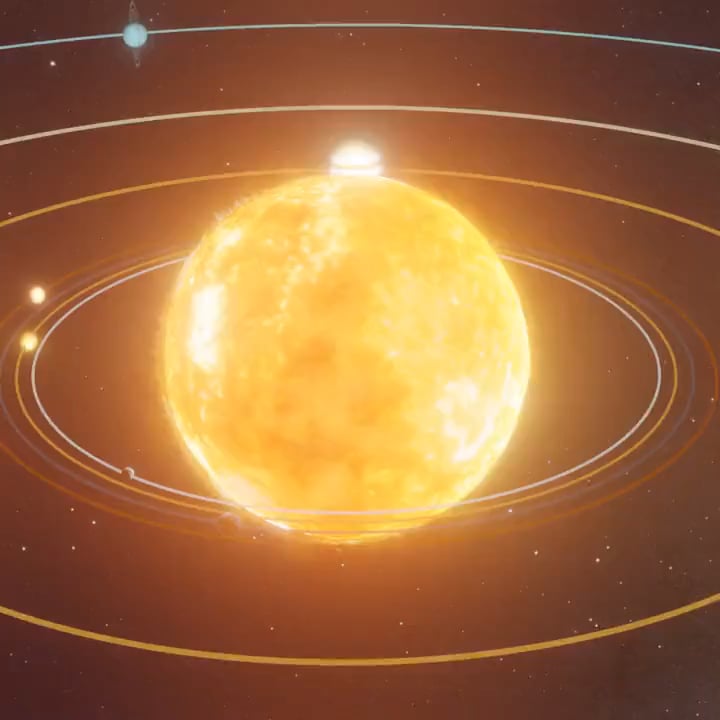
> As the Sun moves through the surrounding partially ionized medium, neutral hydrogen atoms penetrate the heliosphere, and through charge exchange with the supersonic solar wind, create a population of hot pick-up ions (PUIs). Until recently, the consensus was that the shape of the heliosphere is comet-like. The termination shock crossing by Voyager 2 demonstrated that the heliosheath (the region of shocked solar wind) pressure is dominated by PUIs; however, the impact of the PUIs on the global structure of the heliosphere has not been explored. Here we use a novel magnetohydrodynamic model that treats the PUIs as a separate fluid from the thermal component of the solar wind. The depletion of PUIs, due to charge exchange with the neutral hydrogen atoms of the interstellar medium in the heliosheath, cools the heliosphere, ‘deflating’ it and leading to a narrower heliosheath and a smaller and rounder shape, confirming the shape suggested by Cassini observations. The new model reproduces both the properties of the PUIs, based on the New Horizons observations, and the solar wind ions, based on the Voyager 2 spacecraft observations as well as the solar-like magnetic field data outside the heliosphere at Voyager 1 and Voyager 2.
MaterialSteak614 on
Hon! hon! hon!
Ze plan is going parfaitement!
Today le solar système, tomorrow le universse!
Hon! Hon! Hon!
Other_Beginning7151 on
Whelp I guess that all we have to do now is figure out of Sir Bedevere’s bannana earth is correct.

48 Comments
You’re not fooling me! #flatsolarsystem
How is this the most updated model but shows the planetary orbits as single plane instead of a falling spiral?
I have no idea what I am looking at, what the significnce is, or how they figured it. 10/10 though, no notes.
more of a cosmic cronut
Wait, it’s all France??
So, is Our Sun a shooting star and We never realized it because We are along for the ride?
Mmmm quasaw 😋
Awesome spaceship!
Bakers already control the world, they also control the cosmos.
Fuck yeah it is.
Yummy!!! Butter and jam on mine plz
I prefer to think of it as a bit of a cosmic gumbo.
Wait, it’s not a bagel?
Cosmic Croissant would make a great band name
I’m Commander Shepard and this is my favorite croissant in the universe.
That’s one constipated intestine!
Ah I see. I was expecting a “Cosmic Coruscant” so now I’m disappointed in the lack of Sith.
Where’s the shape coming from? Why does it have that shape; reminiscent of models of the earths magnetosphere being blown by the solar wind.
Did either Voyager probe escape the croissant or did the trajectories point them back into the arms of the croissant?
“Are you going to finish that croissant?”
Pas mal non ? C’est Français !
As long as we don’t have a large planet / small twin star to our sun, lurking outside, waiting to wreck havoc, I am OK 🙂
And moving fast as fuck
You mean…qwuahhhssant
I don’t get it. What’s this supposed to show?
-Quoi? Cest toute la France??
-Sa l’as toujours été.
glad it’s not Klein bottle…
What happens if the system just stops moving?
I’ll have mine to go, please.
https://preview.redd.it/a7jtizgkev5g1.jpeg?width=735&format=pjpg&auto=webp&s=a324c61878e6b4a7c09e0b247cd213ed09f049a9
That looks neat. What’s the source of the graphic?
Edit: searched a bit, this is close: https://www.nasa.gov/solar-system/uncovering-our-solar-systems-shape/
Looks more like a Cronut™️
The team responsible for this model have been working on it for [nearly a decade](https://pubs.aip.org/aip/pop/article-abstract/23/5/056501/966626/Magnetized-jets-driven-by-the-Sun-The-structure-of?redirectedFrom=fulltext). They use data from NASA missions, but the authors are all university researchers.
I dunno, it looks more like a hadouken to me.
ahora todo tiene sentido realmente………….
Kosmik Kwasong
Now I’m hungry, damn it.
It looks like I’m looking up at someone who’s on the toilet.

Mmmmmmmm croissant
Great, the French will never let us live this down
Which direction did the Voyager probes go? Towards that leading edge, etc.?
What if we’re microbes, surviving in a cell, that’s hitching a ride on a galactic crustacean, swimming through the oceanic universe.
This was published in 2020, not 2025.
https://www.nasa.gov/solar-system/uncovering-our-solar-systems-shape/
Paper in Nature Astronomy (which I don’t have access to): https://www.nature.com/articles/s41550-020-1036-0
Abstract:
> As the Sun moves through the surrounding partially ionized medium, neutral hydrogen atoms penetrate the heliosphere, and through charge exchange with the supersonic solar wind, create a population of hot pick-up ions (PUIs). Until recently, the consensus was that the shape of the heliosphere is comet-like. The termination shock crossing by Voyager 2 demonstrated that the heliosheath (the region of shocked solar wind) pressure is dominated by PUIs; however, the impact of the PUIs on the global structure of the heliosphere has not been explored. Here we use a novel magnetohydrodynamic model that treats the PUIs as a separate fluid from the thermal component of the solar wind. The depletion of PUIs, due to charge exchange with the neutral hydrogen atoms of the interstellar medium in the heliosheath, cools the heliosphere, ‘deflating’ it and leading to a narrower heliosheath and a smaller and rounder shape, confirming the shape suggested by Cassini observations. The new model reproduces both the properties of the PUIs, based on the New Horizons observations, and the solar wind ions, based on the Voyager 2 spacecraft observations as well as the solar-like magnetic field data outside the heliosphere at Voyager 1 and Voyager 2.
Hon! hon! hon!
Ze plan is going parfaitement!
Today le solar système, tomorrow le universse!
Hon! Hon! Hon!
Whelp I guess that all we have to do now is figure out of Sir Bedevere’s bannana earth is correct.

So fricken cool!!
As above, so below.